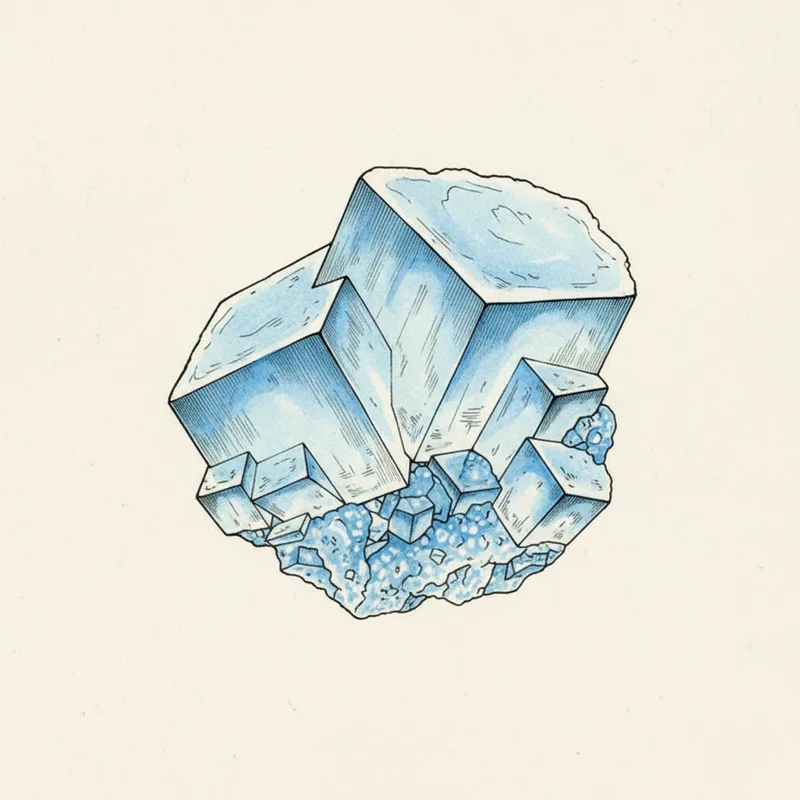
Quick Facts
Formation & Origin
Blue calcite forms in low-temperature sedimentary and hydrothermal environments where calcium-rich groundwater percolates through limestone, dolostone, or volcanic tuff and precipitates calcium carbonate into fractures, vugs, and cavities. As the water loses carbon dioxide to the atmosphere or to a cooler pocket, its ability to hold dissolved calcium drops and CaCO₃ crystallizes out onto cavity walls. Most calcite forming this way is colorless or white, so the blue tint requires something extra.
The pale blue color in commercial blue calcite is almost always caused by micro-inclusions of other minerals rather than by a true chromophore inside the calcite lattice. The most common cause is finely dispersed clay minerals, microscopic hematite or pyrite particles, or tiny fluid inclusions that scatter short-wavelength light in a Rayleigh-type effect, producing the same soft blue cast seen in skim milk or very dilute ink. Some deposits, particularly from Madagascar, incorporate trace copper that can contribute faintly, but chemical analysis of most Mexican and Uruguayan material shows no significant copper or other blue-producing element. This is why blue calcite never shows the strong saturation of a true copper mineral like celestine or hemimorphite.
Because the color depends on a delicate balance of inclusions, blue calcite bleaches under prolonged sunlight, and long exposure to UV flattens the tone toward gray-white. The mineral often forms in the same deposits as orange, honey, and green calcite varieties, and a single mine can produce all four from different levels as local groundwater chemistry shifts.
Identification Guide
Blue calcite is quickly recognized by its softness and the signature three directions of perfect rhombohedral cleavage. A steel knife tip leaves a clean scratch at Mohs 3, and broken fragments reliably split into tilted parallelograms rather than conchoidal shards. Specific gravity falls between 2.69 and 2.72, heavier than it looks in the hand. The mineral is strongly birefringent, and a clear cleavage fragment placed over a printed line will show a double image, a diagnostic property shared with all calcite regardless of color.
A small drop of dilute hydrochloric acid, or even household white vinegar with patience, will fizz visibly on a fresh surface as CO₂ escapes. This acid reaction is the fastest way to separate blue calcite from blue aragonite, blue dolomite, or dyed blue marble, all of which react differently. Under longwave UV, much blue calcite shows a weak pink, red, or orange fluorescence depending on manganese content, while the blue color itself fades slightly under shortwave UV after extended exposure.
Spotting Fakes
The single biggest concern with blue calcite is dye enhancement of naturally pale or colorless calcite. A cotton swab dampened with pure acetone or isopropyl alcohol, rubbed firmly on an unpolished spot or inside a drilled bead hole, will pick up visible blue stain on dyed material. Genuine blue calcite releases nothing onto the swab. Under 10x magnification, dyed pieces show color concentration along cleavage cracks and porous bands, while natural color is distributed evenly through the body of the stone. The second issue is misidentified material sold as blue calcite. Dyed blue howlite, blue aragonite, and dyed magnesite all appear in the trade under the blue calcite label. Howlite is harder at Mohs 3.5 and does not fizz in acid. Aragonite fizzes but crystallizes in the orthorhombic system and shows fibrous or pseudohexagonal habit rather than rhombohedral cleavage. A quick vinegar drop on an inconspicuous edge plus a check for three-way cleavage separates true calcite from every common substitute.
Cultural & Metaphysical Traditions
Presented as cultural traditions, not scientific evidence
Calcite has been used since antiquity for carving, inlay, and optical demonstration, with Iceland spar variety prized by seventeenth-century natural philosophers for its double refraction. Blue calcite itself is a modern addition to the crystal trade, entering widespread circulation in the late twentieth century alongside other soft-colored calcites from Mexican deposits. Contemporary crystal healing culture associates it with calm communication and gentle emotional release, linked to its pale blue color and the throat chakra rather than to any documented historical lineage.
Where It's Found
Classic source of pale banded blue calcite, often sold as rough slabs and tumbled stones.
Mexico remains the primary commercial source, producing soft sky-blue calcite from sedimentary and volcanic host rock.
Yields gray-blue to powder-blue calcite with higher clay-inclusion content and slightly deeper color.
Historic occurrence in lead and zinc mining districts, producing minor amounts of pale blue calcite as gangue.
Price Guide
Good to Know
Scratch test: At hardness 3, Blue Calcite can be scratched with a copper coin. Handle gently and keep away from harder stones in your collection.
Sources: Found in 4 notable locations worldwide, from Artigas Department to Cumbria.
Heft test: Blue Calcite has average mineral density (2.69-2.72). It feels about as heavy as you'd expect from a stone its size.
Related Minerals
Same species with iron-oxide inclusions instead of blue-producing scatterers.
A different strontium sulfate mineral with a truer, saturated sky-blue color, often confused with blue calcite.
Polymorph of calcite with identical chemistry but orthorhombic crystal structure.
Explore More
Stay in the loop
From the Almanac
Updates from Crystal Almanac, when there’s something worth sharing.