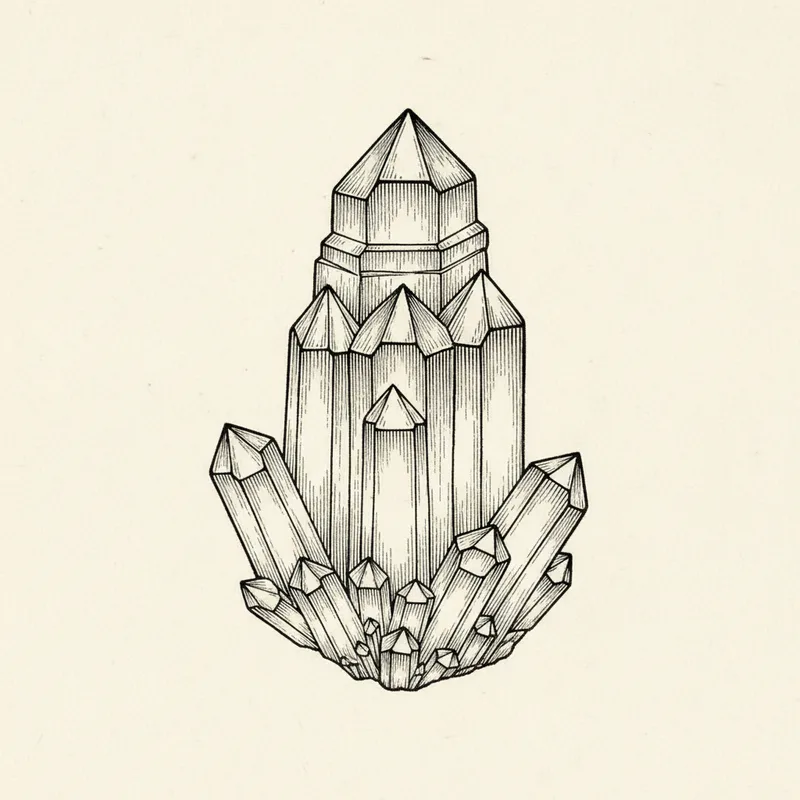
Cathedral Quartz
Stepped-terminated quartz growth habit with stacked parallel spires
Quick Facts
Formation & Origin
Forms during episodic hydrothermal growth when silica supersaturation in the parent fluid fluctuates. When dissolved silica drops below the saturation threshold, crystal growth pauses. When supersaturation recovers, growth resumes from multiple nucleation points along the existing crystal face rather than continuing as a single smooth front. Each interruption event leaves behind a parallel secondary termination, and repeated cycles stack these terminations into the stepped spire morphology that gives cathedral quartz its name. Brazilian cathedrals from Minas Gerais pegmatites and Arkansas cathedrals from Ouachita hydrothermal veins show identical formation mechanisms operating in very different geological contexts. Mineralogically, cathedral quartz is not a separate variety. It is ordinary SiO₂ distinguished purely by growth habit, not by chemistry or crystal structure.
Identification Guide
Macro-crystalline quartz with a dominant main crystal flanked by numerous smaller crystal terminations rising in parallel along its length, producing a stepped or stacked-spire profile. All secondary terminations share the same c-axis orientation as the host crystal, a diagnostic continuity feature. Transparency ranges from water-clear to milky, with phantoms and chlorite inclusions common. Hardness 7 (scratches glass cleanly), conchoidal fracture, no cleavage, specific gravity near 2.65. Under polarized light, optical continuity carries through all stepped terminations because they grew in crystallographic register with the main crystal.
Spotting Fakes
Assembled cathedrals are the most common fake. Individual quartz crystals are glued to the side of a larger crystal to mimic stepped growth. Check the base of each secondary termination under a loupe for glue residue, acetone-soluble adhesive, or a visible seam. Ultraviolet blacklight often fluoresces modern epoxies. Carved cathedral quartz made by grinding steps into a plain crystal loses natural surface luster and shows parallel abrasion marks under magnification instead of the glassy faces of true growth planes. The definitive test is optical continuity. Hold the specimen up to a point light source along the c-axis. Genuine cathedral quartz transmits light uninterrupted vertically through every stepped termination because the entire structure is one continuous crystal. Assembled pieces break this optical path at the glue seams and scatter light at each junction.
Cultural & Metaphysical Traditions
Presented as cultural traditions, not scientific evidence
Modern crystal healing frames cathedral quartz as a library or record keeper, with practitioners believing the stacked terminations store accumulated wisdom. The lightbrary nickname originates from 1990s metaphysical literature positioning it as a repository of ancient knowledge accessed through meditation. No traditional or indigenous spiritual use is documented because the growth habit was only popularized in Western crystal markets in recent decades.
Where It's Found
Primary commercial source. Pegmatite and hydrothermal vein quartz from Diamantina and Corinto districts. Known for large lightbrary specimens with multiple stepped spires on a single main crystal.
Cathedral-habit quartz from hydrothermal veins in the Collier Shale and Crystal Mountain formations. Mount Ida and Jessieville deposits yield smaller but optically clean cathedrals.
Secondary Brazilian source yielding smoky cathedral quartz with pronounced step-terminations.
Price Guide
Good to Know
Scratch test: At hardness 7, Cathedral Quartz can scratch glass and steel. It's durable enough for any type of jewelry.
Sources: Found in 3 notable locations worldwide, from Minas Gerais to Bahia.
Heft test: Cathedral Quartz has average mineral density (2.65). It feels about as heavy as you'd expect from a stone its size.
Related Minerals
Related quartz growth habit where etched or skeletal terminations stack in layered formations, often confused with cathedrals.
Often occurs together with cathedral habit when growth interruptions also trap inclusion layers.
Another interrupted-growth habit producing a secondary crystal overgrowth on an older stem.
Double-terminated quartz variety representing a different growth scenario (free-floating in vugs).
Explore More
Stay in the loop
From the Almanac
Updates from Crystal Almanac, when there’s something worth sharing.