Quick Facts
Formation & Origin
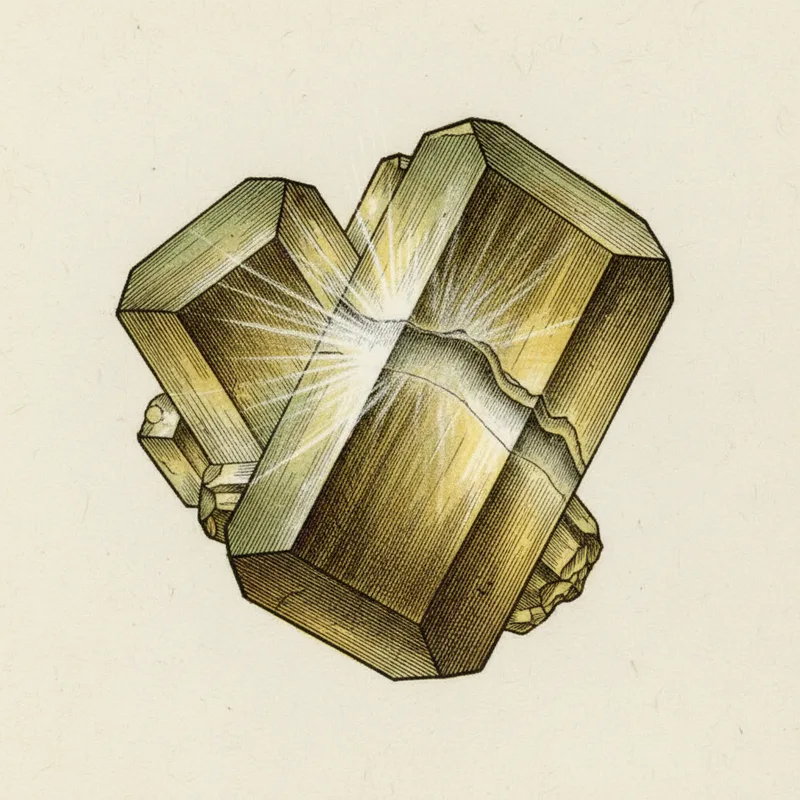
Cat's eye chrysoberyl forms in the same environments as alexandrite - pegmatites and metamorphic rocks where beryllium and aluminum are both available. The chatoyant 'cat's eye' effect (a single bright band of light moving across the stone) is caused by dense parallel inclusions of fine rutile needles (silk) within the chrysoberyl crystal.
When these needles are densely packed and uniformly oriented, they scatter light perpendicular to their direction, creating a concentrated line of reflected light on the surface of a cabochon-cut stone. The effect is strongest when the stone is cut as a cabochon (domed, not faceted) with the needle inclusions parallel to the base. A well-cut cat's eye shows a sharp, bright line that moves smoothly across the dome as the stone is rotated.
The most prized cat's eye effect is called 'milk and honey' - when a penlight is held to one side, one half of the stone appears milky white while the other shows a deep golden honey color, separated by the sharp eye line.
Identification Guide
Cat's eye chrysoberyl is identified by its sharp, well-defined chatoyant band (the 'eye') combined with exceptional hardness (8.5). The eye should be straight, centered, and move smoothly. In fine specimens, the 'milk and honey' effect is diagnostic.
Distinguish from cat's eye quartz (much less sharp eye, lower hardness), cat's eye tourmaline (lower hardness, different colors), and cat's eye apatite (much softer). When gemologists say 'cat's eye' without qualification, they mean chrysoberyl - all other chatoyant stones must be specified (e.g., 'cat's eye quartz').
Spotting Fakes
Fiber optic glass produces a convincing cat's eye effect and is the most common simulant. Glass feels warmer, is lighter, and the eye band lacks the natural depth of genuine chrysoberyl. Cat's eye quartz (much less expensive) is sometimes sold as chrysoberyl - the eye in quartz is typically less sharp and the stone is softer. Synthetic cat's eye chrysoberyl exists but is rare in the market. For valuable specimens, lab reports from GIA or similar confirm identity.
Cultural & Metaphysical Traditions
Presented as cultural traditions, not scientific evidence
In South Asian astrology (Jyotish), cat's eye chrysoberyl is associated with the shadow planet Ketu and is considered one of the nine sacred gems (navaratna). It's believed to protect against evil spirits, accidents, and unforeseen dangers. Sri Lankan gem miners traditionally consider finding a fine cat's eye especially auspicious. In Western tradition, cat's eye was carried as a gambler's talisman and a protection against the evil eye.
Where It's Found
World's finest cat's eye chrysoberyl, historic source
Good quality material
Important commercial source
Emerging source of fine material
Price Guide
Good to Know
Scratch test: At hardness 8.5, Cat's Eye Chrysoberyl can scratch glass and steel. It's durable enough for any type of jewelry.
Sources: Found in 4 notable locations worldwide, from Sri Lanka to Tanzania.
Heft test: Cat's Eye Chrysoberyl has a specific gravity of 3.73 - noticeably heavier than quartz. You'll feel the density when you pick it up.
Related Minerals
Same chrysoberyl species, color-change variety
Parent species without chatoyancy
Similar effect, different mineral, less sharp
Fibrous chatoyancy from different mechanism
Explore More
Stay in the loop
From the Almanac
Updates from Crystal Almanac, when there’s something worth sharing.