Quick Facts
Formation & Origin
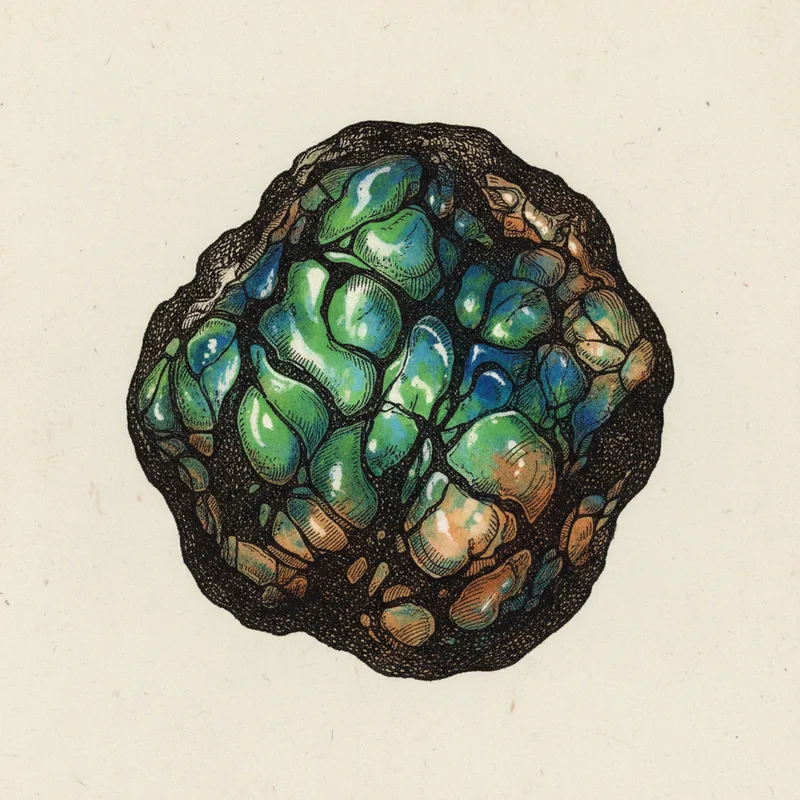
Koroit opal forms inside nodular ironstone concretions scattered through the Cretaceous sedimentary layers of the Great Artesian Basin in western Queensland. Between roughly 100 and 30 million years ago, silica-rich groundwater percolated through weathered sandstone and mudstone, encountering dense iron-cemented nodules. The silica gel infiltrated the complex fracture networks inside these concretions, then slowly dehydrated and solidified into opal without crystallizing.
The result is an interwoven mosaic of opal veins, seams, and pockets threaded through dark rust-colored ironstone. Unlike the black opal of Lightning Ridge, which forms in flat claystone seams, or pure precious opal from Coober Pedy, Koroit opal keeps its natural ironstone host as a permanent backing. The ironstone provides both structural support for the softer opal and a dramatic dark contrast that amplifies the play-of-color when present.
What makes Koroit distinctive are the 'pictures.' As silica filled irregular cracks in the ironstone, it created abstract compositions that often resemble landscapes, maps, faces, or cellular patterns. Cutters work with the stone rather than against it, shaping cabochons to preserve whatever image the ironstone-opal boundary naturally suggests. This artistic patterning is why Koroit material trades less on pure flash and more on the visual narrative locked inside each nodule.
Identification Guide
Genuine Koroit opal shows an unmistakable interplay between dark reddish-brown ironstone and opal veins that range from common potch to vivid precious opal. The boundary between ironstone and opal is always continuous and irregular, never geometric. At 5.5 to 6.5 on the Mohs scale, opal is softer than quartz and scratches with a steel file, while the surrounding ironstone feels notably harder and denser.
Expect specific gravity around 2.0 to 2.5 depending on the ratio of opal to ironstone. Hold a polished piece under angled light and rotate it slowly. Even pieces without strong play-of-color will show subtle internal depth in the opal zones, with faint blue, green, or amber flashes in the thicker seams. The ironstone itself should appear matte to slightly resinous, not glassy. Surface should feel cool and slightly porous along ironstone edges, smooth and glassy across opal zones.
Spotting Fakes
The most common fakes are assembled triplets and dyed substitutes. An assembled triplet bonds a thin slice of opal to a separately sourced ironstone or dark glass backing with epoxy. Under a 10x loupe, a genuine Koroit stone shows a continuous, organic ironstone-to-opal transition with no straight seam, no glue line, and no air bubbles trapped along an interface. If you see a perfectly flat boundary, suspect assembly. Dyed chalcedony or resin with painted ironstone patterns is another common counterfeit. Real Koroit ironstone is uneven in color, with micro-pitting and rust variation. Painted imitations look too uniform and the 'ironstone' often sits on the surface rather than forming the structural host. A drop of acetone on a hidden spot should not remove color from a genuine stone. Also check weight. Real Koroit feels denser than resin composites of the same size because of its high iron content.
Cultural & Metaphysical Traditions
Presented as cultural traditions, not scientific evidence
Australian Aboriginal stories from opal country describe the creator's footprints leaving flashes of color in the rocks. Traditional owners of the Koroit region have long associated the ironstone ridges with ancestral pathways. Victorian-era European collectors valued boulder opals as 'storm stones' that captured lightning in rock. Modern crystal practitioners associate Koroit opal with grounded creativity, artistic vision, and the integration of shadow and light, reflecting its literal mix of dark matrix and bright opal.
Where It's Found
Type locality, ironstone nodules with intricate opal pattern networks
Neighboring field, similar ironstone matrix opal with classic 'Yowah nuts'
Broader boulder opal region feeding the same Cretaceous sedimentary basin
Price Guide
Good to Know
Scratch test: At hardness 6, Koroit Opal resists scratching from a knife but can be scratched by quartz. Best for pendants and earrings rather than rings.
Sources: Found in 3 notable locations worldwide, from Australia to Australia.
Heft test: With a specific gravity of 2.00–2.50, Koroit Opal feels lighter than most minerals. This lightness can help identify it.
Related Minerals
Same Queensland ironstone belt, spherical nodule form
Lightning Ridge equivalent in dark claystone, higher saturation play-of-color
Same SiO₂·nH₂O chemistry without play-of-color
Stay in the loop
From the Almanac
Updates from Crystal Almanac, when there’s something worth sharing.