Quick Facts
Formation & Origin
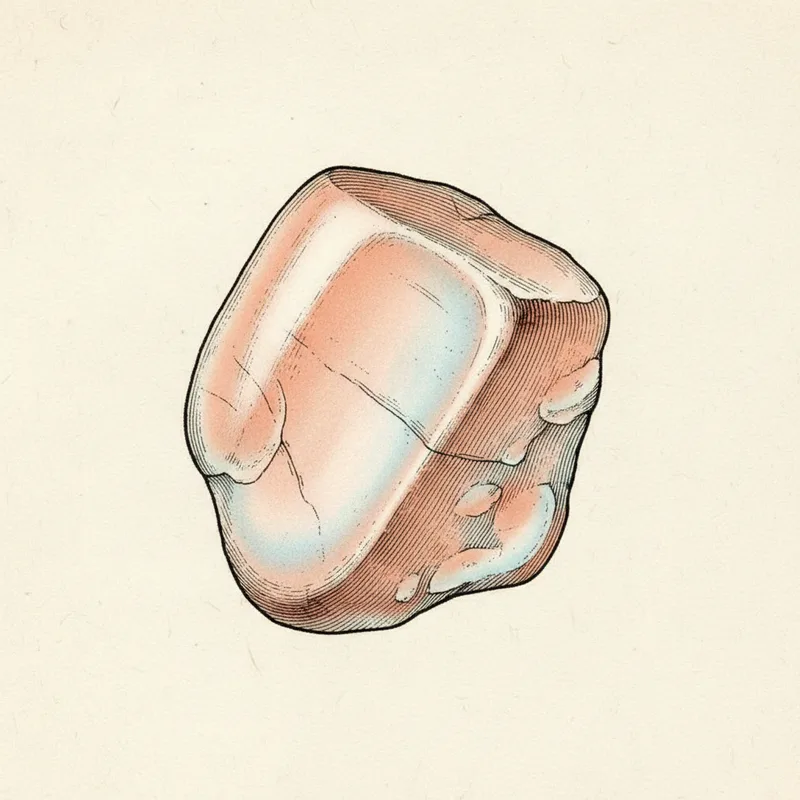
Peach moonstone is a gem variety of alkali feldspar, primarily orthoclase with thin intergrown lamellae of sodium-rich albite or oligoclase. It forms in slowly cooling pegmatites and gneisses where potassium-rich and sodium-rich feldspar components separate during cooling in a process called exsolution. As the host rock cools below about 650°C over geologic timescales, the originally homogeneous feldspar unmixes into alternating microscopic layers of orthoclase and albite, each only a few hundred nanometers thick.
These alternating lamellae are what produce adularescence, the drifting internal glow that defines moonstone. When light enters the stone, it scatters off the regularly spaced feldspar layers in a way described by thin-film interference. Because the lamellae thickness in peach moonstone tends to run slightly thicker than in classic blue-sheen Sri Lankan material, the scattered light skews toward softer white and silvery tones rather than saturated blue. The movement of the sheen as you tilt the stone is a direct optical readout of these internal layers.
The peach bodycolor itself comes from trace iron in the feldspar lattice and from finely disseminated inclusions of hematite and goethite. These iron-oxide particles are too small to see individually but together tint the otherwise colorless feldspar with warm salmon to pale orange hues. Stones with more hematite trend deeper orange, while those with subtler iron content show the creamy apricot tones most associated with the Indian material.
Identification Guide
Peach moonstone is identified first by its adularescence: a soft, mobile glow that appears to float beneath the surface rather than reflect off it. Tilt the cabochon under a single light source and the sheen should drift across the dome rather than staying pinned to one spot. The bodycolor ranges from pale cream-peach to deeper salmon, and unlike rainbow moonstone the sheen in peach material is usually white or silvery rather than electric blue. Hardness of 6 and specific gravity between 2.56 and 2.62 match standard orthoclase, and the stone will show two directions of perfect cleavage if broken, a classic feldspar diagnostic.
Under magnification, peach moonstone often shows centipede-like inclusion patterns and fine tension cracks along cleavage planes, both considered natural and authenticating. A polariscope will reveal the twinned feldspar structure, and the refractive index falls in the 1.518 to 1.526 range with weak birefringence. The peach tone should appear consistent throughout the stone rather than concentrated at the surface or in patches, which would suggest dye.
Spotting Fakes
The most common imitation is opalescent glass, sometimes sold as "opalite moonstone." Under a 10x loupe, glass imitations show spherical gas bubbles and a perfectly clean interior, while genuine peach moonstone shows the centipede inclusions and faint cleavage lines described above. Glass also feels warmer to the touch and lacks the specific heft of feldspar at SG 2.56 plus. Dyed white moonstone is a subtler fake: inspect the girdle and any cleavage cracks, where dye concentrates as darker orange lines following the fissures. Acetone on a cotton swab will sometimes lift surface dye on treated stones, though this is a destructive test and should be done only on material you already suspect. Genuine adularescence travels across the dome as you rotate the stone under a single light source. Painted or backed glass shows static reflective patches that stay fixed to the surface as you tilt.
Cultural & Metaphysical Traditions
Presented as cultural traditions, not scientific evidence
Moonstone has been linked to lunar deities across cultures from the Roman Diana to the Hindu Chandra, with ancient Roman writers describing it as solidified moonlight. The peach variety is a more recent commercial designation but in modern crystal traditions is associated with nurturing warmth, emotional softness, and the energy of the feminine divine. Indian lapidary tradition has cut moonstone for jewelry for over a thousand years, where it is considered sacred to the moon and often set as a temple offering.
Where It's Found
Primary commercial source for peach moonstone cabochons, producing the warm salmon tones most often seen in the trade
Pegmatite deposits yielding large translucent pieces with strong adularescence and creamier peach hues
Alluvial gem gravels producing smaller stones with notably blue to white sheen on a peach bodycolor
Secondary source producing transparent faceting rough with deeper orange saturation from iron content
Price Guide
Good to Know
Scratch test: At hardness 6, Peach Moonstone resists scratching from a knife but can be scratched by quartz. Best for pendants and earrings rather than rings.
Sources: Found in 4 notable locations worldwide, from Rajasthan and Tamil Nadu to Tanzania.
Heft test: Peach Moonstone has average mineral density (2.56-2.62). It feels about as heavy as you'd expect from a stone its size.
Explore More
Stay in the loop
From the Almanac
Updates from Crystal Almanac, when there’s something worth sharing.