Quick Facts
Formation & Origin
Pink Tourmaline is the manganese-colored variety of elbaite, the lithium-aluminum species of the tourmaline group. It crystallizes in granitic pegmatites, coarse-grained igneous bodies that form during the final stages of magma cooling. As a granitic melt drops below roughly 700°C, the last remaining fluid becomes enriched in volatile and incompatible elements such as boron, lithium, fluorine, and manganese. These elements concentrate in the residual melt and trigger the nucleation of tourmaline once boron saturation is reached.
The color comes from Mn²⁺ substituting for aluminum in the crystal structure. Small amounts produce pale pink, higher concentrations shift the stone toward hot pink, and when manganese is abundant and later naturally irradiated by surrounding radioactive minerals, the result is the deep raspberry red known as rubellite. Rubellite holds its red saturation under both daylight and incandescent light, a property that distinguishes it from pink tourmaline that shifts gray under tungsten illumination.
The finest gem pockets form 3-10 km below the surface at temperatures between 350 and 550°C. Growth happens slowly over tens of thousands of years as boron-rich hydrothermal fluids circulate through cavities in the pegmatite. Many pockets stay sealed for tens of millions of years, preserving floating crystals in soft pocket clay until miners break in.
Like all tourmalines, pink tourmaline is both pyroelectric and piezoelectric. Heating or compressing the crystal shifts charge along its polar c-axis, producing a measurable voltage. Dutch merchants shipping Ceylonese tourmaline in the 1700s noticed that warmed crystals pulled ash and dust from their clay pipes and coined the name aschentrekker, or ash-puller, for the stone. The effect is real physics, not folklore, and it remains one of the simplest field tests for tourmaline.
Identification Guide
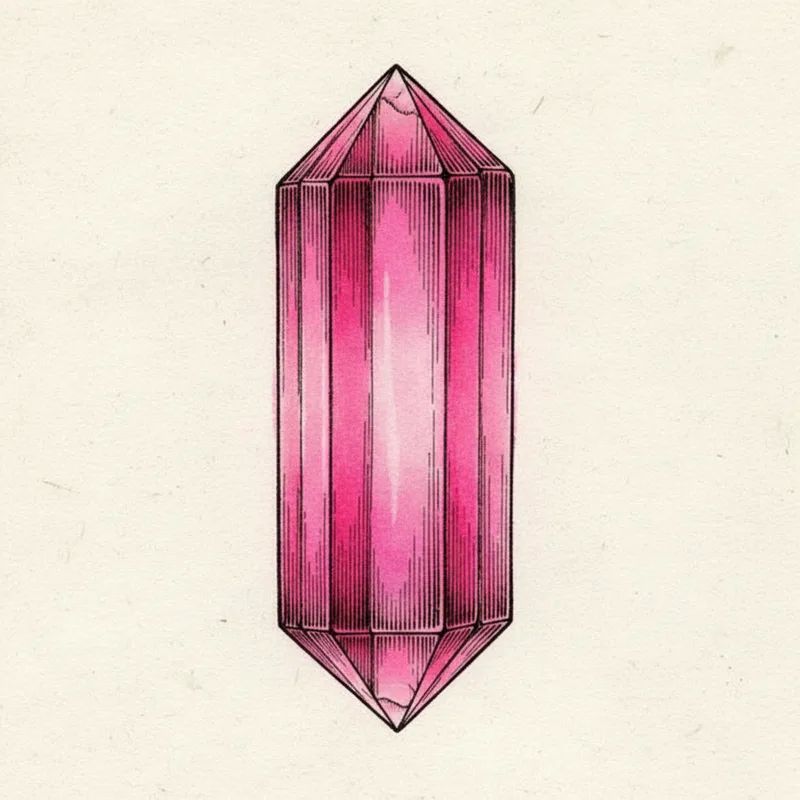
Pink Tourmaline forms long trigonal prisms with a rounded triangular cross-section and strong vertical striations running parallel to the c-axis. The crystals often terminate in small three-sided or flat pinacoid faces. It has no cleavage and fractures conchoidally. Hardness is 7-7.5, specific gravity sits near 3.05, and the luster is vitreous.
The single most useful field test is dichroism. Pink tourmaline is strongly pleochroic, meaning it shows two different colors depending on viewing angle relative to the c-axis. Looking down the length of the crystal usually gives a darker, more saturated pink, while looking across the prism shows a lighter or slightly different hue. A simple dichroscope makes this obvious. The stone also shows visible doubling of back facet edges through the crown due to moderate birefringence.
Distinguish pink tourmaline from pink sapphire (hardness 9, higher specific gravity near 4.0, no striations), morganite beryl (hexagonal habit, lower specific gravity near 2.71, weaker pleochroism), pink topaz (orthorhombic, perfect basal cleavage, higher specific gravity), pink spinel (isometric, no pleochroism, singly refractive), and kunzite (perfect cleavage, strong pleochroism but in a different color axis orientation).
Spotting Fakes
The most common pink tourmaline imitations are glass, irradiated or treated material presented as untreated, and cubic zirconia sold as 'pink ice.' Each has a clear tell. Glass imitations lack pleochroism. A dichroscope held to a genuine pink tourmaline shows two distinctly different pinks as the stone rotates. Glass shows one flat color. Glass also contains gas bubbles, swirl marks, and devitrification streaks visible under 10x magnification, and it feels warmer to the touch because it conducts heat poorly compared to tourmaline. Irradiated pink tourmaline is a legitimate but widely undisclosed treatment. Pale or near-colorless elbaite can be bombarded with gamma rays to deepen pink saturation. The color is stable under normal wear but can fade with prolonged sunlight or heat above 450°C. The stone is still real tourmaline, but the price should reflect the treatment. Ask the seller directly whether the stone is untreated, and request a gemological report from GIA, Gubelin, or SSEF for any stone priced as natural rubellite above roughly 1 carat. Cubic zirconia marketed as 'pink ice' or 'pink diamond simulant' occasionally turns up in tourmaline settings. CZ is singly refractive (no back facet doubling), has a much higher specific gravity near 5.8, and shows extreme fire that natural tourmaline never produces. A simple thermal conductivity pen will also separate CZ from tourmaline in seconds. Finally, some dealers sell pink synthetic quartz or pink topaz cut to resemble rubellite. Quartz has lower hardness (7), lower specific gravity (2.65), and weaker pleochroism. Topaz has perfect basal cleavage that shows as a flat internal plane under magnification.
Cultural & Metaphysical Traditions
Presented as cultural traditions, not scientific evidence
Pink tourmaline has been treasured across cultures for centuries. Empress Dowager Cixi of China was famously obsessed with Californian pink tourmaline, buying tons of rough from the Himalaya Mine in San Diego County in the early 1900s and taking much of her collection to the grave. When the Qing dynasty fell in 1912, the American pink tourmaline market collapsed along with its largest buyer. In Sri Lankan and Burmese traditions, pink tourmaline is associated with compassion and calm. The Dutch name aschentrekker survives in European mineralogical literature as a reference to the pyroelectric effect. Modern practitioners associate pink tourmaline with the heart chakra, emotional healing, and self-love, and it is commonly paired with rose quartz for grief work.
Where It's Found
World's leading source, including Cruzeiro and Jonas mine rubellite
Gem-quality pink crystals from the Paprok and Pech Valley pegmatites
Rich raspberry rubellite, historically important pegmatite district
Historic Himalaya, Tourmaline Queen, and Stewart mines, supplied Empress Dowager Cixi
Price Guide
Good to Know
Scratch test: At hardness 7.5, Pink Tourmaline can scratch glass and steel. It's durable enough for any type of jewelry.
Sources: Found in 4 notable locations worldwide, from Brazil to United States.
Heft test: Pink Tourmaline has average mineral density (3.00-3.10). It feels about as heavy as you'd expect from a stone its size.
Related Minerals
Parent species, pink tourmaline is the manganese variety
Calcium tourmaline with nearly identical pink hues, mostly from Madagascar
Pink beryl, similar color, different crystal system and chemistry
Explore More
Stay in the loop
From the Almanac
Updates from Crystal Almanac, when there’s something worth sharing.