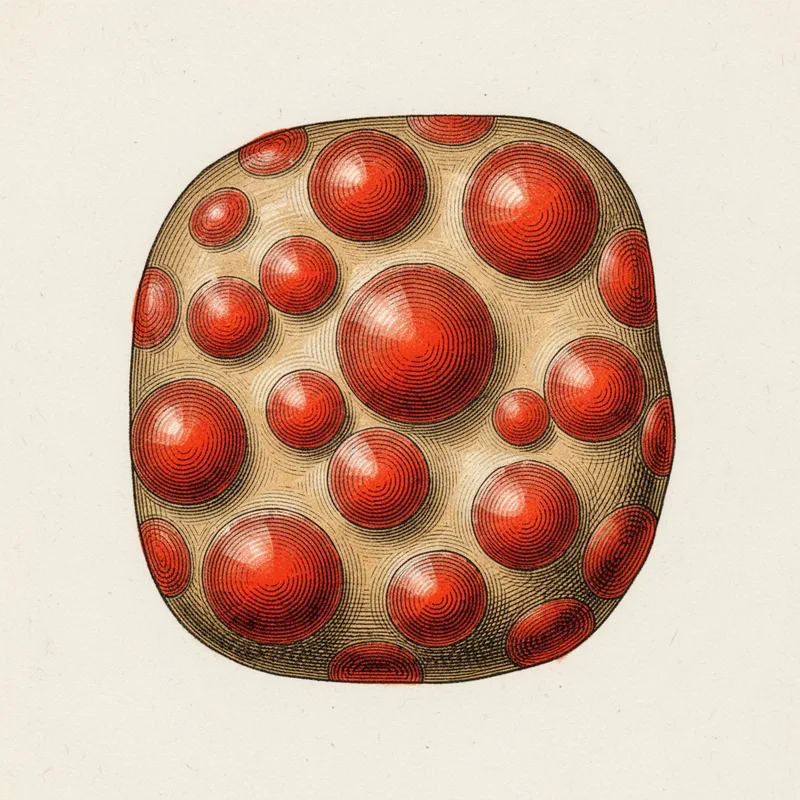
Poppy Jasper
Orbicular jasper with iron-oxide flower patterns from Morgan Hill, California
Quick Facts
Formation & Origin
Morgan Hill poppy jasper formed in the Franciscan Complex chert deposits of the California Coast Ranges, radiolarian-rich deep-marine sediments that underwent hydrothermal alteration during the Mesozoic. Iron-rich hydrothermal fluids circulated through silica-rich host rock, depositing concentrated hematite and goethite spherulites (the 'poppies') within a jasper matrix. Each poppy formed around a nucleation point where iron minerals crystallized in radiating patterns before silica precipitated around them, locking the flower-like structures into the stone. The Morgan Hill deposit is historically the only commercial source of classic poppy jasper, and its distinctive bright red spots in tan matrix are the diagnostic pattern collectors recognize worldwide.
Identification Guide
Poppy jasper is identified by its signature spotted pattern: round to irregular red-orange 'poppies' of concentrated iron oxide (1 to 10 millimeters across) set in a beige, tan, or brown chalcedony matrix. Hardness of 7 scratches glass but not quartz. Opaque with vitreous to waxy luster on polished surfaces. Specific gravity falls in the 2.58 to 2.91 range typical of chalcedony varieties. Genuine Morgan Hill material shows irregular poppy sizes and three-dimensional depth in the spots, with darker centers grading to lighter edges. Under magnification, the spots reveal radiating mineral structure rather than uniform color fill. White streak confirms iron-oxide inclusion rather than bulk coloration.
Spotting Fakes
Dyed orbicular jasper shows unnaturally uniform spot size and dye concentrated in cracks; an acetone swab will transfer color from dyed material but leave genuine jasper unchanged. Painted matrix jasper has surface-only color that acetone or alcohol will remove, and the 'poppies' appear flat rather than three-dimensional. Epoxy-filled composite jasper reveals fluorescent epoxy lines under UV light at 365 nanometers. Genuine Morgan Hill poppy jasper has irregular spot sizes from 1 to 10 millimeters, natural color variation within each spot (darker iron-oxide centers, lighter edges), and matrix inclusions that appear three-dimensional rather than surface-painted. Under 10x loupe, real poppies show radiating crystalline structure; fakes show uniform pigment fill.
Cultural & Metaphysical Traditions
Presented as cultural traditions, not scientific evidence
Modern crystal healing traditions associate poppy jasper with vitality, motivation, and creative energy, drawing on the flower imagery as a symbol of blooming potential. Native peoples of the California coast historically used jasper varieties for tool-making and ceremonial objects, though poppy jasper specifically entered the lapidary trade in the late 19th century. Contemporary practitioners regard it as a stone of joyful action and physical stamina. These associations are cultural traditions and not scientifically verified claims.
Where It's Found
Classic type locality; mining closed mid-1900s, all current genuine material is from collector stockpiles
Modern commercial source, more orange-red tone vs Morgan Hill's bright red
Minor orbicular jasper deposits with similar patterning but different color palette
Price Guide
Good to Know
Scratch test: At hardness 7, Poppy Jasper can scratch glass and steel. It's durable enough for any type of jewelry.
Sources: Found in 3 notable locations worldwide, from United States to United States.
Heft test: Poppy Jasper has average mineral density (2.58 to 2.91). It feels about as heavy as you'd expect from a stone its size.
Explore More
Stay in the loop
From the Almanac
Updates from Crystal Almanac, when there’s something worth sharing.