Quick Facts
Formation & Origin
Quantum Quattro is a trade name coined in the 1990s for a specific polymineral material from the Onganja mine in Namibia. It is not a single mineral species. It is an assemblage of four copper-bearing minerals, sometimes with a fifth smoky quartz component, that crystallized together in the oxidized zone of a copper sulfide orebody.
The Onganja deposit began as primary copper sulfides. Over millions of years, oxygenated groundwater percolated through fractured host rock and attacked these sulfides, releasing copper ions into solution. As these copper-rich fluids moved through silica-bearing country rock and encountered carbonates, they precipitated multiple copper minerals nearly simultaneously in tight spatial association.
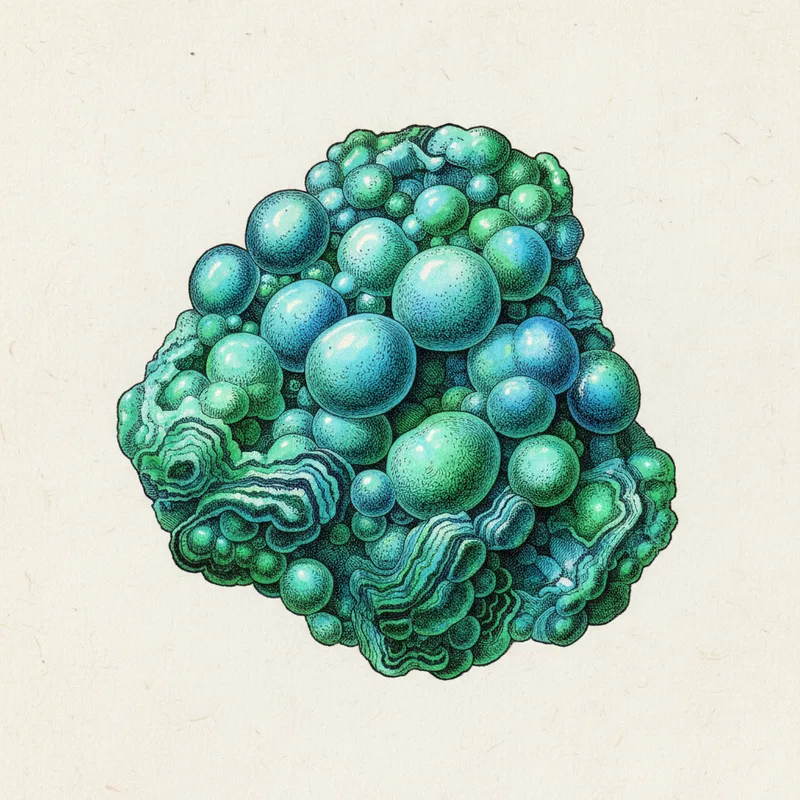
The four signature phases reflect different copper bonding environments. Chrysocolla is an amorphous hydrated copper silicate with a soft, gel-like structure that gives the material its pale turquoise body. Shattuckite is a crystalline copper silicate that forms the deeper blue fibrous zones. Dioptase is a copper cyclosilicate that crystallizes as vivid emerald-green prismatic crystals scattered through the matrix. Malachite, a copper carbonate rather than a silicate, forms the brighter green banded veins. When smoky quartz is also present it records the final phase of silica precipitation, and collectors call the full five-phase material Quantum Quattro Silica.
The Onganja mine is now largely worked out. Most genuine four-phase material on the market today is from older stockpiled parcels rather than fresh production.
Identification Guide
Genuine Quantum Quattro shows all four phases visible under a 10x loupe in a single specimen. Look for the pale turquoise chrysocolla body, deeper blue shattuckite fibers or patches, emerald-green dioptase as discrete small crystals or crystal clusters, and brighter banded malachite segments. The bulk hardness averages around 5, but the component minerals vary widely: malachite is 3.5 to 4, chrysocolla 2.5 to 3.5, shattuckite 3.5, dioptase 5, and any quartz component 7. A scratch test on a single polished face will give different results depending on which phase the point lands on.
Specific gravity runs between 2.8 and 3.8 depending on the proportion of dioptase and malachite, which are denser than chrysocolla. Streak varies across the stone. Chrysocolla and shattuckite give pale blue to blue-green, dioptase gives pale green, malachite gives pale green to almost white. The polished surface often shows a slightly uneven texture where softer chrysocolla has been polished lower than the harder dioptase and quartz.
Spotting Fakes
The most common problem is mislabeling rather than outright fakery. Plain chrysocolla, or chrysocolla with malachite but no dioptase, is often sold as Quantum Quattro at a premium price. Genuine material must show all four phases. Under a 10x loupe you should be able to identify emerald-green dioptase crystal inclusions, banded malachite segments, and the botryoidal chrysocolla plus shattuckite matrix in the same specimen. If you cannot find the dioptase, it is not Quantum Quattro. Dyed or color-enhanced chrysocolla is a secondary issue. Dyed material shows uniform blue saturation with no phase boundaries and often a slightly unnatural cyan tone. Wiping with a cotton pad lightly dampened with acetone will sometimes pick up dye on a treated piece, though this test risks damaging a genuine specimen and should only be done on an inconspicuous edge. Remember that Quantum Quattro is a trade name, not a mineralogical species. No laboratory will certify a specimen as Quantum Quattro. What they can certify is the presence of each component mineral. A credible dealer should be able to point out each of the four phases on a given specimen and, ideally, disclose whether the piece is from original Onganja stock or from a later adjacent deposit.
Cultural & Metaphysical Traditions
Presented as cultural traditions, not scientific evidence
Quantum Quattro entered the crystal market in the 1990s and carries no ancient tradition, since the material itself was unknown before then. Modern metaphysical practitioners associate it with layered healing work, drawing on the individual traditional associations of its four components: chrysocolla as a communication stone, shattuckite as an intuition stone, dioptase as an emotional repair stone, and malachite as a transformation stone. These associations are cultural and marketing traditions of the recent era, not documented historical practice.
Where It's Found
The sole classic source, now largely worked out. All original Quantum Quattro material comes from this copper deposit.
Nearby deposits occasionally yield similar polymineral copper silicate matrix sold under the same trade name
Produces similar chrysocolla and malachite intergrowths but rarely the full four-phase combination
Price Guide
Good to Know
Scratch test: At hardness 5, Quantum Quattro resists scratching from a knife but can be scratched by quartz. Best for pendants and earrings rather than rings.
Sources: Found in 3 notable locations worldwide, from Namibia to Democratic Republic of the Congo.
Heft test: Quantum Quattro has average mineral density (2.8–3.8 (varies with proportion of dioptase and malachite)). It feels about as heavy as you'd expect from a stone its size.
Explore More
Stay in the loop
From the Almanac
Updates from Crystal Almanac, when there’s something worth sharing.