Quick Facts
Formation & Origin
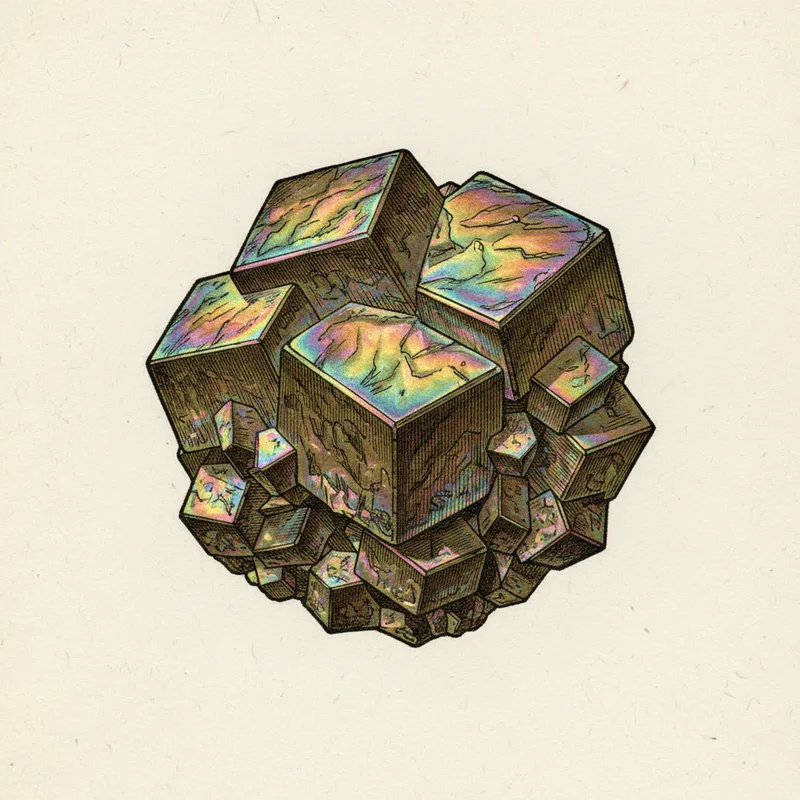
Rainbow garnet is an iridescent variety of andradite, a calcium-iron silicate garnet. It forms in skarn deposits, zones of intense chemical reaction where hot granitic magma intrudes carbonate-rich host rocks like limestone or dolomite. At Tetela de Ocampo in Puebla state, a granitic body pushed into a limestone sequence, and the resulting contact metamorphism cooked calcium, iron, and silica into dodecahedral andradite crystals at temperatures around 400 to 600 degrees Celsius.
The rainbow effect is not body color. It is thin-film interference generated by exsolution lamellae, microscopically thin layers of slightly differing andradite composition that stacked during cooling. These lamellae sit at thicknesses comparable to visible light wavelengths, roughly 100 to 500 nanometers apart. When light enters the crystal and reflects off each boundary, the layered reflections interfere constructively at certain wavelengths and destructively at others, producing the shifting rainbow colors that rotate as the stone moves.
The Japanese material from Tenkawa in Nara Prefecture was discovered in the 1940s and described scientifically decades before the Mexican find. Japanese specimens tend to be smaller and show more muted gold and violet flashes. The Tetela material, coming onto the market from around 2004, delivers larger crystals with broader rainbow ranges including vivid blues, greens, and magentas. Both sources share the same skarn origin and exsolution mechanism.
Identification Guide
Rainbow garnet shows an olive to brownish-green body color topped with a shifting iridescent sheen that changes as the stone rotates under steady light. Crystals are typically small, from a few millimeters up to about two centimeters, and often preserve the classic garnet dodecahedral or trapezohedral faces. Hardness of 6.5 to 7 and specific gravity near 3.85 match the andradite range.
The rainbow effect is entirely internal. Under a loupe you can sometimes see faint parallel bands or a subtle domain structure where lamellae meet polish. Crucially, the iridescence moves with the stone's orientation, not with the light source, because it is refracted and reflected within the crystal. A steady lamp and a slow rotation of the specimen is the cleanest diagnostic. Surface should feel glassy and hard, with no coating residue. Crystals sit noticeably heavy for their size compared to similar-looking glass or plastic imitations.
Spotting Fakes
The most common imitations are coated stones, oil-treated hessonite or common andradite, and simple colored glass. Coated fakes rely on a surface film to generate pseudo-iridescence. Wipe a hidden area with acetone or isopropyl alcohol on a soft cloth. Genuine rainbow garnet is completely unaffected, while surface coatings and oil treatments lose their rainbow within seconds. Glass imitations show telltale swirl marks, gas bubbles, and slightly warm body temperature. Real garnet feels cold and dense. Watch how the rainbow behaves under a single steady light. Authentic iridescence appears to float inside the stone and rotates as you turn it, because the interference is produced by internal lamellae. Surface-treated fakes show iridescence that sits flat on the outer skin and disappears at certain viewing angles in a binary way. Hardness also helps. A quick hardness pick test above 6.5 rules out most glass and plastic substitutes.
Cultural & Metaphysical Traditions
Presented as cultural traditions, not scientific evidence
Japanese collectors in the Nara tradition viewed Tenkawa iridescent garnets as sacred mountain stones, linked to the shrine culture of the Yoshino region. In Mexico, Tetela material entered the market during the early 2000s and has been adopted by contemporary mineral collectors rather than folk traditions. Garnet more broadly carries a long history across Roman, medieval European, and South Asian cultures as a stone of vitality and passage. Modern crystal practitioners associate rainbow garnet with creative renewal, joy, and the alignment of emotional and willpower centers.
Where It's Found
Premier modern source, discovered early 2000s, strongest rainbow iridescence
Original discovery site from the 1940s, smaller crystals with subtle flash
Historic skarn locality, fine collector specimens with dodecahedral form
Limited occurrences of iridescent andradite in skarn-hosted deposits
Price Guide
Good to Know
Scratch test: At hardness 7, Rainbow Garnet can scratch glass and steel. It's durable enough for any type of jewelry.
Sources: Found in 4 notable locations worldwide, from Mexico to United States.
Heft test: Rainbow Garnet has a specific gravity of 3.80–3.90 - noticeably heavier than quartz. You'll feel the density when you pick it up.
Related Minerals
Transparent green andradite variety, same chemistry without iridescence
Black titanium-rich andradite from similar skarn environments
Calcium-aluminum sister species in the same garnet group
Explore More
Stay in the loop
From the Almanac
Updates from Crystal Almanac, when there’s something worth sharing.