Quick Facts
Formation & Origin
Rhodizite forms in the late-stage, highly evolved portions of lithium-cesium-tantalum (LCT) pegmatites, the same geochemical environment that produces pollucite, lepidolite, and pink elbaite tourmaline. Pegmatite crystallization begins with common feldspars and quartz, and as the melt cools, incompatible elements that do not fit into those structures become concentrated in the remaining fluid. Eventually, pockets rich in lithium, cesium, beryllium, and boron remain.
Rhodizite is rare because its formula demands an unusual coincidence. Cesium, beryllium, and boron all have to concentrate in the same pocket at the same time. Cesium is one of the rarest alkali metals in the crust, beryllium is geochemically shy, and boron tends to leave the system as tourmaline grows. Only in the most evolved cesium-rich pegmatites do all three remain in solution long enough for rhodizite to crystallize.
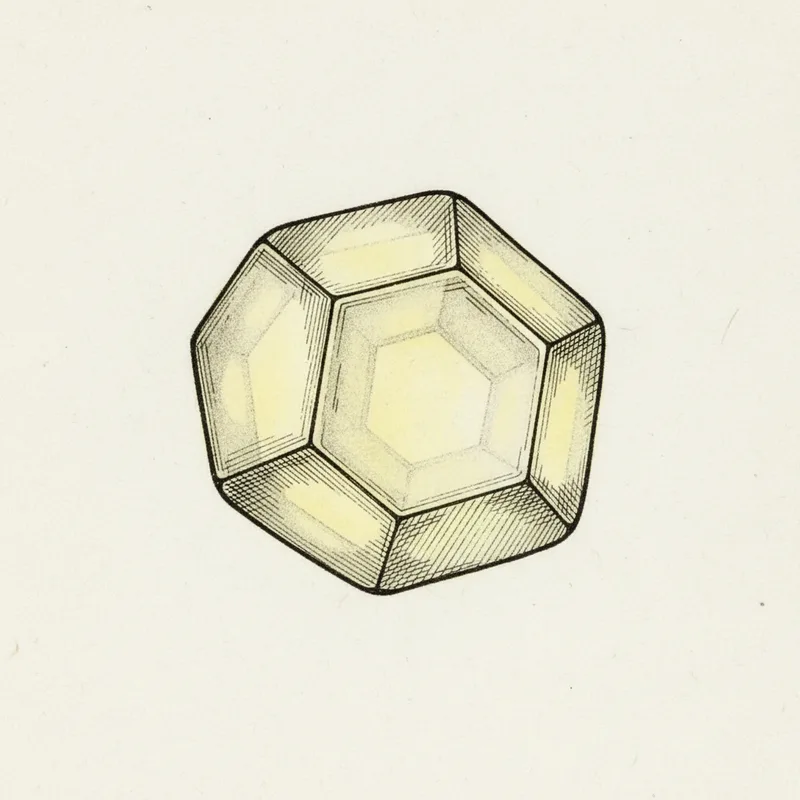
At Antandrokomby in Madagascar's Sahatany Valley, rhodizite grows as sharp dodecahedral crystals, sometimes modified by tetrahedral faces, embedded in pink and lavender lepidolite alongside elbaite tourmaline. The cubic symmetry gives crystals a toy-like geometric appearance that is striking at any size. Despite being a borate, rhodizite reaches hardness 8 on the Mohs scale, higher than almost any other borate mineral and competitive with topaz.
Identification Guide
Rhodizite's diagnostic combination is unusual enough to be a strong identifier. Look for sharp dodecahedral (12-sided) crystals, often small (under 1 cm), showing pale yellow to honey-gold color, sitting in a matrix of pink lepidolite or tourmaline. Hardness 8 rules out most softer yellow minerals, and the cubic dodecahedral habit rules out topaz (orthorhombic) and citrine (trigonal).
Specific gravity around 3.40 is noticeably heavier than quartz or topaz. Under shortwave ultraviolet light, many rhodizite crystals fluoresce a distinct yellow-green, which is a reliable indicator. The mineral is also pyroelectric, meaning it develops an electrical charge when heated, a property that specialist labs can test but that is not practical at home.
The locality itself is a strong identifier. Nearly all gem-quality rhodizite on the market traces to Madagascar's Sahatany Valley, so a seller who cannot name a specific pegmatite should raise doubt.
Spotting Fakes
Outright counterfeits are uncommon because rhodizite is niche enough that most buyers come through specialist mineral dealers. The practical risk is misidentification. Yellow topaz, citrine, and yellow beryl can all look superficially similar as faceted gems. Verify the crystal habit first. Genuine rhodizite specimens are almost always sold as natural crystals showing dodecahedral form, not as faceted stones. If a seller offers a faceted yellow gem as rhodizite without a natural crystal to back it up, ask questions. Yellow topaz has perfect basal cleavage (rhodizite does not) and a lower specific gravity of about 3.5 to 3.6 with orthorhombic prismatic habit. Citrine is softer at hardness 7, will scratch under a hardened steel file where rhodizite will not, and crystallizes in trigonal prisms rather than cubic dodecahedra. Glass imitations are easy to spot under magnification through gas bubbles, swirl marks, and soft edges that true crystal faces do not show. Synthetic rhodizite is not produced commercially, so a low-price 'lab-grown rhodizite' listing is a red flag by itself. When in doubt, ask for locality provenance (a legitimate Antandrokomby specimen should come with a locality label) and check the fluorescence under shortwave UV.
Cultural & Metaphysical Traditions
Presented as cultural traditions, not scientific evidence
Rhodizite has no pre-modern folkloric tradition. It was first described scientifically in 1836 and remained a specimen curiosity until the early 2000s, when it was marketed in the metaphysical trade as a 'master amplifier' stone said to boost the effects of other crystals. That framing is a contemporary marketing claim with no historical basis and should be treated as a cultural fact about the current market rather than a traditional belief. Users in the modern trade pair it with other pegmatite minerals like tourmaline and lepidolite.
Where It's Found
The primary world source. Gem-quality dodecahedral crystals occur in lepidolite and tourmaline-bearing pegmatites.
Historically important locality producing small sharp dodecahedra.
The type locality. First described by Gustav Rose in 1836. Specimens are small and rare.
Minor occurrences in lithium-rich pegmatites. Typically small crystals.
Price Guide
Good to Know
Scratch test: At hardness 8, Rhodizite can scratch glass and steel. It's durable enough for any type of jewelry.
Sources: Found in 4 notable locations worldwide, from Madagascar to United States.
Heft test: Rhodizite has average mineral density (3.40). It feels about as heavy as you'd expect from a stone its size.
Related Minerals
Cesium-dominant analogue of rhodizite, same structure
Cesium-rich pegmatite partner mineral
Common matrix mineral in Madagascar rhodizite specimens
Co-crystallizes in the same cesium-rich pegmatite pockets
Explore More
Stay in the loop
From the Almanac
Updates from Crystal Almanac, when there’s something worth sharing.