Quick Facts
Formation & Origin
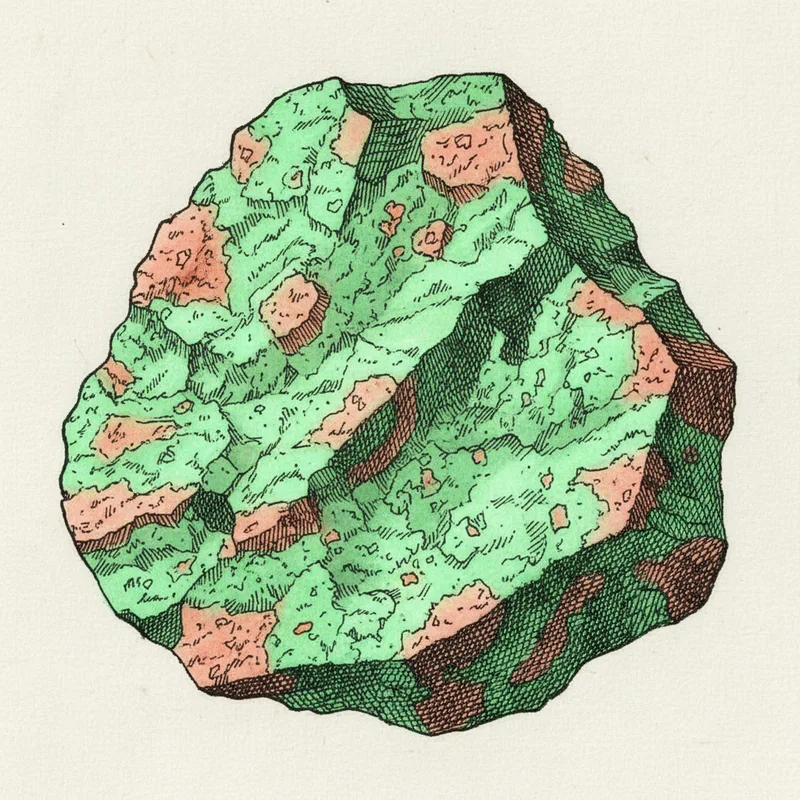
Unakite is not a single mineral - it's an altered granite composed of three main components: green epidote, pink orthoclase feldspar, and clear to milky quartz. It forms when granite undergoes hydrothermal alteration - hot, mineral-rich fluids circulate through the granite, transforming some of the original minerals into epidote while leaving the feldspar and quartz largely intact.
The result is a mottled green-and-pink stone that's technically a metamorphic rock rather than a mineral. The green patches are epidote (a calcium aluminum iron silicate), the pink patches are orthoclase feldspar, and the grayish areas are quartz.
Unakite is named after the Unaka Mountains on the Tennessee-North Carolina border, where it was first described. It's abundant, durable (hardness 6-7 depending on the specific mineral being tested), and takes a good polish, making it popular for both collecting and jewelry.
Identification Guide
Unakite is one of the easiest rocks to identify - the mottled combination of pistachio green and salmon pink is unique and unmistakable. No other common rock shows this specific color combination.
The green patches will be slightly harder and glassier (epidote, hardness 6-7) than the pink patches (feldspar, hardness 6). Quartz areas (hardness 7) may also be visible as gray or translucent patches. Distinguish from rhodonite (uniform pink with black veining, no green) and ruby in zoisite (vivid red and deeper green, contains actual ruby crystals).
Spotting Fakes
Unakite is so abundant and inexpensive that faking would be pointless. The only potential confusion is with other green-and-pink rocks, but unakite's specific color combination (pistachio green + salmon pink) is diagnostic. Some very low-quality material may lack strong color contrast and look muddy - this isn't fake, just poor-grade unakite.
Cultural & Metaphysical Traditions
Presented as cultural traditions, not scientific evidence
Unakite has no ancient traditions (it wasn't described as a distinct material until relatively recently). Modern crystal practitioners associate it with emotional balance - the green representing growth and the pink representing love. It's commonly used in fertility-related crystal work and is considered a grounding stone for emotional healing. Its dual-color nature makes it a popular choice for practitioners working with heart-mind integration.
Where It's Found
Type locality, named for these mountains
Good commercial-grade material
Major producer of tumbled and carved unakite
Available in commercial quantities
Price Guide
Good to Know
Scratch test: At hardness 6.5, Unakite resists scratching from a knife but can be scratched by quartz. Best for pendants and earrings rather than rings.
Sources: Found in 4 notable locations worldwide, from United States to Brazil.
Heft test: Unakite has average mineral density (2.85-3.20). It feels about as heavy as you'd expect from a stone its size.
Explore More
Rocks & Multi-Mineral Composites
The Love Collection
Green epidote + pink feldspar. Used in fertility-related traditions and for balancing giving and receiving in relationships.
Mohs Hardness Scale
See where Unakite sits on the scale
Crystal Care Guide
Water safety, sunlight, and handling tips
Stay in the loop
From the Almanac
Updates from Crystal Almanac, when there’s something worth sharing.