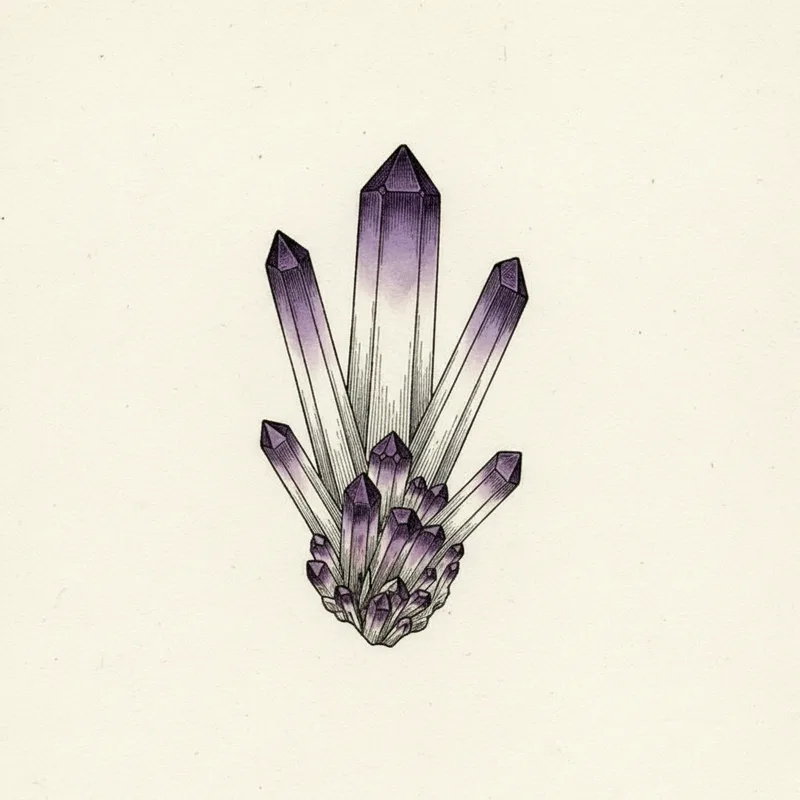
Vera Cruz Amethyst
Slender prismatic amethyst from Las Vigas, Mexico with saturated purple tips
Quick Facts
Formation & Origin
Forms in miarolitic cavities of Cretaceous rhyolite and andesite flows in the Eastern Sierra Madre near Las Vigas. Late-stage silica-rich hydrothermal fluids percolated through gas pockets (miaroles) left in cooling volcanic rock, depositing quartz on cavity walls. The distinctive pencil-thin slender habit results from rapid growth in narrow vug spaces with high silica supersaturation, which favors elongation along the c-axis over lateral thickening. Iron (Fe³⁺) incorporation was lower in the host fluid than in classic Brazilian amethyst, producing the pale-to-medium lavender body color rather than deep grape purple. The saturated tips occur because color center precursors concentrated at the growth front during the final stages of crystallization, with natural gamma irradiation from host rock converting Fe to the color centers responsible for amethyst purple. Many crystals grew free-floating in open cavities, producing the characteristic doubly-terminated floater habit prized by collectors.
Identification Guide
Slender prismatic quartz crystals, typically pencil-thin (2-8 mm diameter) and disproportionately long (2-10 cm or more) for their width. Color transitions from water-clear or pale lavender at the base to saturated violet at the termination, with the purple concentrated in the tip third of the crystal. Frequently doubly terminated. Crystals often occur as individuals or in loose parallel clusters on matrix rather than the tight druzy aggregates typical of Uruguayan or Brazilian amethyst. Hardness 7, vitreous luster, conchoidal fracture, specific gravity 2.65. Clarity is exceptional, with very few inclusions compared to commercial amethyst varieties.
Spotting Fakes
Synthetic hydrothermal amethyst (Russian or Chinese lab-grown) is the primary concern at premium price points. Under a microscope, synthetic amethyst appears too clean and lacks the natural growth striations, minor inclusions, and subtle color zoning of genuine Vera Cruz material. Characteristic breadcrumb inclusions and natural tiger-stripe banding along the c-axis indicate natural origin. Heat-treated citrine partially converted back toward amethyst coloration shows uneven, patchy color zoning rather than the clean base-to-tip gradient of Vera Cruz. Brazilian amethyst clusters are sometimes mislabeled as Vera Cruz at lower price points. Brazilian crystals have a thicker, stouter habit, deeper purple saturation throughout the crystal rather than concentrated at the tip, and typically occur as druzy linings inside geodes rather than individual prismatic points on matrix. Genuine Vera Cruz has an unmistakable visual signature: slender pencil-point habit, clear-to-purple gradient, and frequent double termination.
Cultural & Metaphysical Traditions
Presented as cultural traditions, not scientific evidence
Amethyst has been associated with sobriety, clarity, and spiritual insight since antiquity. The Greek name amethystos translates roughly as not drunken and refers to the folk belief that the stone prevented intoxication. In modern crystal practice Vera Cruz amethyst is specifically valued for its perceived high vibration, with practitioners citing its clarity and slender structure as markers of refined energy compared to bulkier amethyst varieties. No indigenous Mexican spiritual tradition specifically tied to the Las Vigas material is documented, as commercial mining began only in the 1970s.
Where It's Found
The classic source. Piedra Parada, La Catedral, and Amatista mines produce the signature slender doubly-terminated crystals from miarolitic cavities in Cretaceous rhyolite. Active mining since the 1970s.
Smaller secondary district adjacent to Las Vigas with similar geology. Yields comparable but generally shorter crystals.
Broader volcanic host region. Scattered newer workings continue to produce connoisseur-grade material as the classic pits deepen.
Price Guide
Good to Know
Scratch test: At hardness 7, Vera Cruz Amethyst can scratch glass and steel. It's durable enough for any type of jewelry.
Sources: Found in 3 notable locations worldwide, from Las Vigas de Ramirez to Eastern Sierra Madre.
Heft test: Vera Cruz Amethyst has average mineral density (2.65). It feels about as heavy as you'd expect from a stone its size.
Related Minerals
Another connoisseur-grade amethyst (Namibia) with similar emphasis on clarity and specimen quality over saturation.
Contrast case. Deeply saturated geode-lining amethyst with entirely different habit and formation setting.
Iron-bearing quartz where the color center pathway yields yellow rather than purple.
Green quartz produced by heat-treating certain amethysts, including some Vera Cruz material.
Natural amethyst-citrine bicolor quartz sharing amethyst chemistry and iron color-center mechanism.
Explore More
Stay in the loop
From the Almanac
Updates from Crystal Almanac, when there’s something worth sharing.