Quick Facts
Formation & Origin
Andamooka opal formed in the Cretaceous sedimentary basin known as the Bulldog Shale, roughly 100 million years ago, when central Australia lay beneath a shallow inland sea. As the sea retreated and the climate dried, silica-rich groundwater percolated through porous sedimentary layers over tens of millions of years.
What makes Andamooka geologically distinct from Coober Pedy or Lightning Ridge is the host rock. While most opal fields produce opal in veins and seams within clay or sandstone, Andamooka's signature product is matrix opal. Precious opal infused itself directly into porous limestone and calcareous concretions, filling microscopic voids throughout the host rock rather than pooling in cavities. Weathering over 30 to 50 million years dissolved carbonate, created porosity, then redeposited silica gel that ripened into opal within the rock matrix itself.
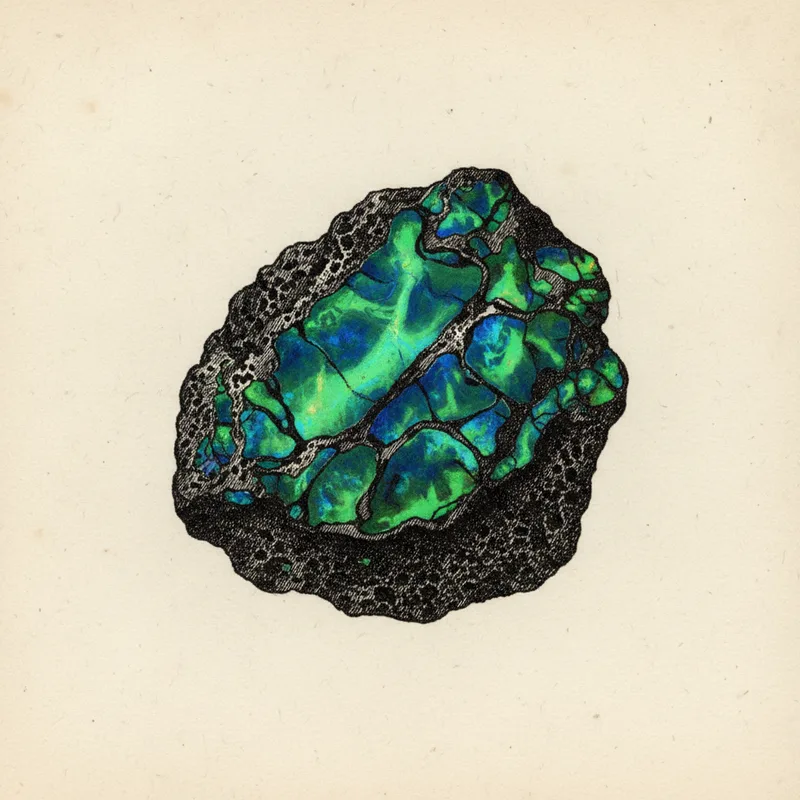
The ordered stacking of silica spheres at scales of 150 to 350 nanometers produces play-of-color by diffracting visible light, the same physical principle that colors a peacock's feather. Because the spheres in matrix opal are scattered through a host rock rather than forming clean seams, Andamooka stones show a distinctive pebbled or speckled play-of-color against a pale calcareous background.
Identification Guide
Andamooka opal presents two distinct looks. Untreated matrix opal shows pinpoint flashes of color scattered across a creamy white or tan limestone background, resembling confetti frozen in pale stone. Treated matrix opal shows vivid play-of-color against a near-black background, the result of a well-documented century-old enhancement that carbonizes organic sugar within the porous host.
At hardness 6, Andamooka opal sits at the top end of the opal range, slightly harder and more durable than Ethiopian hydrophane or Lightning Ridge black opal. Specific gravity runs 1.98 to 2.25. Under magnification, genuine Andamooka matrix shows opal filling natural pore spaces and irregular veins that follow the host rock's original texture.
Less common but more valuable is Andamooka crystal opal, transparent to translucent precious opal in clean seams, with no matrix host. These stones can rival Coober Pedy crystal opal and command significantly higher prices per carat.
Spotting Fakes
Painted or surface-dyed matrix is the most common deception. A cotton swab dipped in acetone will lift paint or plastic coating; genuine treated matrix has carbon permanently bonded into the limestone host and does not smear. Under 10x magnification, fake black backing shows a uniform painted layer, while real treated matrix shows carbon distributed through the porous rock. Gilson synthetic opal, produced commercially since 1974, reveals a too-regular columnar or lizard-skin sphere pattern under high magnification and lacks any natural matrix host. Assembled doublets and triplets show a flat glue seam at the junction of the opal slice and dark backing when viewed edge-on under 10x; genuine Andamooka never has a straight glue line. Genuine treated Andamooka matrix shows random crack patterns, natural pore distribution, and opal veins that wander through the rock without following geometric patterns. The 1954 Queen's Andamooka Opal, a 203 carat treated matrix piece gifted to Queen Elizabeth II, remains the most famous example of the legitimate treatment that GIA and the Australian Opal Association accept when properly disclosed.
Cultural & Metaphysical Traditions
Presented as cultural traditions, not scientific evidence
Opal was Australia's national gemstone from the early twentieth century and carries deep significance in Aboriginal creation stories of central Australia, where the stone is associated with the Rainbow Serpent. Medieval European traditions considered opal a stone of truth and hope, though a superstition born from Sir Walter Scott's 1829 novel briefly cast it as unlucky. Modern crystal practitioners associate Andamooka matrix with emotional integration and creative expression, interpreting the scattered fire across pale stone as a metaphor for finding beauty in ordinary ground.
Where It's Found
Primary source, discovered 1930, famous for matrix opal in porous limestone host
Sister field, primarily light and crystal opal, not matrix
Third classic SA field, closed to mining in 2019, dark opal in sandstone
Newer field southwest of Mintabie, similar geology
Price Guide
Good to Know
Scratch test: At hardness 6, Andamooka Opal resists scratching from a knife but can be scratched by quartz. Best for pendants and earrings rather than rings.
Sources: Found in 4 notable locations worldwide, from Australia to Australia.
Heft test: With a specific gravity of 1.98–2.25, Andamooka Opal feels lighter than most minerals. This lightness can help identify it.
Related Minerals
Sister South Australian field, primarily light and crystal opal
Premium New South Wales field, natural dark body tone
Queensland variety with opal in ironstone host
Volcanic hydrophane opal, sedimentary silica cousin
Same mineral without play-of-color structure
Stay in the loop
From the Almanac
Updates from Crystal Almanac, when there’s something worth sharing.