Quick Facts
Formation & Origin
Apophyllite crystallizes in volcanic rock cavities (vesicles) from low-temperature hydrothermal fluids - the same environment that produces zeolites, with which it almost always co-occurs. The Deccan Traps of India, massive basalt flows covering much of western India, provide ideal conditions for apophyllite formation.
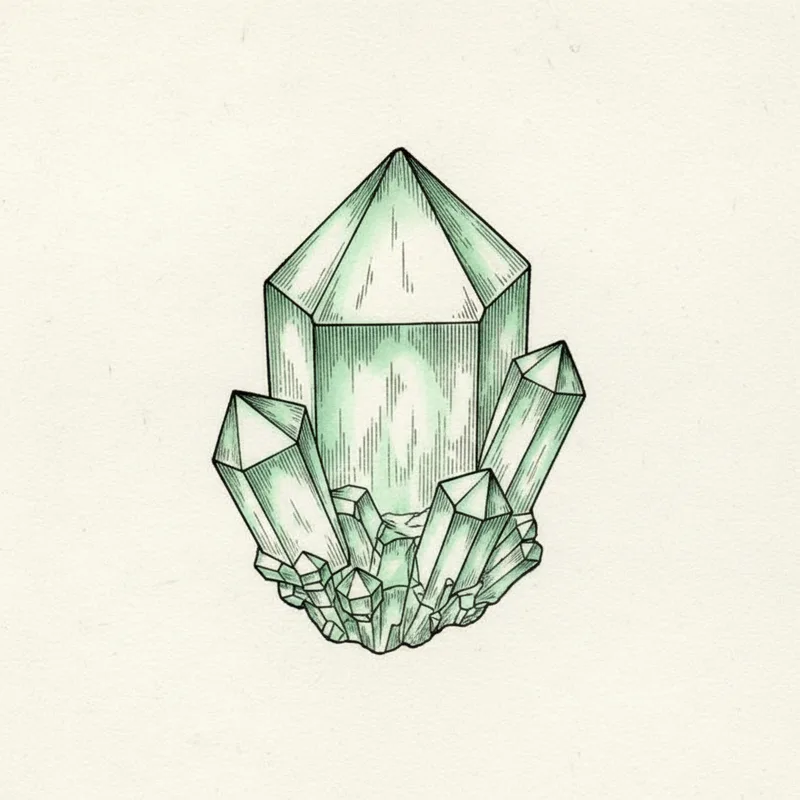
The crystals grow as water-rich silicate solutions percolate through the porous basalt over millions of years. Individual crystals can reach remarkable transparency and size - Indian specimens with crystals exceeding 10 centimeters are not uncommon. The characteristic crystal form is a square prism terminated by a pyramid, giving crystals a distinctive geometric appearance.
Green apophyllite gets its color from trace iron, while the common colorless variety has exceptional transparency that rivals optical-grade calcite. The pearly luster on the basal cleavage face (the flat end of the crystal) is a distinctive identification feature.
Identification Guide
Apophyllite is identified by its square prismatic crystal habit with pyramidal terminations, strong pearly luster on the basal face, and association with zeolite minerals in basalt cavities. At hardness 4.5-5, it can be scratched by a knife.
Distinguish from quartz (hexagonal, much harder at 7), calcite (rhombohedral, fizzes in acid), and fluorite (cubic, different cleavage). Apophyllite's combination of square cross-section, pearly basal cleavage, and occurrence with zeolites is diagnostic.
Spotting Fakes
Apophyllite from India is abundant and inexpensive in most forms, so faking is unnecessary. Very large, perfect, transparent crystals command premium prices and are worth verifying. The main practical concern is fragility - apophyllite has perfect basal cleavage and is easily damaged. Handle carefully and store where it won't be knocked. Some specimens are stabilized with glue at the base where crystals attach to matrix.
Cultural & Metaphysical Traditions
Presented as cultural traditions, not scientific evidence
Apophyllite's exceptional clarity and light-conducting properties have made it popular for meditation and spiritual practices. Practitioners value it for astral travel, accessing the Akashic records, and enhancing clairvoyance. The green variety is associated with nature connection and heart healing. The name comes from the Greek 'apophylliso' meaning 'to leaf off,' referring to how it flakes when heated.
Where It's Found
World's finest specimens, massive production
Green variety with prehnite
Classic American locality
Fine colorless crystals in basalt
Price Guide
Good to Know
Scratch test: At hardness 5, Apophyllite resists scratching from a knife but can be scratched by quartz. Best for pendants and earrings rather than rings.
Sources: Found in 4 notable locations worldwide, from India to Iceland.
Heft test: With a specific gravity of 2.37, Apophyllite feels lighter than most minerals. This lightness can help identify it.
Explore More
Zeolite Group
The Meditation Collection
Exceptional transparency acts as a natural meditation lens. Practitioners look into the crystal as a focus practice.
Mohs Hardness Scale
See where Apophyllite sits on the scale
Crystal Care Guide
Water safety, sunlight, and handling tips
Stay in the loop
From the Almanac
Updates from Crystal Almanac, when there’s something worth sharing.