Quick Facts
Formation & Origin
Chevron amethyst grows in hydrothermal cavities and vein systems where silica-rich fluids cycle through fractures in host rock, most often granite, basalt, or altered metamorphic terrain. As the fluid cools and loses pressure, silicon and oxygen precipitate onto the cavity walls as quartz. Two chemical conditions alternate during this process. When dissolved iron is present and the fluid is exposed to natural gamma radiation from the surrounding rock, the growing quartz traps Fe³⁺ in its lattice and develops color centers that read as purple, producing amethyst. When iron concentrations drop or radiation exposure is interrupted, pure or nearly pure quartz grows instead, which appears white or milky due to microscopic fluid inclusions.
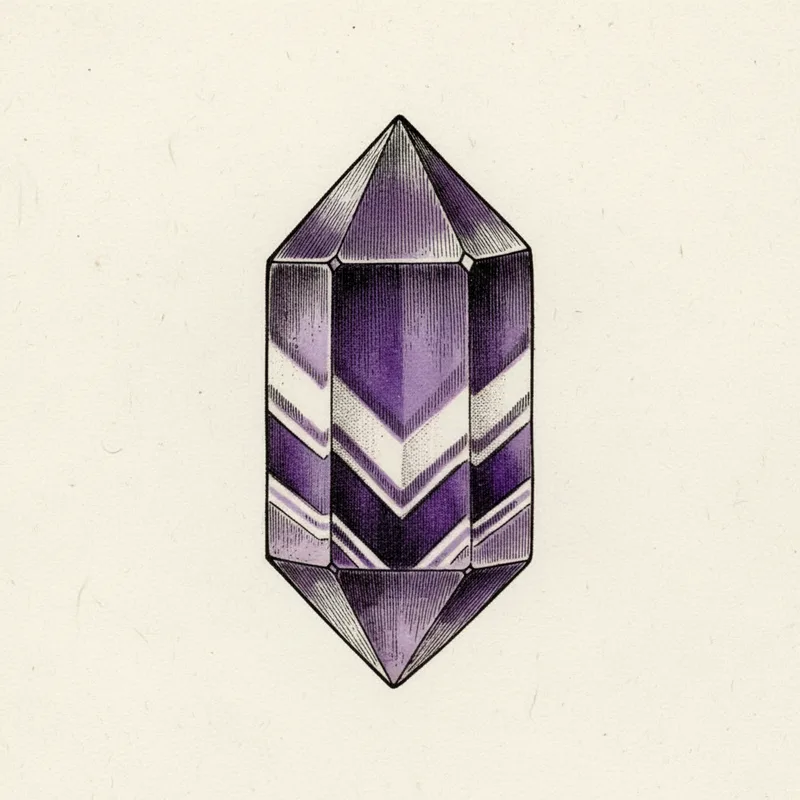
The characteristic V-shaped chevron pattern is a direct record of these alternating fluid pulses. Quartz grows fastest along its c-axis, so each pulse of mineralization advances the crystal face forward while the outer edges of neighboring crystals meet in a seam. Viewed in cross section, the layers stack like nested arrowheads pointing toward the termination. The sharper and more uniform the banding, the more rhythmic the original fluid cycling, which usually indicates a relatively stable pocket with repeated recharge events rather than a single rapid fill.
Unlike pure amethyst, which typically grows as isolated terminations lining a geode, chevron material forms where the cavity filled more completely, producing massive banded aggregates rather than pointed crystals. This is why chevron is almost always sold as tumbled pieces, polished spheres, or slabs rather than as single crystals. The milky quartz layers are also why chevron reliably fluoresces only weakly under UV compared to clearer amethyst, since the inclusion-rich bands scatter much of the incoming light.
Identification Guide
Chevron amethyst is identified first by the alternating purple and white banding, which follows the growth zones of the original crystal and is visible on any cut or broken surface. Under a loupe, the boundary between layers is sharp but irregular, often showing tiny zigzag steps where crystal faces met. Hardness runs a full 7 on Mohs across both color zones, which distinguishes it from banded fluorite or banded calcite imitators that are much softer. Specific gravity sits at 2.63 to 2.65, consistent with any quartz variety.
The stone is uniaxial positive with a refractive index of 1.544 to 1.553, and the purple zones show weak pleochroism from reddish-violet to bluish-violet when rotated. White bands are never perfectly opaque under strong light, and they transmit a soft internal glow that dyed imitators cannot replicate. Natural chevron never shows dye concentration along fractures, and the white quartz bands should feel continuous with the purple bands rather than looking painted on the surface. A streak test on unglazed porcelain produces white with no color transfer.
Spotting Fakes
The most common fake is assembled or doublet material, where a slice of pale amethyst is glued to a slice of white quartz to mimic banding. Check the edge of any polished piece under 10x magnification for a glue line, trapped air bubbles along the seam, or a too-perfectly-straight boundary between colors. Genuine chevron banding follows curved crystal growth fronts and always shows subtle irregularities, while glued assemblies show a single flat plane. Heat from sustained hand contact will sometimes soften older epoxy and produce a faint chemical odor. The second concern is heat-treated or irradiated white quartz dyed to look like banded amethyst. A cotton swab dipped in pure acetone, rubbed firmly on an inconspicuous area, will lift surface dye on treated pieces. Dyed material also usually shows color concentration in fractures and pits, and the purple looks flat and uniform rather than showing the slight color zoning visible in natural amethyst. Under shortwave UV, genuine chevron shows only a faint response, while some synthetic dyes fluoresce a bright pink or orange that never occurs in natural quartz.
Cultural & Metaphysical Traditions
Presented as cultural traditions, not scientific evidence
Chevron amethyst is a modern trade name, popularized in the 1970s lapidary market, that blends older Greek and Roman traditions around amethyst as a stone of clarity with newer metaphysical associations tied to the white quartz component. Contemporary crystal healing culture frames it as a stone that pairs the purifying symbolism of milky quartz with the introspective symbolism of amethyst, and it is often called Dream Amethyst in English-language shops for its association with dream recall journaling practices. Historical sources do not distinguish chevron material from other amethyst in ancient use.
Where It's Found
Historic source of deeply saturated chevron material with sharp V-banding; mined since the nineteenth century.
Produces chevron amethyst in large geodes with crisp alternation of violet and snow-white quartz layers.
Common source of tumbled and carved chevron, usually from altered pegmatite veins with moderate color.
Yields softer-hued chevron with wider white bands; widely used for beads and cabochons.
Price Guide
Good to Know
Scratch test: At hardness 7, Chevron Amethyst can scratch glass and steel. It's durable enough for any type of jewelry.
Sources: Found in 4 notable locations worldwide, from Vidnoye and Ural Region to Madhya Pradesh.
Heft test: Chevron Amethyst has average mineral density (2.63-2.65). It feels about as heavy as you'd expect from a stone its size.
Explore More
Stay in the loop
From the Almanac
Updates from Crystal Almanac, when there’s something worth sharing.