Quick Facts
Formation & Origin
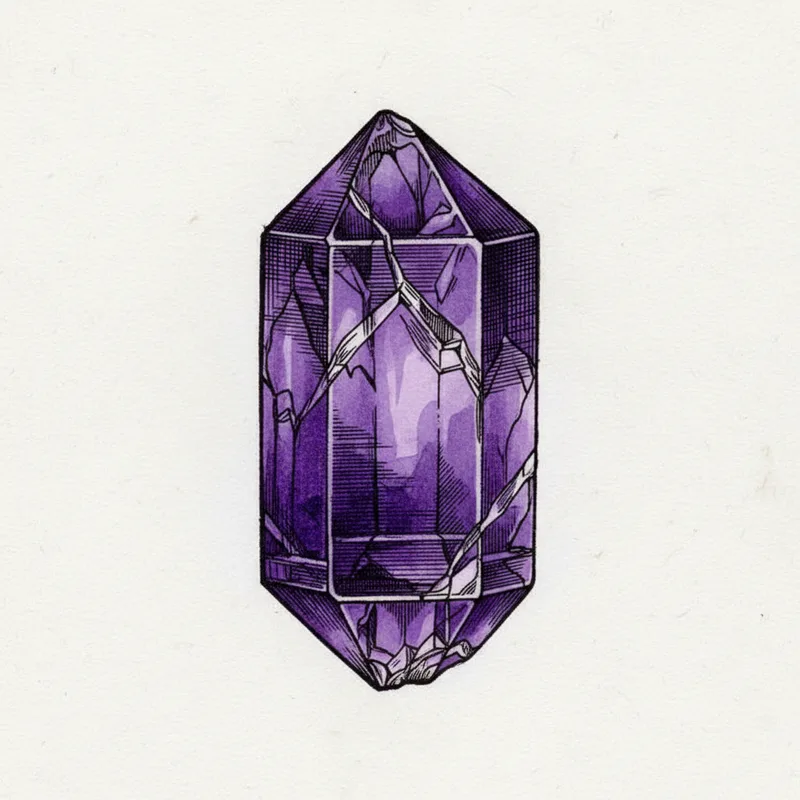
Amethyst forms in volcanic rock cavities called geodes. When silica-rich groundwater seeps through volcanic rock, it slowly deposits layers of quartz crystals over millions of years. The purple color comes from trace amounts of iron (Fe³⁺) and natural irradiation within the Earth's crust. The intensity of the color depends on the concentration of iron and the amount of radiation the crystal receives during formation.
Cathedral geodes from Uruguay can reach over two meters tall, their interiors lined with deep violet crystals that took tens of millions of years to grow. In Brazil's Rio Grande do Sul, entire basalt flows contain hollow cavities that became crystal-lined chambers, some large enough to stand inside.
Identification Guide
Amethyst is relatively easy to identify by its distinctive purple color and hexagonal crystal habit. It has a Mohs hardness of 7, meaning it cannot be scratched by a steel knife. The color ranges from pale lavender to deep royal purple, often with color zoning visible as angular bands within the crystal.
Unlike purple fluorite (which it's sometimes confused with), amethyst has no cleavage and breaks with a conchoidal fracture. Under UV light, some amethyst specimens will fluoresce a weak blue-green. It's also significantly harder than fluorite (7 vs 4 on the Mohs scale).
Spotting Fakes
Heat-treated citrine is often sold as 'burnt amethyst.' Look for an unnatural orange-yellow color and lack of color zoning. Synthetic amethyst is nearly identical to natural but tends to have more uniform color without the banding seen in natural specimens. Glass imitations feel warm to the touch compared to real quartz, which remains cool. If a dealer claims an amethyst is from a high-value locality, ask for provenance documentation.
Cultural & Metaphysical Traditions
Presented as cultural traditions, not scientific evidence
Revered since antiquity. The ancient Greeks believed amethyst could prevent intoxication (the name derives from 'amethystos,' meaning 'not drunk'). Medieval European soldiers wore amethyst amulets for protection in battle. In Tibetan Buddhist tradition, amethyst rosaries are considered aids to meditation. Contemporary crystal practitioners associate it with mental clarity, emotional balance, and restful sleep.
Where It's Found
World's largest producer of amethyst geodes
Deep saturated color, cathedral geodes
Exceptional clarity and gem-grade material
Fine druzy specimens with delicate crystal points
Price Guide
Good to Know
Scratch test: At hardness 7, Amethyst can scratch glass and steel. It's durable enough for any type of jewelry.
Sources: Found in 4 notable locations worldwide, from Brazil to South Korea.
Heft test: Amethyst has average mineral density (2.65). It feels about as heavy as you'd expect from a stone its size.
Explore More
Quartz & Chalcedony
The Calming Collection
The ancient Greeks' anti-anxiety stone. Its name literally means 'not intoxicated' - they believed it calmed the mind.
The Protection Collection
Medieval European soldiers wore amethyst amulets for protection in battle. The stone has been associated with sobriety and clear-headedness since antiquity.
The Meditation Collection
Tibetan Buddhist tradition uses amethyst rosaries for meditation. Its purple color and accessible price make it the most widely used meditation crystal.
The Sleep Collection
The most popular sleep crystal worldwide. Medieval Europeans placed it under pillows. Tibetan tradition uses it in sleep-adjacent meditation. Its purple color and calming associations make it the default choice for the bedside.
The Beginner's Collection
The perfect first crystal. Purple quartz colored by iron and natural radiation - real geology you can see. Widely available for $3-15, instantly recognizable, and represents the entire quartz family.
The Healing Collection
Greek physicians prescribed amethyst for sobriety and clear thinking. Medieval healers used it for pain relief and as an antidote to poison. The most historically documented healing crystal in the Western tradition.
The Travel Collection
Medieval European travelers carried amethyst as protection against intoxication and poor judgment - practical concerns on long journeys through inns and markets.
The Grief Collection
Medieval healing traditions used amethyst specifically for grief. Its calming properties and association with spiritual protection made it the standard stone for the bereaved in European tradition.
Best Crystals for Grief and Loss
Best Crystals for Confidence and Self-Esteem
Best Crystals for Manifestation: A Practical Guide
Mohs Hardness Scale
See where Amethyst sits on the scale
Crystal Care Guide
Water safety, sunlight, and handling tips
Stay in the loop
From the Almanac
Updates from Crystal Almanac, when there’s something worth sharing.