Quick Facts
Formation & Origin
Demantoid is the green gem variety of andradite garnet, a calcium-iron silicate that crystallizes in serpentinized ultramafic rocks and skarns. The Russian Ural deposits formed when chromium-bearing chromite grains were partially altered during the serpentinization of peridotite. Hot, chemically active fluids mobilized calcium, iron, and silicon into cavities, where andradite crystallized around relict chromite cores.
The trademark green color comes from trace chromium (Cr³⁺) substituting into the garnet structure. Stones colored by iron alone tend toward yellowish or brownish green and are sometimes sold as 'topazolite'. True emerald-green demantoid requires chromium, which is why the chromite-rich Russian deposits produce the most saturated colors.
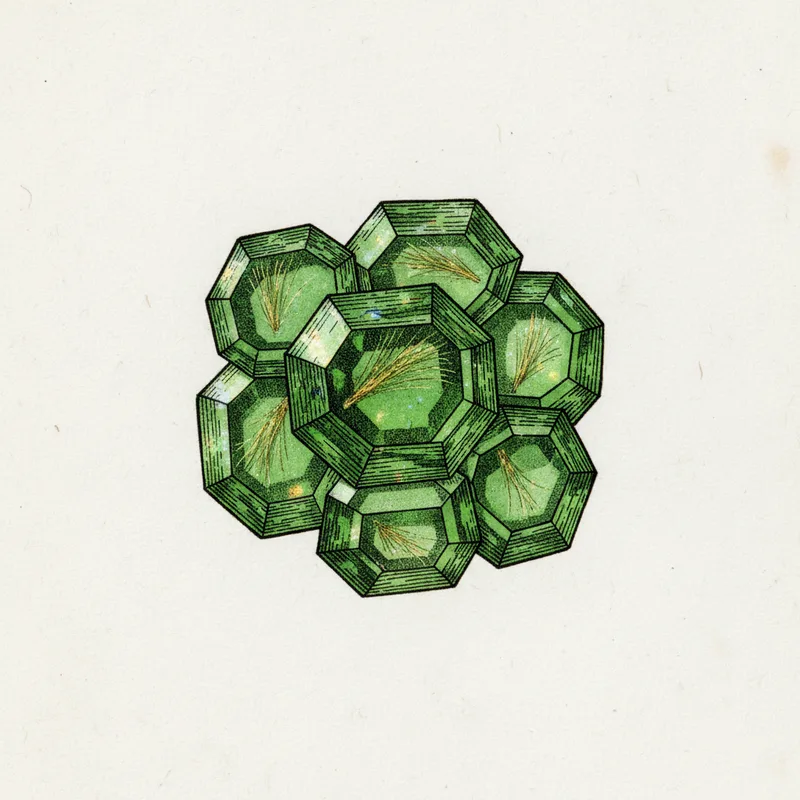
Russian material commonly contains byssolite (a fibrous chrysotile asbestos variety) growing outward from a central chromite crystal, forming delicate golden filaments known as 'horsetail' inclusions. These are diagnostic for Ural-origin demantoid and are prized rather than penalized. Namibian and Madagascan demantoid lacks horsetails but often exceeds Russian material in clarity and size.
Identification Guide
Demantoid is identified by its extraordinary dispersion of 0.057, higher than diamond's 0.044, which gives faceted stones visible rainbow flashes of fire. Its refractive index (1.880-1.889) is one of the highest of any gem garnet. Specific gravity runs 3.82-3.85, and the stone is singly refractive as expected for a cubic mineral.
Horsetail inclusions (radiating golden byssolite fibers around a dark chromite center) are diagnostic for Russian Ural origin and visible under 10x magnification. Namibian stones typically show thin fluid inclusions or are clean. The adamantine luster (from which the name 'demantoid', Dutch for 'diamond-like', is derived) distinguishes it from other green garnets.
Spotting Fakes
The most common substitutes are synthetic green garnets: YAG (yttrium aluminum garnet) and GGG (gadolinium gallium garnet), both produced since the 1960s. Natural demantoid fluoresces weakly or not at all under shortwave UV, while synthetic YAG often fluoresces strongly orange or yellow. Tsavorite garnet is a natural green stone often confused with demantoid but has a lower refractive index (1.740 vs 1.88) and lacks horsetail inclusions. Glass imitations show gas bubbles and swirl marks under a 10x loupe and lack demantoid's high dispersion. Because demantoid is singly refractive, a polariscope test alone will not separate it from glass or synthetic garnets, so a refractometer reading is essential. Any stone sold as 'Russian demantoid' should show horsetail inclusions under magnification. Certificates from GIA, SSEF, or Gübelin confirming Ural origin add significant value.
Cultural & Metaphysical Traditions
Presented as cultural traditions, not scientific evidence
Demantoid rose to fame in the late 1800s when it became a favorite of the Russian imperial court and featured in Fabergé jewelry. Crystal practitioners associate its green fire with vitality, creative courage, and manifestation, connecting the heart chakra to the solar plexus. Traditional Russian lore considered it a stone of abundance and loyalty, often exchanged between close friends.
Where It's Found
Historic source since 1868, only origin with diagnostic horsetail inclusions
Modern source since the mid-1990s, clean stones with vivid color
Discovered 2009, often larger stones but lacks horsetail inclusions
Smaller modern source producing yellowish-green material
Price Guide
Good to Know
Scratch test: At hardness 6.5, Demantoid resists scratching from a knife but can be scratched by quartz. Best for pendants and earrings rather than rings.
Sources: Found in 4 notable locations worldwide, from Russia to Iran.
Heft test: Demantoid has a specific gravity of 3.82-3.85 - noticeably heavier than quartz. You'll feel the density when you pick it up.
Related Minerals
Parent species, demantoid is the green variety
Rival green garnet from the grossular species
Yellow andradite variety, demantoid's iron-only cousin
Explore More
Stay in the loop
From the Almanac
Updates from Crystal Almanac, when there’s something worth sharing.