Quick Facts
Formation & Origin
Euclase forms in beryllium-rich pegmatites and the low-temperature hydrothermal veins that cut through them. In the classic Ouro Preto deposits of Minas Gerais, Brazil, the finest blue crystals grew in quartz veins that crosscut older beryl-bearing pegmatites. As late-stage fluids circulated, they dissolved beryllium from the host beryl and redeposited it as euclase under cooler, wetter conditions, which is why this mineral carries a hydroxyl group while beryl does not.
The Colombian Gachalá euclase is a geological cousin of the region's famous emeralds. Both formed in the same hydrothermal system, where hot brines traveled through black shales and carbonate rocks, pulling chromium and vanadium into solution before dropping their loads in calcite veins. The vivid neon blue of the finest specimens comes from iron in trigonal coordination, a rare electronic configuration that produces a color saturation unmatched by any other blue silicate.
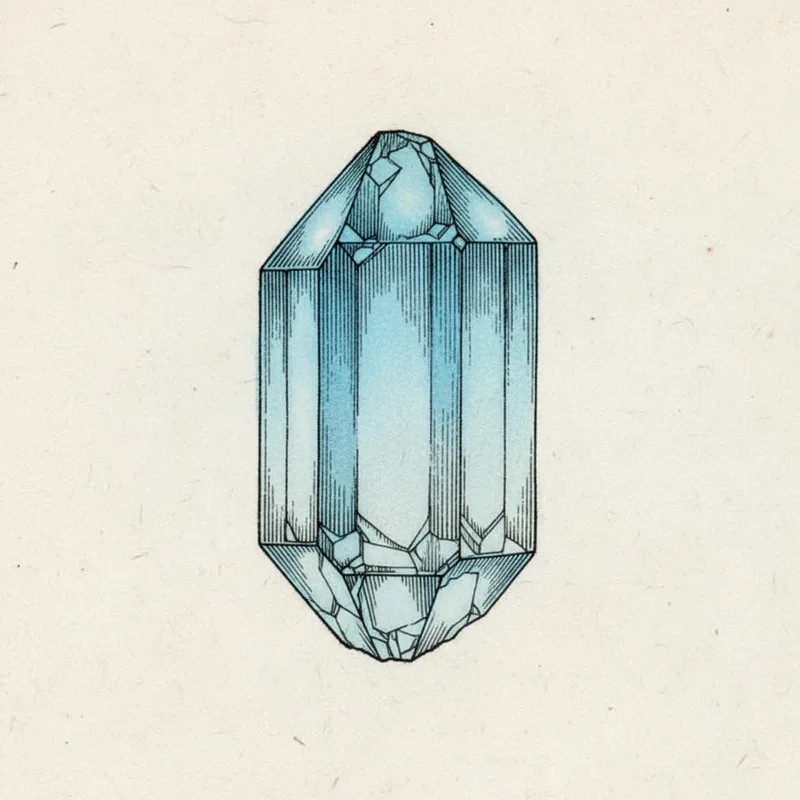
Because euclase crystals grew slowly in confined spaces, they often show complex prism faces and sharp terminations. The name itself captures the mineral's defining structural feature. Greek roots eu (good) and klasis (cleavage) describe the perfect one-direction cleavage parallel to the 010 face, a property that makes the crystals beautiful to collectors but notoriously difficult for faceters.
Identification Guide
Euclase is a monoclinic silicate with refractive indices between 1.65 and 1.67 and a specific gravity near 3.10. These numbers separate it cleanly from its two main lookalikes, blue topaz and aquamarine. The mineral shows a vitreous luster, clear transparency in gem material, and a white streak. Crystals are typically prismatic with sharp terminations and often appear in quartz matrix.
The defining diagnostic feature is perfect cleavage in one direction. Under magnification, cleavage traces appear as parallel planes running the length of the crystal. Faceted stones sometimes show internal cleavage feathers that catch light unevenly. Birefringence of about 0.02 produces visible doubling of back facet edges when viewed through the table of a larger cut stone.
Color ranges from colorless through pale yellow and green to the prized sky blue and neon blue of Brazilian and Colombian specimens. Hardness is 7.5 on the Mohs scale, slightly softer than topaz at 8 and comparable to garnet. Heft is noticeably greater than aquamarine, which helps in hand-sorting mixed parcels.
Spotting Fakes
The main confusion risk is blue topaz, which shares euclase's color range and is far more common. Refractive index settles this quickly. Topaz reads 1.61 to 1.62 on a refractometer, while euclase reads 1.65 to 1.67. Any standard gemological refractometer separates them in seconds. Aquamarine is the second look-alike. Its color tends to be lighter and more cyan, and its specific gravity of 2.7 is dramatically lower than euclase at 3.10. A simple heft comparison, two similar-sized stones in each hand, reveals the difference immediately. Hydrostatic weighing confirms it. Blue cubic zirconia and blue glass are occasional substitutes in costume pieces. Cubic zirconia is singly refractive, so it shows no doubling of back facets under a loupe, while euclase is anisotropic and does. Glass shows swirl marks, rounded facet edges, and gas bubbles under 10x magnification. Synthetic euclase does not exist in any commercial quantity. The mineral is too niche and the market too small to justify flux or hydrothermal production, so buyers can largely rule out synthetic origin for any stone offered as euclase.
Cultural & Metaphysical Traditions
Presented as cultural traditions, not scientific evidence
A latecomer to metaphysical literature because of its rarity, euclase is treated in modern practice as a stone of clear communication and honest self-expression. Crystal practitioners associate the blue varieties with the throat chakra and describe the stone as supporting truthful speech, decisive thinking, and the release of self-deception. Some traditions pair it with emerald for heart-and-voice alignment, a reference to its frequent co-occurrence with emerald in Colombian deposits. These associations are cultural rather than scientific, offered here as modern folklore rather than fact.
Where It's Found
Classic locality for deep blue crystals in quartz veins cutting beryl pegmatites
Rare neon blue euclase found alongside emeralds in the same hydrothermal system
Pale blue to colorless crystals from lithium-bearing pegmatites
Historic source, pale green to colorless material from placer deposits
Price Guide
Good to Know
Scratch test: At hardness 7.5, Euclase can scratch glass and steel. It's durable enough for any type of jewelry.
Sources: Found in 4 notable locations worldwide, from Brazil to Russia.
Heft test: Euclase has average mineral density (3.05–3.10). It feels about as heavy as you'd expect from a stone its size.
Related Minerals
Chemical parent, beryllium silicate without hydroxyl
Look-alike blue gem, aluminum silicate with fluorine or hydroxyl
Hydrothermal associate in Colombian Gachalá deposits
Explore More
Stay in the loop
From the Almanac
Updates from Crystal Almanac, when there’s something worth sharing.