Quick Facts
Formation & Origin
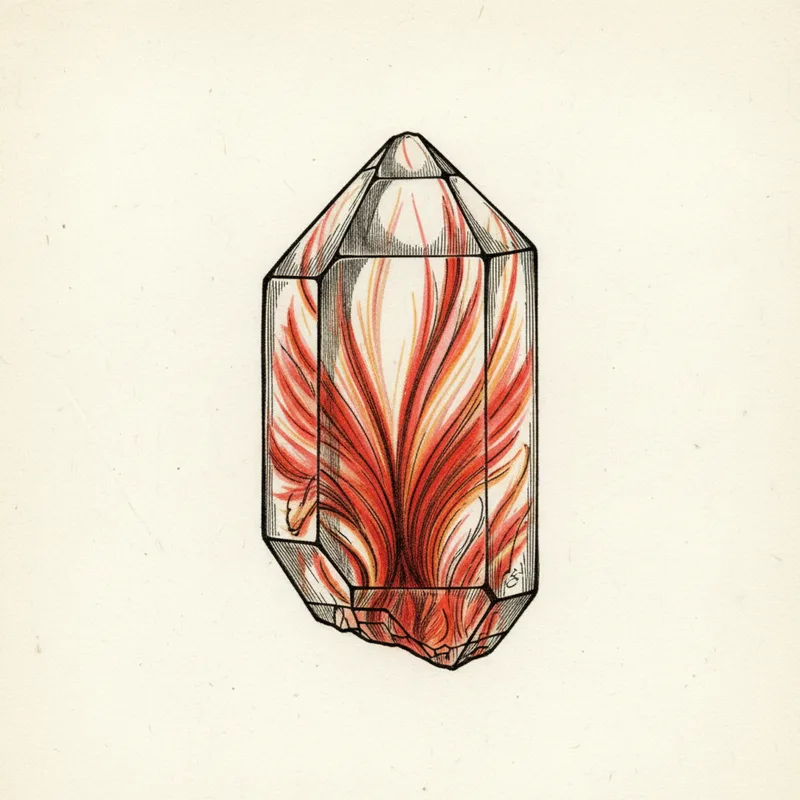
Fire quartz is a standard clear or smoky quartz that happened to crystallize in an iron-rich environment. Hydrothermal silica solutions percolated through fractures in host rock carrying both dissolved SiO₂ and fine suspended particles of iron oxides. As temperature and pressure dropped, quartz began to precipitate, and the growing crystal front captured these iron-oxide particles and locked them inside the lattice.
The dramatic flame, starburst, and cloud patterns are a record of growth dynamics. Hematite (Fe₂O₃) gives the vivid red and the metallic flecks, while limonite and goethite (both FeO(OH)) produce the softer orange, yellow, and rust tones. When inclusions settled slowly in a still growth environment they formed clouds. When quartz grew quickly across a hematite plate, the fragments were fanned out into radiating flame shapes. The starburst pattern prized in Madagascar harlequin quartz forms when a single hematite crystal was shattered and its pieces swept outward along the quartz growth front.
The color is entirely from the inclusions. The quartz host itself is colorless or smoky. Viewed under a loupe, individual iron-oxide particles, platelets, and needles are visible as discrete objects suspended in otherwise clean quartz.
Identification Guide
Fire quartz is recognized by clear or smoky quartz with discrete, visible iron-oxide inclusions rather than an evenly tinted body color. Under a 10x loupe you should see individual particles, plates, or fibrous bundles, not a uniform wash of color. Hardness is 7 on the host quartz, and fracture is conchoidal. Specific gravity sits right at 2.65 for typical material, creeping slightly higher when a specimen is densely loaded with hematite.
The inclusions themselves are softer than the host. Hematite runs 5 to 6, limonite and goethite sit around 5 to 5.5. This does not meaningfully lower the bulk hardness, because the quartz matrix dominates. A steel file will not scratch a fire quartz surface. Under magnification the inclusions often show metallic reflections (hematite) or earthy dull reflections (limonite). Streak tested on an exposed inclusion will run red-brown, confirming iron oxide.
Spotting Fakes
Three common fakes and mislabels circulate under the fire quartz name. First, heat-treated or irradiated quartz that fakes a red-orange color. This material shows uniform tone throughout the body rather than discrete inclusions. Hold it to strong light. If the color is a smooth wash with no visible particles under a loupe, it is treated quartz, not natural fire quartz. Second, glass with iron-oxide dusting or surface coating. Under 10x magnification look for round gas bubbles, swirl marks, and coating that stops at the surface rather than extending through the interior. Real inclusions are three-dimensional and suspended throughout the host. Third, 'cherry quartz,' which is manufactured red glass with no crystalline structure. It is legitimate material but is not quartz. Cherry quartz shows suspended red streaks or veils inside clear glass, feels warmer to the touch than real quartz (glass is a poorer thermal conductor), contains spherical bubbles, and has a softer hardness around 5 to 6. A quick scratch test on an inconspicuous spot settles it.
Cultural & Metaphysical Traditions
Presented as cultural traditions, not scientific evidence
Modern crystal practitioners associate fire quartz with grounded vitality, pairing the amplifying qualities traditionally attributed to clear quartz with the stabilizing and protective associations given to hematite. Malagasy stone traders marketed the harlequin material heavily from the late twentieth century as a courage stone. In broader metaphysical literature it is used as a focus stone for motivation, willpower, and physical endurance. These associations are cultural and symbolic rather than scientifically established.
Where It's Found
The classic 'harlequin' material, clear quartz with vivid red hematite starbursts
Large smoky and clear points with limonite cloud and flame inclusions
Commercial tumbled material, often heavier limonite and goethite content
Quartz clusters with scattered hematite plates and red iron staining
Price Guide
Good to Know
Scratch test: At hardness 7, Fire Quartz can scratch glass and steel. It's durable enough for any type of jewelry.
Sources: Found in 4 notable locations worldwide, from Madagascar to United States.
Heft test: Fire Quartz has average mineral density (2.65 (slightly higher with dense hematite inclusions)). It feels about as heavy as you'd expect from a stone its size.
Explore More
Stay in the loop
From the Almanac
Updates from Crystal Almanac, when there’s something worth sharing.