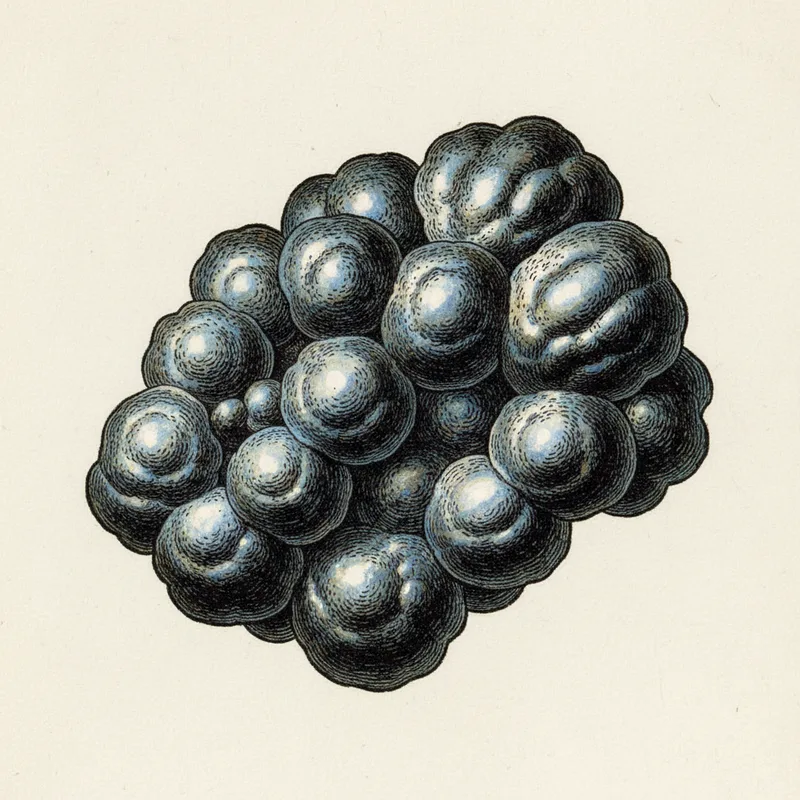
Hematite
The Blood Stone
Affiliate links. We may earn a commission, at no cost to you.
Quick Facts
Formation & Origin
Hematite is the most important iron ore on Earth and one of the most abundant minerals in the crust. It forms across a staggering range of environments - from volcanic fumaroles to ancient ocean floors to the surface of Mars (hematite is what makes Mars red).
The most geologically significant hematite deposits are banded iron formations (BIFs) - layered sedimentary rocks laid down 2-3 billion years ago when Earth's atmosphere had almost no oxygen. Iron dissolved in ancient oceans was oxidized by the first photosynthetic organisms, precipitating as layers of hematite alternating with silica. These deposits, found in Australia, Brazil, South Africa, and the American Iron Range, contain the vast majority of the world's iron ore.
Specimen-quality hematite takes many forms: specular hematite (flat, mirror-like crystals), kidney ore (smooth, rounded botryoidal masses), iron roses (thin, overlapping tabular crystals arranged like petals), and massive earthy hematite used as red pigment since prehistory.
Identification Guide
Hematite's most diagnostic feature is its red-brown streak - regardless of whether the specimen appears metallic silver, steel gray, or earthy red, the streak is always red-brown. This is the test. No other common metallic mineral has a red streak.
At hardness 5.5, hematite can be scratched by a steel file but not by a copper coin. Its high specific gravity (5.26) gives it a distinctive heft - hematite feels noticeably heavy for its size. Metallic varieties show a mirror-like luster on fresh surfaces. Magnetic hematite (sold as 'magnetic hematite' in crystal shops) is usually synthetic ceramic, not genuine hematite - real hematite is not magnetic.
Spotting Fakes
'Magnetic hematite' is the biggest fraud in the hematite market. Real hematite is not magnetic (or only very weakly so). The magnetic black beads sold everywhere are synthetic barium-strontium ferrite ceramic - a manufactured material with no geological value. If it sticks to a magnet, it's not hematite. Genuine hematite beads are non-magnetic, very heavy, and leave a red-brown streak when scratched on unglazed porcelain.
Some links in this post go to Amazon. Crystal Almanac earns a commission from qualifying purchases at no extra cost to you. Tools recommended here are ones we would use ourselves to run the tests described - the recommendation comes first, the link is downstream of it.
Cultural & Metaphysical Traditions
Presented as cultural traditions, not scientific evidence
The name comes from the Greek 'haima' meaning blood, referring to the red streak and the red color of hematite powder. Ancient Egyptians placed hematite in tombs. Roman soldiers rubbed hematite on their bodies before battle, believing it made them invincible. Native American peoples used earthy hematite as red ochre pigment for cave paintings and ceremonial body paint. Modern practitioners associate it with grounding, protection, and mental focus.
Metaphysical and “healing” associations are cultural traditions, not medical advice or scientific fact. Crystals are not a substitute for professional medical care.
Where It's Found
Massive deposits, specular and botryoidal forms
Classic kidney ore (botryoidal) specimens
Rose-form crystal clusters, popular display pieces
Iron Range deposits, banded iron formation
Price Guide
Good to Know
Scratch test: At hardness 5.5, Hematite resists scratching from a knife but can be scratched by quartz. Best for pendants and earrings rather than rings.
Global supply: Found in 4 notable locations worldwide, from Brazil to United States.
Heft test: With a specific gravity of 5.26, Hematite feels surprisingly heavy for its size. This weight is actually a useful identification tool.
Common Questions
What is the chemical formula of Hematite?
The chemical formula of Hematite is Fe₂O₃.
What is Hematite's Mohs hardness?
Hematite has a Mohs hardness of 5.5 on the 1 to 10 Mohs scale, hard enough to scratch glass but softer than quartz.
Is Hematite a mineral?
Yes. Hematite is a naturally occurring mineral (Oxide Group) with a definite chemical composition and an ordered crystal structure.
Care & Safety
The water, salt, and sunlight questions people actually ask before cleansing or displaying hematite, answered from its hardness (Mohs 5.5) and chemistry (Fe₂O₃).
Can Hematite go in water?
Not recommended. Iron oxide can rust when submerged. Brief rinse is tolerable but prolonged soaking causes surface deterioration.
Can Hematite go in salt water?
No. Hematite is best kept away from water altogether, and salt water is the harsher version of that problem: the dissolved salt is corrosive while the stone is wet, then leaves gritty crystals behind in cracks and crevices as it dries. Hematite's iron content also makes rust staining likely if salt residue sits on the surface.
Sources & References
The mineralogical and gemological data on this page is drawn from and can be cross-checked against these external references.
- WikipediaHematite on Wikipedia
- WebmineralHematite mineral data (Webmineral)
- Handbook of MineralogyHematite (Handbook of Mineralogy, PDF)
Related Minerals
Iron oxide that IS magnetic, unlike hematite
Iron oxyhydroxide, forms from weathered hematite
Iron titanium oxide, similar appearance
Another metallic mineral, golden vs silver
Explore More
Oxide & Hydroxide Minerals
The Protection Collection
Roman soldiers rubbed it on their bodies believing it made them invincible. The name means 'blood stone' in Greek.
The Grounding Collection
Specific gravity 5.26 - it feels shockingly heavy. The physical weight creates an immediate sense of substance and connection to earth.
The Confidence Collection
Specific gravity 5.26 - almost three times heavier than typical quartz. The physical weight creates an immediate, grounding sense of substance. Roman soldiers literally rubbed it on their bodies.
How to Protect Crystals from Summer Heat and Sunlight
The Surprisingly Recent History of Crystal Healing
Best Crystals for Grounding and Stability
Mohs Hardness Scale
See where Hematite sits on the scale
Crystal Care Guide
Water safety, sunlight, and handling tips
Save This Stone

Keep this hematite reference handy. Save the card to a Pinterest board and the profile is one tap away.
Save to PinterestStay in the loop
From the Almanac
Updates from Crystal Almanac, when there’s something worth sharing.