Quick Facts
Formation & Origin
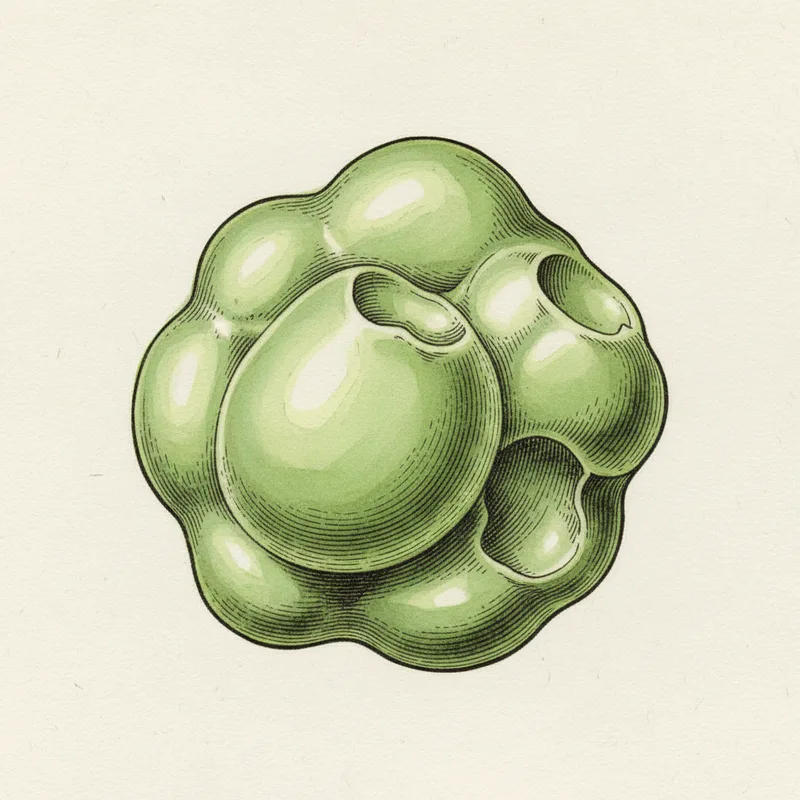
Green opal, like all opal, is hydrated amorphous silica. It forms when silica-rich groundwater percolates through fractures, voids, and weathered volcanic rock, slowly depositing silica gel as water evaporates or pressure drops. Unlike quartz, the silica never arranges itself into a true crystal lattice. Instead, it solidifies as a glass-like amorphous solid riddled with microscopic water pockets, typically 3 to 10 percent water by weight.
The green color comes from trace impurities, not from the silica itself. Two mechanisms dominate. In Tanzanian and some Peruvian material, nickel substitutes into silicate nanostructures within the opal, producing the same apple green hue seen in garnierite and related nickel ores. In Oregon and many Madagascan specimens, the green comes from chlorite or celadonite micro-inclusions, iron-magnesium sheet silicates suspended throughout the opal matrix.
Because green opal is common opal, or potch, it lacks the precisely ordered silica spheres that diffract light into the rainbow play of color seen in precious opal. The internal spheres are either too small, too large, or too irregularly packed to produce spectral flash. What you get instead is pure body color, often with a soft waxy glow as light scatters through the hydrated silica.
Identification Guide
Green opal reads as softly glassy with a waxy, almost frosted surface rather than the sharp vitreous polish of chalcedony. Hardness sits near 6, so a steel file will scratch it and quartz will scratch it easily. Conchoidal fracture is diagnostic. Broken edges curve like chipped glass, and fresh surfaces often show a subtle pearly internal sheen. Specific gravity is noticeably low for a silicate, around 2.0 to 2.2, so pieces feel lighter in the hand than jade or chrysoprase of comparable size.
Distinguish green opal from chrysoprase (harder, more translucent, brighter apple-green glow), serpentine (softer, greasier luster, often fibrous), and dyed green chalcedony (uniform saturated color with no internal depth). Genuine opal is surprisingly warm against the skin compared to glass and tends to show faint internal cloudiness rather than perfect clarity. The hydrated nature matters for handling. Green opal can lose water over years in dry conditions and develop fine surface crazing, a network of hairline cracks that glass and chalcedony never show.
Spotting Fakes
Most fake green opal on the market is either green glass or dyed chalcedony sold as 'African opal' or 'Andean jade.' Glass imitations reveal themselves under a 10x loupe. Look for perfectly round gas bubbles frozen in the matrix and swirl marks from casting. Glass also feels distinctly colder to the touch than real opal, which has low thermal conductivity and warms quickly. Tap two pieces lightly. Glass gives a sharp ring, opal a duller click. Dyed material is the more common fraud. Wipe the stone with a cotton swab dampened in acetone or rubbing alcohol. Any green color transferring to the swab confirms surface dye. Inspect drill holes and cracks under magnification. Dyes pool and darken along fractures, while natural coloration is evenly distributed through the body. A third trick is heat check. Real opal should never be subjected to hot water or heat, but on a suspect piece a drop of warm water on an unpolished edge can sometimes darken dye lines. Finally, be wary of uniform bright emerald-green material priced well below chrysoprase. Genuine green opal runs from soft mint to olive, rarely the saturated pure green of dyed stock.
Cultural & Metaphysical Traditions
Presented as cultural traditions, not scientific evidence
Ancient Romans associated opal generally with hope and purity, and Pliny the Elder ranked it among the most precious gems. Green opal specifically entered European lapidary traditions as a stone of emotional renewal and connection to growing things. Modern crystal practitioners place green opal at the heart chakra for gentle emotional healing, forgiveness work, and reconnecting with nature after periods of stress. It is often paired with rose quartz in grief rituals.
Where It's Found
Mint and apple green common opal from Andean copper districts
Vivid apple green colored by nickel-bearing silicates
Translucent olive to mint green nodules from altered volcanic tuff
Opaque moss green material, often banded with white
Price Guide
Good to Know
Scratch test: At hardness 6, Green Opal resists scratching from a knife but can be scratched by quartz. Best for pendants and earrings rather than rings.
Sources: Found in 4 notable locations worldwide, from Peru to Madagascar.
Heft test: With a specific gravity of 2.00–2.20, Green Opal feels lighter than most minerals. This lightness can help identify it.
Related Minerals
Same hydrated silica, but with ordered spheres producing play of color
Nickel-colored green silica, but crystalline chalcedony rather than amorphous
Regional variety including green, blue, and pink common opal from the Andes
Stay in the loop
From the Almanac
Updates from Crystal Almanac, when there’s something worth sharing.