Quick Facts
Formation & Origin
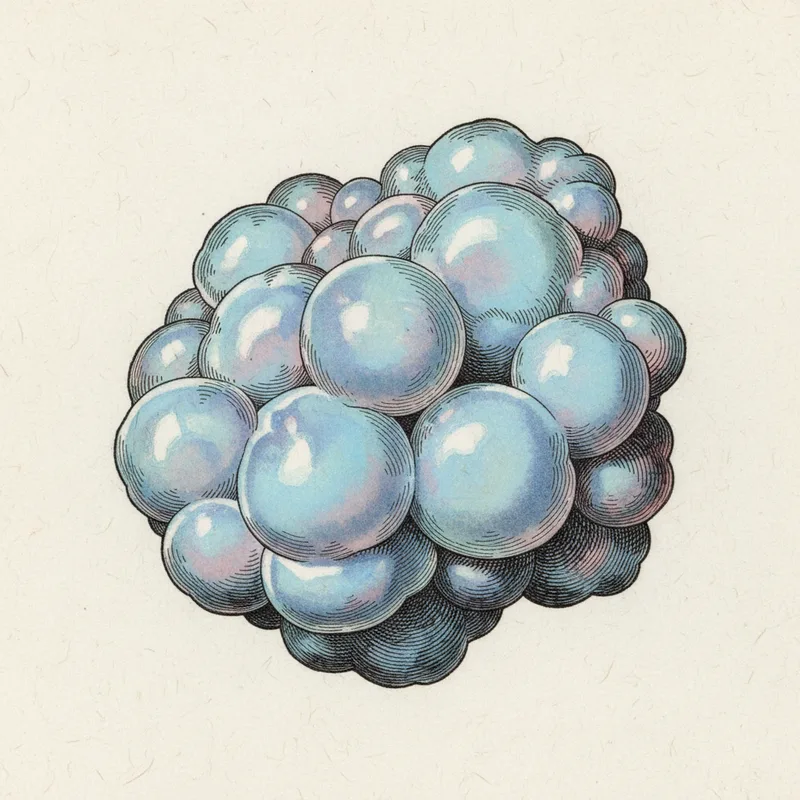
Peruvian opal is common opal formed in a very specific geological setting, the porphyry copper belt of the Andes. Tens of millions of years of subduction along the western edge of South America drove andesitic and dacitic magmas upward into the crust. As these intrusions cooled, they released hot, silica-rich hydrothermal fluids that also carried copper, iron, and other metals. Where those fluids met cooler host rock and shallow groundwater, silica precipitated into fractures, vugs, and altered wall rock as amorphous opal.
The stone's distinctive palette traces back to the same fluids that deposited Peru's copper ores. The celebrated sky-blue Peruvian opal owes its color to trace copper, frequently in the form of submicroscopic chrysocolla inclusions or copper-bearing silicate nanostructures distributed through the opal matrix. Pink varieties pick up their hue from organic compounds, fine hematite, or manganese oxides absorbed during deposition. Green material draws on the same nickel and chlorite chemistry seen in other green common opals. Because deposition happened slowly and from multiple fluid pulses, a single specimen can show banded zones of blue, green, pink, and cream.
As hydrated amorphous silica, Peruvian opal contains roughly 3 to 10 percent water locked into its structure, and exceptional pieces can run higher. Like all common opal, it lacks the ordered silica sphere packing that produces the rainbow play of color seen in Australian or Ethiopian precious opal. The beauty is in the body color and the translucency, a cloudy inner glow rather than spectral fire.
Identification Guide
Peruvian opal shows a soft, almost milky translucency, most visible when a cabochon is held against a light source. Colors are characteristically pastel. Saturated electric blues or hot pinks are a red flag for dye. The sky-blue variety often carries faint dendritic or cloudy inclusions from its copper-rich parent fluids, and pink material frequently shows darker matrix veining from the host andesite. Hardness runs near 6, conchoidal fracture is clean, and specific gravity sits low at 2.0 to 2.2, so pieces feel light for their size.
Because the opal retains structural water, long exposure to dry heat, direct sun, or ultrasonic cleaners can cause crazing, a fine network of surface cracks that permanently cloud the stone. Pieces from older parcels sometimes show early crazing as a diagnostic sign of authenticity. Distinguish Peruvian blue opal from chrysocolla (softer, often streakier, bluer), larimar (banded white and blue pectolite, harder at 4.5 to 5 and higher SG), and hemimorphite (much higher SG, often druzy). Peruvian pink opal is most often confused with rhodonite (pink with black manganese veins, harder) and dyed pink howlite (the dominant fake in the market).
Spotting Fakes
The most common Peruvian opal fraud is dyed howlite or dyed magnesite sold under names like 'Andean opal,' 'Peruvian turquoise,' or 'Andean pink opal.' Howlite is porous and takes dye readily, producing a convincing sky blue at a tenth the price of real material. The test takes seconds. Swab the stone with acetone or isopropyl alcohol on a white cotton pad. Real Peruvian opal will leave the pad clean. Dyed howlite transfers blue or pink color almost immediately. A 10x loupe sharpens the diagnosis. Dyed material shows color concentrated along fine veins and pores, while genuine opal is evenly colored through the body. Glass and resin imitations are the next tier of fake. Glass shows round gas bubbles under magnification, casts with swirl marks, and feels distinctly colder than real opal against the lip or cheek. Opal has low thermal conductivity and warms fast. Resin is lighter still and often fluoresces bright blue under UV. Real Peruvian opal usually shows only faint green or no UV reaction. Finally, watch for 'stabilized' or 'composite' material, genuine low-grade opal impregnated with blue resin to deepen color. Under magnification the resin fills surface pits with a glassy sheen that differs from the waxy matrix around it. When in doubt, ask for SG testing. Real Peruvian opal sits at 2.0 to 2.2, dyed howlite at 2.45 to 2.55, and most resin composites well under 2.0.
Cultural & Metaphysical Traditions
Presented as cultural traditions, not scientific evidence
Peruvian opal was reportedly prized by the Inca, who associated the stone with the goddess Pachamama and used it as an offering stone for prosperity and rain. Spanish colonial records describe Andean opal being set alongside silver in ceremonial objects. Modern crystal practitioners place blue Peruvian opal at the throat chakra for clear communication and calm speech, and pink Peruvian opal at the heart chakra for gentle emotional release. The stone is commonly associated with water journeys and with reconnecting to ancestral or land-based memory.
Where It's Found
Most famous source, producing the classic sky-blue Andean opal
Pink and bicolor material tied to northern copper mining operations
Mint green and pale aqua variants from altered andesitic host rock
Historic producer of gem-grade translucent blue cabochon material
Price Guide
Good to Know
Scratch test: At hardness 6, Peruvian Opal resists scratching from a knife but can be scratched by quartz. Best for pendants and earrings rather than rings.
Sources: Found in 4 notable locations worldwide, from Peru to Peru.
Heft test: With a specific gravity of 2.00–2.20, Peruvian Opal feels lighter than most minerals. This lightness can help identify it.
Stay in the loop
From the Almanac
Updates from Crystal Almanac, when there’s something worth sharing.