Quick Facts
Formation & Origin
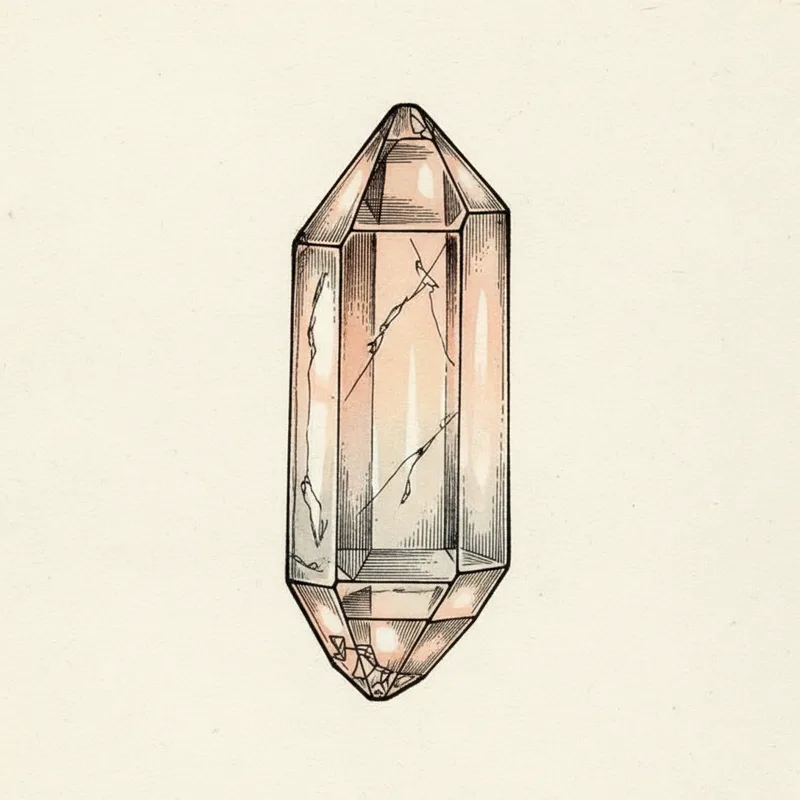
Lemurian quartz is quartz. Mineralogically, there is nothing unique about its composition or crystal structure. What distinguishes 'Lemurian' crystals is a surface feature: prominent horizontal striations (growth lines) on alternating crystal faces, and the fact that the original specimens were found loose in sandy soil rather than attached to matrix.
The horizontal striations are growth lines that occur on many quartz crystals worldwide - they record the layer-by-layer growth of the crystal face. In Lemurian quartz, these striations are particularly pronounced and can be felt as ridges when running a finger across the crystal face. The alternating smooth and striated faces follow the normal crystallographic symmetry of quartz.
The 'Lemurian' name and mythology were created in the late 1990s by crystal healers who attributed the crystals to the legendary lost civilization of Lemuria - a 19th-century hypothetical continent later disproven by plate tectonics. The crystals were said to be 'programmed' with ancient wisdom. This is a modern marketing narrative, not geology. The crystals themselves are genuine quartz with a common surface feature given extraordinary significance by the metaphysical market.
Identification Guide
Lemurian quartz is identified by prominent horizontal striations on alternating crystal faces, typically found as individual points (not clusters), often with a slightly frosted or matte surface texture from being loose in soil. The striations should be feel-able ridges, not just visual lines.
Distinguish from regular striated quartz (striations are common on many quartz crystals), laser quartz (very elongated, different shape), and polished quartz sold as Lemurian (genuine Lemurians have natural surface texture). The distinction between 'Lemurian' and 'regular striated quartz' is primarily a trade/metaphysical distinction, not a mineralogical one.
Spotting Fakes
Since Lemurian quartz is regular quartz with a marketing premium, the 'fake' question is nuanced. Any striated quartz crystal can be (and is) sold as Lemurian. The original Serra do Cabral material has a specific appearance (frosted surface, individual points, pronounced striations), but the term has been applied to striated quartz from many localities. You're paying for the crystal's physical qualities and your connection to it, not for a mineralogically distinct variety.
Cultural & Metaphysical Traditions
Presented as cultural traditions, not scientific evidence
The Lemurian mythology holds that an advanced ancient civilization (Lemuria) encoded knowledge into quartz crystals and seeded them across the Earth before their civilization's destruction. Practitioners 'read' the striations by running a finger along them during meditation, believing each line contains stored information. While the Lemuria narrative has no historical or geological basis, the practice of focused meditation with these crystals is meaningful to many practitioners. The Lemurian quartz market demonstrates how mythology and marketing can create value beyond a mineral's geological identity.
Where It's Found
Original Lemurian seed crystal deposit
Pink-tinted variety
Some material marketed as Lemurian
Price Guide
Good to Know
Scratch test: At hardness 7, Lemurian Quartz can scratch glass and steel. It's durable enough for any type of jewelry.
Sources: Found in 3 notable locations worldwide, from Brazil to Russia.
Heft test: Lemurian Quartz has average mineral density (2.65). It feels about as heavy as you'd expect from a stone its size.
Related Minerals
The same mineral, standard variety
Another growth-feature quartz variety
Elongated quartz, also marketed with metaphysical names
Purple quartz, can also show striations
Explore More
Quartz & Chalcedony
The Meditation Collection
The horizontal striations provide a tactile meditation practice - running a finger along the ridges as a focus technique.
Mohs Hardness Scale
See where Lemurian Quartz sits on the scale
Crystal Care Guide
Water safety, sunlight, and handling tips
Stay in the loop
From the Almanac
Updates from Crystal Almanac, when there’s something worth sharing.