Quick Facts
Formation & Origin
Mtorolite is a chromium-colored variety of chalcedony, the cryptocrystalline form of quartz. The vivid green is produced by Cr³⁺ ions substituting into the silica lattice, the same chromophore responsible for the color of emerald and chrome diopside. Unlike chrysoprase, which takes its green from nickel, mtorolite owes its color entirely to chromium sourced from adjacent chromite deposits.
The type locality at Mtoroshanga in Zimbabwe sits on the Great Dyke, a Precambrian layered ultramafic intrusion roughly 2.5 billion years old that hosts one of the world's largest chromite reserves. Where chromite-rich horizons weathered near the surface, circulating groundwater mobilized silica and chromium together. The silica gel precipitated slowly in fractures and voids within serpentinized host rock, locking chromium into the chalcedony as it crystallized.
This geological setting is what distinguishes mtorolite from other green chalcedonies. It requires both a chromite source and the right weathering conditions in serpentinite or related ultramafic rock. Chrysoprase, by contrast, forms in nickeliferous laterites over serpentinite, a different weathering chemistry in related rock types. Early 20th century collectors sometimes labeled mtorolite as 'noble serpentine,' a mistake corrected once proper mineralogical analysis identified it as a chalcedony.
Identification Guide
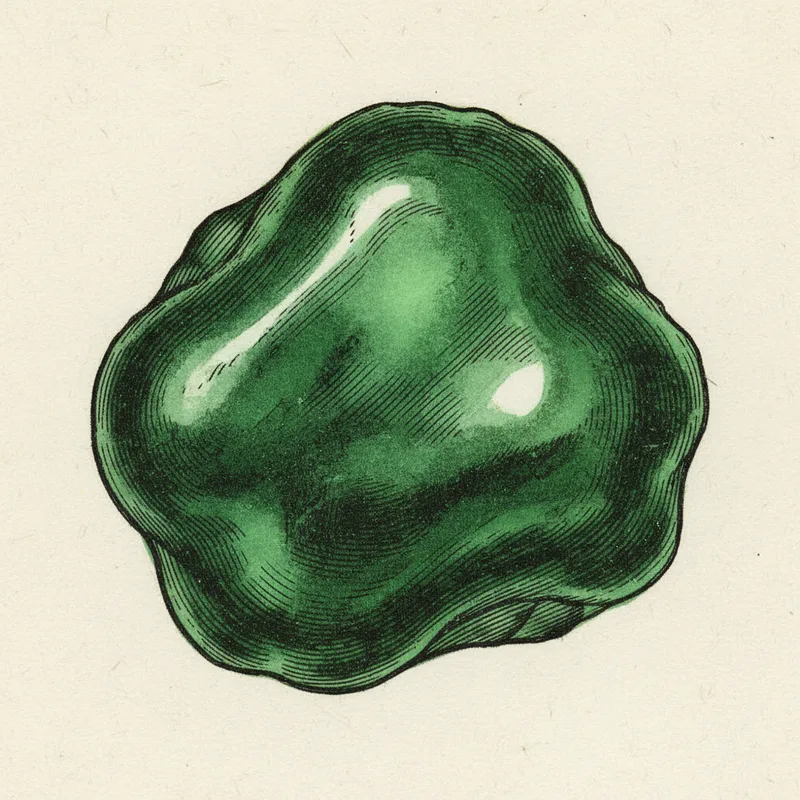
Mtorolite shows a deep, saturated emerald to chrome-green color that is more intense than the apple-green tones of chrysoprase. At hardness 7 it polishes cleanly, with a waxy to slightly vitreous luster typical of fine chalcedony. The color is evenly distributed through the mass rather than banded or spotted, and the best material is semi-translucent at the edges when held to strong light.
Specific gravity around 2.60 matches standard chalcedony. Under long-wave UV, mtorolite shows no fluorescence, which is a useful separator from chrysoprase, which can show a faint response. The absence of visible crystal structure, combined with a conchoidal fracture on broken surfaces, confirms the cryptocrystalline quartz identity.
Spotting Fakes
Dyed green chalcedony is the most common imitation. A cotton swab dipped in acetone rubbed on an inconspicuous area will lift surface dye from treated material. Genuine mtorolite color penetrates the stone and does not transfer. Dye often concentrates in fractures and along the base of cabochons, visible with a 10x loupe. Chrysoprase is sometimes sold as mtorolite or vice versa. Chrysoprase is typically paler and more apple-toned, and can show weak fluorescence under long-wave UV, while mtorolite is inert. Glass imitations reveal themselves with gas bubbles and swirl marks under magnification and run warmer than chalcedony in hand. Genuine Zimbabwean material has the deep chromium-driven saturation and no UV response.
Cultural & Metaphysical Traditions
Presented as cultural traditions, not scientific evidence
Shona traditions in Zimbabwe associated the green chalcedonies of the Great Dyke with fertility, rainfall, and the spirits of the land, though specific ritual uses varied by community and are not well documented in Western literature. Modern metaphysical practitioners treat mtorolite as a heart-chakra stone linked to emotional balance, courage, and grounded optimism, often framed as a stronger-acting companion to chrysoprase.
Where It's Found
Classic and primary world source, gives the stone its name
Secondary commercial source in ophiolite terranes
Minor occurrences in chromite-bearing ultramafics
Price Guide
Good to Know
Scratch test: At hardness 7, Mtorolite can scratch glass and steel. It's durable enough for any type of jewelry.
Sources: Found in 3 notable locations worldwide, from Zimbabwe to Russia.
Heft test: Mtorolite has average mineral density (2.60). It feels about as heavy as you'd expect from a stone its size.
Related Minerals
Sister green chalcedony, colored by nickel instead of chromium
Shares the Cr³⁺ chromophore, different mineral species
Chromium source mineral in the host ultramafic rock
Common host rock where mtorolite forms
Explore More
Stay in the loop
From the Almanac
Updates from Crystal Almanac, when there’s something worth sharing.