Quick Facts
Formation & Origin
Halite precipitates directly from evaporating saline water, either in closed continental lakes or marine lagoons cut off from the open ocean. As water evaporates and salinity climbs past roughly 26 percent dissolved solids, sodium and chloride ions can no longer remain in solution and lock into a cubic lattice, each sodium ion surrounded by six chlorides and vice versa. The result is one of the simplest and most symmetrical minerals on Earth.
Pink color in halite comes from two distinct mechanisms. In hypersaline settings like Searles Lake in California, halophilic archaea of the genus Halobacterium thrive in brines too salty for almost any other life. These single-celled organisms contain pink carotenoid pigments, chiefly bacterioruberin, that protect them from ultraviolet radiation. As halite crystals grow in the brine, pigment molecules and cell fragments are trapped along growth surfaces, coloring the crystals from within. Bloom cycles produce the vivid pinks and corals seen in collector specimens.
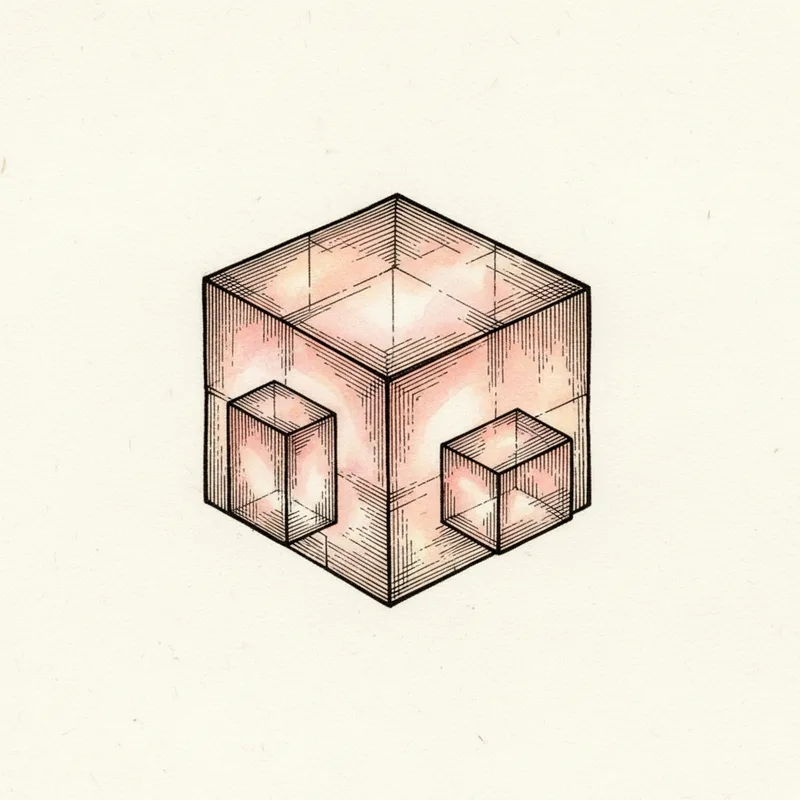
The second mechanism is inorganic. Fine hematite micro-inclusions, dispersed through the growing crystal, tint halite salmon to dusty rose. Mount Morgan in Australia and some of the Polish and German deposits fall into this category. Pink halite often shows hopper cube morphology, skeletal cubes where crystal faces grew inward faster at the edges than at the centers, a signature of rapid precipitation from supersaturated brine.
Identification Guide
Pink halite is unmistakable once you know it. Perfect cubic crystals, often hopper-faced, with glassy luster and body color ranging from palest blush to deep coral. At hardness 2.5 it is one of the softest minerals you will ever handle. A fingernail, rated 2.5 itself, will barely scratch it; a copper coin or steel blade slices it easily.
Cleavage is perfect along three mutually perpendicular directions, the defining cubic cleavage. Broken fragments are themselves little cubes. Specific gravity is low at 2.1 to 2.2, so specimens feel noticeably lighter than a similarly sized quartz or calcite piece.
The traditional field test is taste. Halite is salty, and cautiously touching a clean edge to the tongue confirms identification instantly. More importantly, halite is freely soluble in water. A single drop of water on a specimen leaves a visible etch pit within seconds. This is also the central care warning. Humid air alone can fog and eventually dissolve a display piece, so pink halite belongs in a sealed case with a silica gel packet, ideally in a climate-controlled room.
Spotting Fakes
Dyed white halite is the most common substitution. Genuine pigment from archaea or hematite is locked into the crystal lattice and will not migrate. A cotton swab lightly dampened with distilled water, touched briefly to an inconspicuous edge, will lift surface dye; genuine pink color stays put. Dyed specimens also often show pigment concentrated unnaturally in cracks rather than distributed through growth zones. Pink glass cubes, molded or cut, are harder but still easy to rule out. Glass does not dissolve in water, so a quick immersion test in a small dish of warm tap water will make genuine halite visibly dissolve within a minute or two while glass sits unchanged. Sacrificing a tiny chip is worth the certainty. Pink fluorite cubes are sometimes mistaken for halite at a glance. Fluorite has hardness 4 and is not water-soluble, so a fingernail scratch test distinguishes them instantly; halite is the only common pink cubic mineral a fingernail can scratch. Pink-dyed quartz and rose quartz clusters share the color but never the cubic habit, and quartz at hardness 7 is untouchable by a knife. Genuine pink halite has perfect cubic cleavage, tastes unmistakably salty, and will etch under a drop of water within seconds.
Cultural & Metaphysical Traditions
Presented as cultural traditions, not scientific evidence
Salt is one of humanity's oldest ritual substances. Ancient Egyptian, Greek, and Roman cultures used salt for purification, preservation, and covenant, and Roman soldiers were partly paid in salt, the origin of the word salary. Japanese Shinto practice still uses salt to purify sumo rings and entryways. Modern crystal practitioners associate pink halite specifically with emotional cleansing and heart-opening, treating the dissolving nature of salt as a metaphor for releasing what no longer serves. Practical note: because pink halite dissolves in water, it must never be used in elixirs or baths.
Where It's Found
Classic pink halite colored by halophilic archaea, hopper cube specimens
Pink cubes from the world's largest underground salt mine
Hematite-pigmented pink halite from evaporite lakes
Historic pink and rose halite from Cretaceous marine evaporites
Permian Zechstein evaporite sequence, pink halite in potash beds
Price Guide
Good to Know
Scratch test: At hardness 2.5, Pink Halite can be scratched with a fingernail. This is a display specimen, not a wearable stone.
Sources: Found in 5 notable locations worldwide, from United States to Germany.
Heft test: With a specific gravity of 2.10–2.20, Pink Halite feels lighter than most minerals. This lightness can help identify it.
Related Minerals
Same mineral without pigment, common table salt
Potassium chloride, evaporite companion to halite
Another evaporite mineral from saline basins
Another pink cubic mineral, harder and water-stable
Evaporite mineral from the same playa lake environments
Stay in the loop
From the Almanac
Updates from Crystal Almanac, when there’s something worth sharing.