Quick Facts
Formation & Origin
Selenite is a crystalline variety of gypsum that forms through the evaporation of calcium sulfate-rich water. In its most dramatic expression, this process created the Giant Crystal Cave (Cueva de los Cristales) in Naica, Mexico, where selenite crystals grew to 12 meters long and weighed up to 55 tons - the largest crystals ever discovered on Earth.
The Naica crystals grew over approximately 500,000 years in a cave filled with mineral-rich water heated to about 58 degrees Celsius by underlying magma. At this precise temperature, gypsum is barely soluble - meaning crystals could grow extremely slowly, adding only a few atomic layers per year. This glacial growth rate, combined with perfectly stable conditions over millennia, produced crystals of extraordinary size and perfection.
Desert rose selenite forms through a different process - gypsum crystallizes within sand in arid environments, incorporating sand grains as it grows and forming rosette-shaped clusters. Oklahoma's hourglass selenite contains an internal hourglass-shaped pattern of brown sand trapped during growth, visible when the crystal is held up to light.
Identification Guide
Selenite is instantly recognizable by its extreme softness - at Mohs 2, you can scratch it with your fingernail. It's one of the softest minerals you'll commonly encounter. Transparent selenite transmits light beautifully and has a distinctive pearly to vitreous luster.
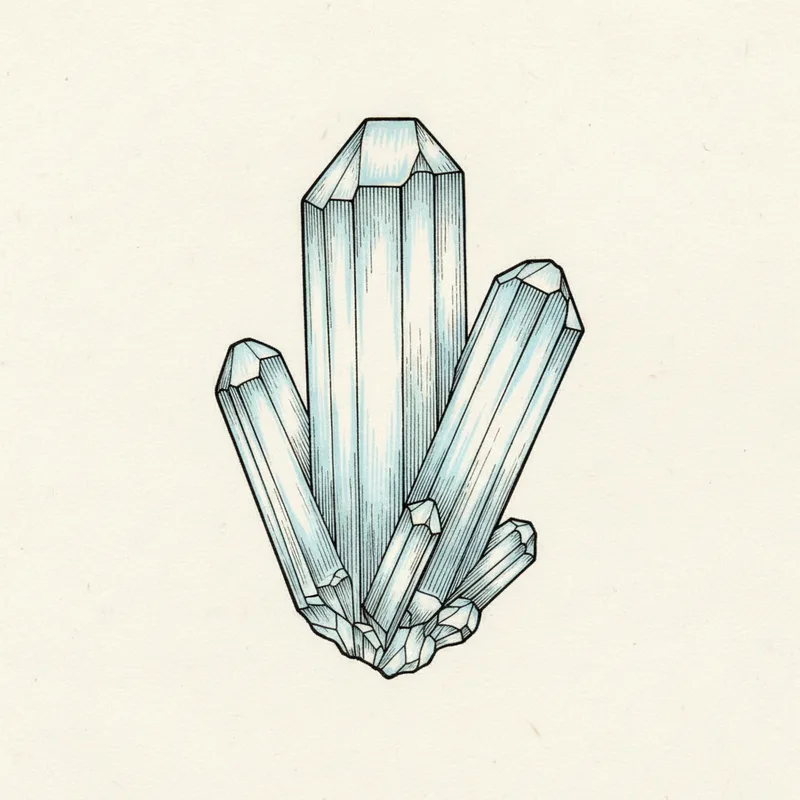
The crystal habit is typically bladed (flat, sword-like crystals) or tabular. Selenite has perfect cleavage in one direction, meaning thin sheets can be peeled off with a fingernail. A critical property to know: selenite is water-soluble. Never clean selenite with water or it will slowly dissolve and lose its polish. This same property means selenite left outdoors will deteriorate.
Spotting Fakes
Selenite is too inexpensive and abundant to be commonly faked. The main issue is confusion with other white/clear minerals. Selenite is dramatically softer than quartz (2 vs 7) - the fingernail test immediately distinguishes them. Some sellers market polished selenite at inflated prices as 'satin spar' or 'liquid light' - these are genuine selenite/gypsum but not rare. The 'charging' and 'cleansing' claims in the wellness market are cultural beliefs, not properties of the mineral - selenite has no special ability to clean other crystals.
Cultural & Metaphysical Traditions
Presented as cultural traditions, not scientific evidence
Named after Selene, the Greek goddess of the moon, for its lunar glow. Ancient Greeks used transparent selenite as window glass. In Mexican folk tradition, selenite from the caves of Chihuahua is considered a connection to the underworld. Modern crystal practitioners consider selenite a 'high vibration' stone associated with mental clarity, spiritual connection, and energy cleansing - it's one of the most popular crystals in the wellness market.
Where It's Found
Giant Crystal Cave - selenite crystals up to 12 meters long
Desert rose formations and bladed crystals
Hourglass selenite with unique brown sand inclusions
Large transparent blade crystals
Price Guide
Good to Know
Scratch test: At hardness 2, Selenite can be scratched with a fingernail. This is a display specimen, not a wearable stone.
Sources: Found in 4 notable locations worldwide, from Mexico to Australia.
Heft test: With a specific gravity of 2.32, Selenite feels lighter than most minerals. This lightness can help identify it.
Related Minerals
Sand-included selenite in rosette formations
Fibrous variety of gypsum, silky luster
Massive fine-grained gypsum, used for carving
Dehydrated form of gypsum
Explore More
Sulfate Minerals
The Meditation Collection
Named after Selene, Greek moon goddess. Its translucent, luminous quality creates a calming visual focus in low light.
The Sleep Collection
Named for Selene, the Greek moon goddess. Its translucent, luminous quality creates a soft visual anchor in low light. Often placed on nightstands as a gentle, light-catching presence.
The Beginner's Collection
Gypsum (CaSO₄·2H₂O) in its transparent form. Dramatically soft (hardness 2) and will scratch with a fingernail. Teaches hardness scale better than any textbook explanation.
Spring Crystal Rituals: Stones for New Beginnings
Lepidolite for Anxiety: Science vs. Lore
Carnelian: Meaning, Properties, and How to Use It
Mohs Hardness Scale
See where Selenite sits on the scale
Crystal Care Guide
Water safety, sunlight, and handling tips
Stay in the loop
From the Almanac
Updates from Crystal Almanac, when there’s something worth sharing.