Quick Facts
Formation & Origin
Sinhalite forms in skarns, the contact metamorphic rocks that develop where boron-rich fluids from cooling granite intrusions meet magnesium-aluminum-bearing country rocks. The typical host is a dolomitic marble adjacent to a granite. As the intrusion sends hot fluids into the carbonate, new minerals crystallize in a narrow reaction zone, and sinhalite is among them when boron and aluminum are both available.
The Sri Lankan discovery story is a classic piece of gemological history. For decades, brownish stones from the Ratnapura alluvial gravels were traded as brown peridot. In 1952, gemologists reexamining parcels noticed refractive indices higher than peridot could produce. Careful analysis revealed a new mineral, and it was named after Sinhala, the traditional name for Sri Lanka. The source rocks themselves are long gone, weathered away and buried, but the gems survive in the river gravels that drained the ancient metamorphic terrain.
Mogok in Myanmar produces the second most important sinhalite, from marble-hosted deposits that still exist in place. The stones show strong yellow to green brown pleochroism, a direct consequence of the mineral's orthorhombic symmetry and its iron chromophore. Because sinhalite needs a specific chemistry of boron, magnesium, and aluminum in close contact, it remains genuinely rare, with only a handful of productive sources worldwide.
Identification Guide
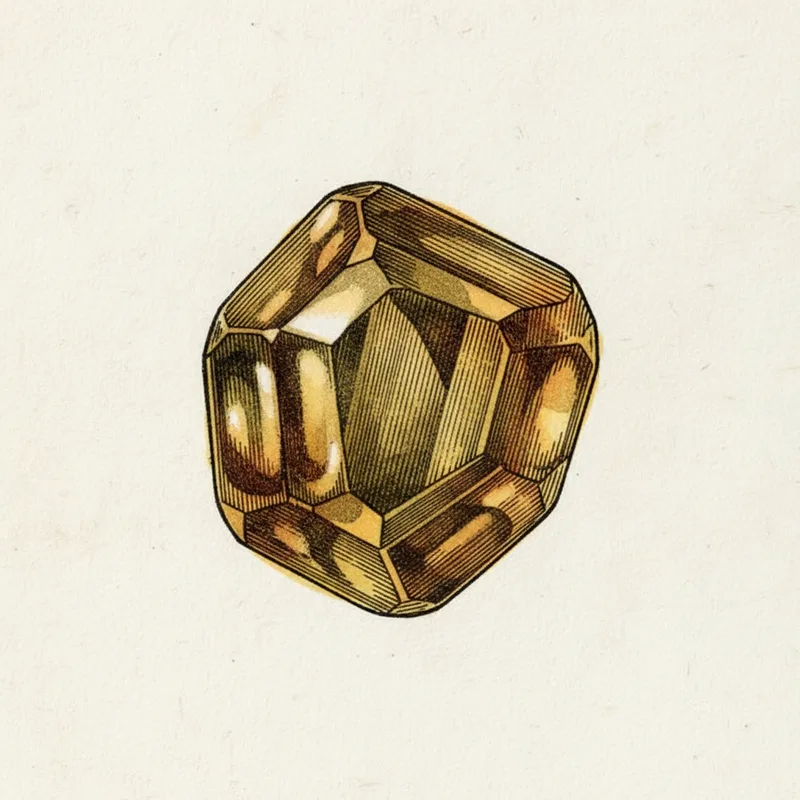
Sinhalite is an orthorhombic borate with refractive indices between 1.67 and 1.71, specific gravity of 3.47 to 3.50, and a vitreous luster. Color runs from yellowish brown through olive to dark brown, with the occasional greenish brown stone. The streak is white and the hardness 6.5 on the Mohs scale, suitable for most jewelry but softer than sapphire or chrysoberyl.
The most diagnostic feature is strong trichroic pleochroism. When rotated under a dichroscope, a sinhalite shows three distinct colors, typically pale brown, greenish brown, and deep yellowish brown. This separates it from peridot, which shows much weaker pleochroism and a simpler color shift. Birefringence sits near 0.038, higher than peridot.
Under magnification, sinhalite often contains two-phase inclusions and occasional healed fractures. Crystals in matrix are short prismatic and uncommon. Most gem material reaches the market as rolled pebbles from the Sri Lankan gem gravels, with flat, abraded surfaces typical of alluvial transport. The higher specific gravity is immediately noticeable when heft-testing against peridot of similar size.
Spotting Fakes
Peridot confusion is the central and historical issue. Sinhalite's refractive index of 1.67 to 1.71 overlaps peridot's 1.65 to 1.69 at the low end, so a casual refractometer reading on a small stone can mislead. The decisive test is specific gravity. Sinhalite sits at 3.47 to 3.50 while peridot ranges from 3.32 to 3.37. Hydrostatic weighing or a heavy liquid like methylene iodide separates them cleanly. Pleochroism gives a second independent check. Under a dichroscope, peridot shows near-colorless to green, often faint. Sinhalite shows strong green, brown, and yellow in three distinct directions. Any dichroscope reveals the difference in seconds. Chrysoberyl is a third look-alike because it shares the brownish-yellow color zone. It has a higher refractive index of 1.74 to 1.75, higher hardness at 8.5, and a different crystal system. A scratch test against quartz plus a refractometer reading rules it out. Brown tourmaline and brown zircon occasionally substitute, but tourmaline shows much stronger birefringence doubling and zircon is far denser at 4.6 to 4.7. Glass imitations are rare because sinhalite is itself affordable at the commercial grade, but a loupe check for bubbles and swirl marks confirms natural origin.
Cultural & Metaphysical Traditions
Presented as cultural traditions, not scientific evidence
Sinhalite entered metaphysical writing only recently, as a reflection of its late discovery and narrow distribution. Practitioners associate the warm brown color with grounding, practical confidence, and the solar plexus chakra. Sri Lankan lore does not carry specific traditions for sinhalite itself, since the stones were sold as peridot for generations before the mineral was recognized. Modern crystal writers sometimes frame it as a stone of rediscovery, a reference to the 1952 identification from mislabeled parcels. These associations are cultural and modern rather than traditional or scientific.
Where It's Found
Type locality, stones eroded from buried skarn source rocks
Secondary source of facet-grade brown sinhalite in marble-hosted deposits
Minor occurrences reported in metamorphic skarn zones
Non-gem crystals found in contact-metamorphosed marbles
Price Guide
Good to Know
Scratch test: At hardness 6.5, Sinhalite resists scratching from a knife but can be scratched by quartz. Best for pendants and earrings rather than rings.
Sources: Found in 4 notable locations worldwide, from Sri Lanka to United States.
Heft test: Sinhalite has average mineral density (3.47–3.50). It feels about as heavy as you'd expect from a stone its size.
Explore More
Stay in the loop
From the Almanac
Updates from Crystal Almanac, when there’s something worth sharing.