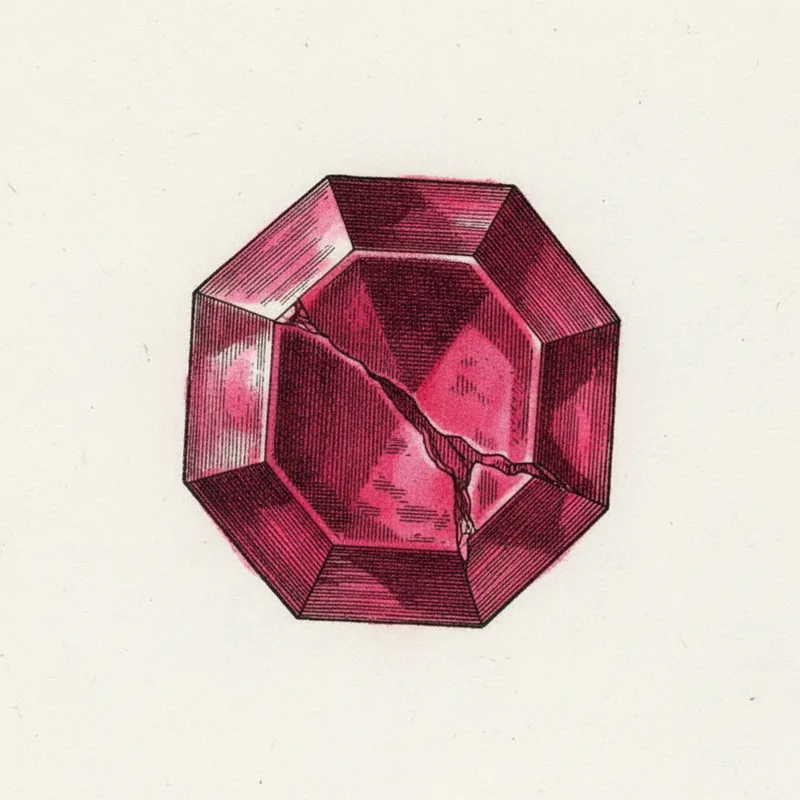
Quick Facts
Formation & Origin
Spinel forms in the same geological environments as ruby and sapphire - aluminum-rich metamorphic rocks and marbles. In fact, spinel and corundum frequently occur side by side in the same deposit, which is why they were confused for centuries. The Mogok deposits in Myanmar produce both ruby and red spinel from the same marble host rock.
Unlike corundum, spinel is singly refractive (cubic crystal system), which gives it a different optical character - spinel has a clean, vivid color without the directional color variation (pleochroism) seen in corundum. This can actually be an advantage aesthetically, as spinel shows consistent color from all angles.
The 2007 discovery of neon pink-red spinels from Mahenge, Tanzania, sent shockwaves through the gem world. These spinels glow with a fluorescent intensity unlike anything seen before, and prices for top Mahenge stones have skyrocketed.
Identification Guide
Spinel is identified by its cubic crystal habit (octahedral crystals), hardness of 8, and lack of pleochroism. Unlike ruby and sapphire, spinel is singly refractive - it shows no doubling of facet edges when viewed through the stone.
Distinguish from ruby (doubly refractive, trigonal crystals), garnet (lower hardness, different SG), and red tourmaline (lower hardness, prismatic habit). Spinel's octahedral crystal form is diagnostic when crystals are available.
Spotting Fakes
Synthetic spinel has been produced since the early 1900s and is common. Flame-fusion synthetic spinel is used to imitate many gems (ironically, synthetic blue spinel is more often sold as fake sapphire or aquamarine than as spinel). Lab testing distinguishes natural from synthetic. The biggest historical 'fake' involving spinel: the 170-carat 'Black Prince's Ruby' in the British Crown Jewels and the 'Timur Ruby' are both actually spinel.
Cultural & Metaphysical Traditions
Presented as cultural traditions, not scientific evidence
Spinel spent centuries being called ruby - it had no separate identity in the gem trade until modern mineralogy distinguished them. The great rubies of royal collections (British, Russian, Iranian) are largely spinel. Rather than diminishing spinel's reputation, this history has given it a romantic mystique as the stone that fooled kings. Modern collectors consider fine spinel undervalued relative to ruby and sapphire.
Where It's Found
Finest red spinels, historic source alongside ruby
Full color range, alluvial deposits
Exceptional neon pink-red, modern sensation
Historic source of 'Balas rubies'
Price Guide
Good to Know
Scratch test: At hardness 8, Spinel can scratch glass and steel. It's durable enough for any type of jewelry.
Sources: Found in 4 notable locations worldwide, from Myanmar to Tajikistan.
Heft test: Spinel has a specific gravity of 3.60 - noticeably heavier than quartz. You'll feel the density when you pick it up.
Related Minerals
Historically confused, different mineral entirely
Found in same deposits, different structure
Zinc spinel, same crystal structure
Also cubic, similar colors, different chemistry
Explore More
Oxide & Hydroxide Minerals
How to Tell Real Tourmaline from Glass and Plastic: 9 Tests
Ruby vs Garnet: The Red Stone Showdown
6 Undervalued Gemstones That Outperform Diamonds
Mohs Hardness Scale
See where Spinel sits on the scale
Crystal Care Guide
Water safety, sunlight, and handling tips
Stay in the loop
From the Almanac
Updates from Crystal Almanac, when there’s something worth sharing.