Quick Facts
Formation & Origin
Star Ruby is corundum, aluminum oxide, colored red by trace chromium and patterned by oriented inclusions of rutile, titanium dioxide. Like all gem corundum it forms in aluminum-rich, silica-poor environments. Silica is the disqualifier: if aluminum meets silica, it locks up in feldspar or mica rather than corundum, which is why gem ruby is geologically rare.
The classical Burmese star rubies come from the Mogok Valley, where corundum crystallized in marble during regional metamorphism of a former limestone reef. High-grade metamorphism recrystallized the limestone and mobilized trace aluminum and chromium from interbedded shales and volcanic horizons. As the corundum crystals grew at temperatures near 650-800°C, titanium dissolved in the melt and slowly diffused into the crystal structure, substituting for aluminum.
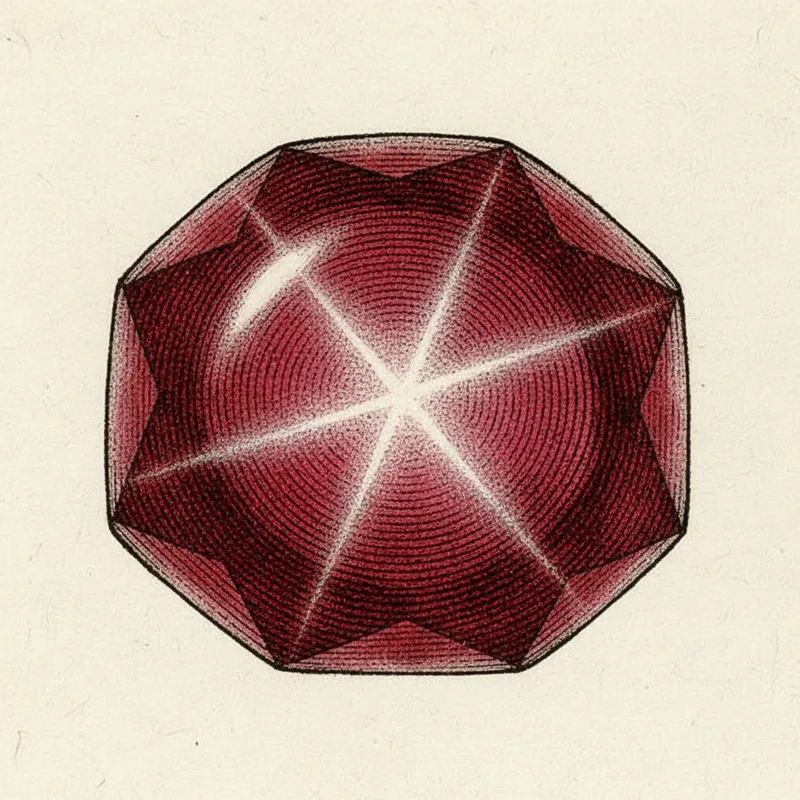
Asterism is a later, lower-temperature event. As the corundum cooled below roughly 400°C, titanium became insoluble in the Al₂O₃ lattice and exsolved, meaning it precipitated out as microscopic rutile needles. Corundum has trigonal symmetry with three equivalent horizontal a-axes set 60 degrees apart. The rutile needles nucleate parallel to these directions, producing three intersecting sets of parallel silk. When a dome-cut cabochon is rotated under a single light, each set of needles reflects a sharp line of light. The three lines cross at the center and produce a six-ray star.
Faceted corundum does not show asterism: faceting slices through the needle field at many angles and scatters the reflection. The oriented silk only produces a coherent star when the crystal is cut en cabochon with the base perpendicular to the c-axis. Rare specimens contain two generations of rutile exsolution oriented along different symmetry axes, and these produce a 12-ray star. Mogok and Kashmir have yielded a small number of authenticated 12-ray stones.
Identification Guide
Star Ruby is identified first by its sharp six-ray star that glides smoothly across the dome of a cabochon as the stone is tilted under a point light source. The star should have well-defined legs that meet at a single center and follow the light rather than breaking into separate arcs. Color ranges from deep red in fine Burmese material to brownish or purplish red in commercial Indian stones. Translucency varies with silk density: the more rutile inclusions, the stronger the star and the more milky the body.
Mohs hardness is 9 and specific gravity is near 4.0, both unusually high and diagnostic. Star rubies also typically fluoresce red under long-wave UV light when the chromium content is high and iron content is low. Burmese stars glow strongly, Thai and African stars much less so.
Distinguish star ruby from star garnet (hardness 7-7.5, lower specific gravity, usually shows a four-ray star), star spinel (isometric, much rarer, usually shows a four-ray star, lower specific gravity near 3.6), and star rose quartz (hardness 7, specific gravity 2.65, weak diffuse star). A star ruby feels noticeably heavy for its size compared to any silicate imitation.
Spotting Fakes
Three fakes dominate the star ruby market, and each has a distinct tell. First, synthetic Linde star rubies. These are flame-fusion (Verneuil-process) synthetic corundum with titanium added to the melt and then heat-treated to exsolve rutile. The chemistry is real corundum, so hardness and specific gravity match, but the stones are almost always too perfect. Look for an unnaturally flawless star with perfectly straight legs of equal length and no natural inclusions in the body. Under 10x magnification, Verneuil synthetics show curved growth lines, the fingerprint of boule growth, rather than the straight angular growth zones seen in natural corundum. Gas bubbles in curved trails also indicate synthesis. Second, glass or composite imitations with painted or stenciled stars. These are obvious once you know to look at the base of the cabochon rather than the dome. The star should appear to float inside the stone as you tilt it, shifting position with the angle of light. A painted star stays fixed on the back surface and moves with the stone rather than gliding across it. Turn the cabochon over: if you can see the star lines drawn on the flat base, it is a fake. Glass also has lower hardness (5-6), much lower specific gravity, and often contains round gas bubbles under magnification. Third, diffusion-treated corundum. Low-quality pale corundum is coated with titanium oxide powder and heated near its melting point, which drives a thin layer of titanium into the surface and grows a shallow rutile haze that produces a star. The treatment only penetrates a fraction of a millimeter. Repolishing the stone removes the star entirely, and immersion in methylene iodide under diffused light usually reveals a sharp color boundary just below the surface. Any star ruby sold at a price too good to be true should be assumed diffusion-treated until a lab report says otherwise. For any star ruby over roughly 1 carat, insist on a report from GIA, Gubelin, SSEF, or AGL stating origin, treatment status, and asterism type.
Cultural & Metaphysical Traditions
Presented as cultural traditions, not scientific evidence
Star Ruby has been treated as a talismanic stone across Hindu, Burmese, and medieval European traditions. In Sanskrit astrology it is a stone of the Sun and is called tara-ratna, star-jewel. The three intersecting rays of the star were interpreted as faith, hope, and destiny in European lapidary tradition, and as the three-in-one trinity by some medieval Christian writers. Burmese warriors historically carried cabochon star rubies as protective amulets, and the belief that deep-red star stones conferred invincibility is documented in 13th century travel accounts. Modern practitioners associate star ruby with vitality, courage, and clarity of purpose, and it is often paired with black tourmaline as a grounding and protective combination.
Where It's Found
Finest classical star rubies, sharp six-ray stars in marble-hosted corundum
Lighter pinkish-red stars recovered from gem gravels, often translucent
Opaque to translucent star rubies, commercial-grade cabochons
Marble-hosted star corundum with strong asterism and good red saturation
Price Guide
Good to Know
Scratch test: At hardness 9, Star Ruby can scratch glass and steel. It's durable enough for any type of jewelry.
Sources: Found in 4 notable locations worldwide, from Myanmar to Vietnam.
Heft test: Star Ruby has a specific gravity of 3.97-4.05 - noticeably heavier than quartz. You'll feel the density when you pick it up.
Related Minerals
Same mineral without rutile inclusions, faceted transparent red corundum
Same corundum species with asterism, all non-red colors
Different mineral with four-ray asterism from rutile or ilmenite inclusions
Explore More
Stay in the loop
From the Almanac
Updates from Crystal Almanac, when there’s something worth sharing.