Quick Facts
Formation & Origin
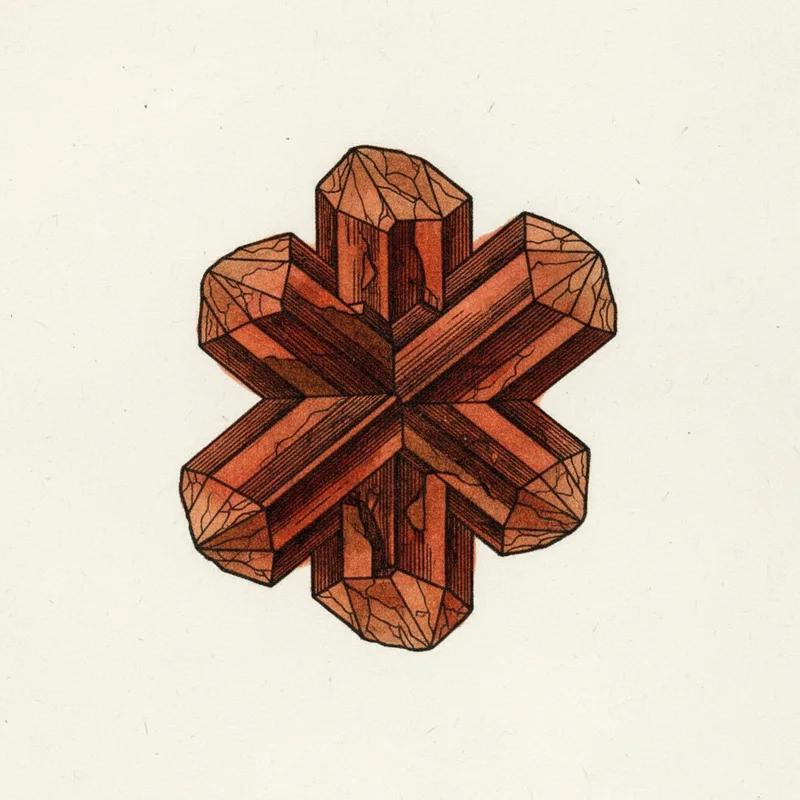
Staurolite is a metamorphic mineral that forms in medium-grade metamorphic rocks (schists and gneisses) under specific pressure-temperature conditions. What makes staurolite famous is its tendency to form cruciform (cross-shaped) twins - two crystals penetrating each other at either 60 degrees or 90 degrees, creating natural cross shapes.
The 90-degree twins form a perfect Greek cross (plus sign shape). The 60-degree twins form a diagonal cross (X shape). These 'fairy crosses' have been collected as natural curiosities and good-luck charms for centuries. The geological process that creates these twins involves two staurolite crystals nucleating at the same point and growing through each other along specific crystallographic planes.
Staurolite is also an important index mineral for geologists - its presence in a rock indicates that the rock experienced specific metamorphic conditions (about 500-700 degrees Celsius at moderate pressures). Along with garnet and kyanite, staurolite helps geologists map the pressure-temperature history of metamorphic terrains.
Identification Guide
Staurolite is identified by its dark brown color, monoclinic prismatic crystals, and characteristic cruciform twinning. At hardness 7, it's durable. The cross-shaped twins are essentially diagnostic - no other common mineral forms natural crosses.
Distinguish from andalusite (can show cross-like chiastolite variety but has different symmetry), garnet (equant crystals, no twinning into crosses), and tourmaline (prismatic but not twinned into crosses). Single staurolite crystals without twinning are less distinctive but can be identified by color, hardness, and metamorphic association.
Spotting Fakes
Staurolite fairy crosses from Virginia and Georgia are genuine and abundant. The main concern is that some commercial 'fairy crosses' have been shaped or modified to make the cross more symmetrical or defined - natural crosses are often rough and slightly asymmetric. Carved stone crosses sold as staurolite should be examined skeptically. Genuine fairy crosses show the rough, natural crystal surfaces and are embedded in or weathered from schist matrix.
Cultural & Metaphysical Traditions
Presented as cultural traditions, not scientific evidence
According to Cherokee legend, the fairy crosses were formed from the tears of fairies who wept when they heard the news of Christ's crucifixion. Appalachian folklore considers them powerful good-luck charms and protection amulets. Presidents Theodore Roosevelt and Woodrow Wilson reportedly carried staurolite fairy crosses. In modern crystal healing, they're associated with grounding, connection between earth and sky, and spiritual protection during transitions.
Where It's Found
Classic fairy cross specimens, Virginia state stone
Fine crystal specimens
Classic European locality
Large crystals available
Price Guide
Good to Know
Scratch test: At hardness 7, Staurolite can scratch glass and steel. It's durable enough for any type of jewelry.
Sources: Found in 4 notable locations worldwide, from United States to Brazil.
Heft test: Staurolite has a specific gravity of 3.75 - noticeably heavier than quartz. You'll feel the density when you pick it up.
Related Minerals
Another metamorphic index mineral, often co-occurs
Metamorphic indicator, similar conditions
Shows cross pattern (chiastolite), different mineral
Another Al₂SiO₅ polymorph, higher grade
Explore More
Stay in the loop
From the Almanac
Updates from Crystal Almanac, when there’s something worth sharing.