Quick Facts
Formation & Origin
Kyanite forms under high-pressure metamorphic conditions - specifically when aluminum-rich sedimentary rocks (like shale or mudstone) are subjected to intense pressure during tectonic events. It's one of three polymorphs of aluminum silicate (along with andalusite and sillimanite), each of which forms under different pressure-temperature conditions. Kyanite is the high-pressure member.
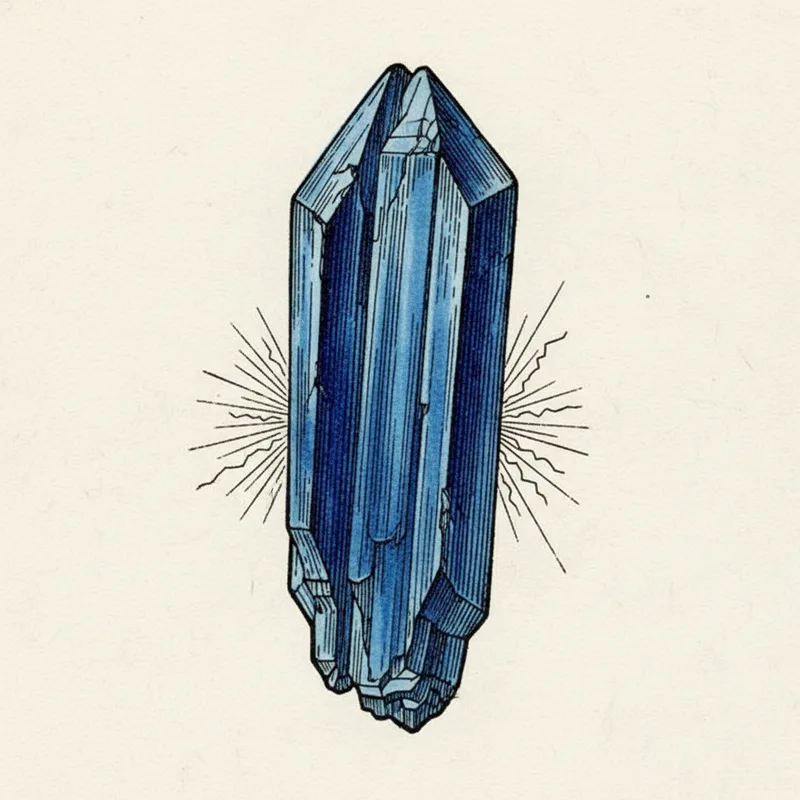
This makes kyanite a valuable indicator mineral for geologists - finding kyanite in a rock tells them it experienced pressures equivalent to burial depths of 15+ kilometers. The crystal's blade-like habit (long, flat crystals) is distinctive and immediately recognizable.
Kyanite has one of the most unusual physical properties in mineralogy: its hardness varies depending on direction. Along the length of the blade, hardness is about 4.5 (scratchable with a knife). Across the width, hardness jumps to 6.5-7 (not scratchable with a knife). This directional hardness variation (called anisotropy) is extreme in kyanite and rarely seen so dramatically in other minerals.
Identification Guide
Kyanite's blade-like crystal habit and blue color are its most distinctive features. The directional hardness is diagnostic - try scratching along the length versus across the width. If the knife scratches one direction but not the other, it's almost certainly kyanite.
Distinguish from blue tourmaline (round cross-section, striated), sodalite (massive, no blade habit), and dumortierite (fibrous, not bladed). Kyanite crystals often show color variation along their length, with deeper blue at the center fading to white or clear at the edges. The pearly luster on cleavage surfaces is also characteristic.
Spotting Fakes
Kyanite is rarely faked due to its distinctive habit and modest price. The main caution is that kyanite blades are fragile and have perfect cleavage in one direction - they split easily. Handle with care. Some sellers market 'kyanite' beads that are actually dyed blue quartz or glass - genuine kyanite beads would be difficult to manufacture due to the mineral's directional properties and cleavage.
Cultural & Metaphysical Traditions
Presented as cultural traditions, not scientific evidence
Kyanite is unusual in crystal healing tradition because it's said to be one of the few stones that 'never needs cleansing' - it's believed to not accumulate negative energy. While this has no scientific basis, it makes kyanite popular with practitioners who dislike cleansing rituals. Historically, kyanite was not widely known outside geological circles until the crystal wellness market embraced it in the early 2000s. Modern practitioners associate it with communication, self-expression, and balancing energy.
Where It's Found
Classic blue blade crystals, major source
Fine blue specimens, high-altitude collection
Rare green and orange varieties
Industrial and specimen grade
Price Guide
Good to Know
Scratch test: At hardness 4.5, Kyanite can be scratched with a copper coin. Handle gently and keep away from harder stones in your collection.
Sources: Found in 4 notable locations worldwide, from Brazil to United States.
Heft test: Kyanite has a specific gravity of 3.67 - noticeably heavier than quartz. You'll feel the density when you pick it up.
Related Minerals
Same composition (Al₂SiO₅), lower pressure polymorph
Same composition, high-temperature polymorph
Also aluminum-based, similar blue color
Blue aluminum mineral, similar appearance
Explore More
Other Silicates & Gems
The Communication Collection
Said to 'never need cleansing.' Associated with cutting through confusion and speaking truth without fear.
Ruby vs Garnet: The Red Stone Showdown
How to Store and Display Your Crystal Collection
How to Cleanse Crystals: What Works (and What Doesn't)
Mohs Hardness Scale
See where Kyanite sits on the scale
Crystal Care Guide
Water safety, sunlight, and handling tips
Stay in the loop
From the Almanac
Updates from Crystal Almanac, when there’s something worth sharing.