Quick Facts
Formation & Origin
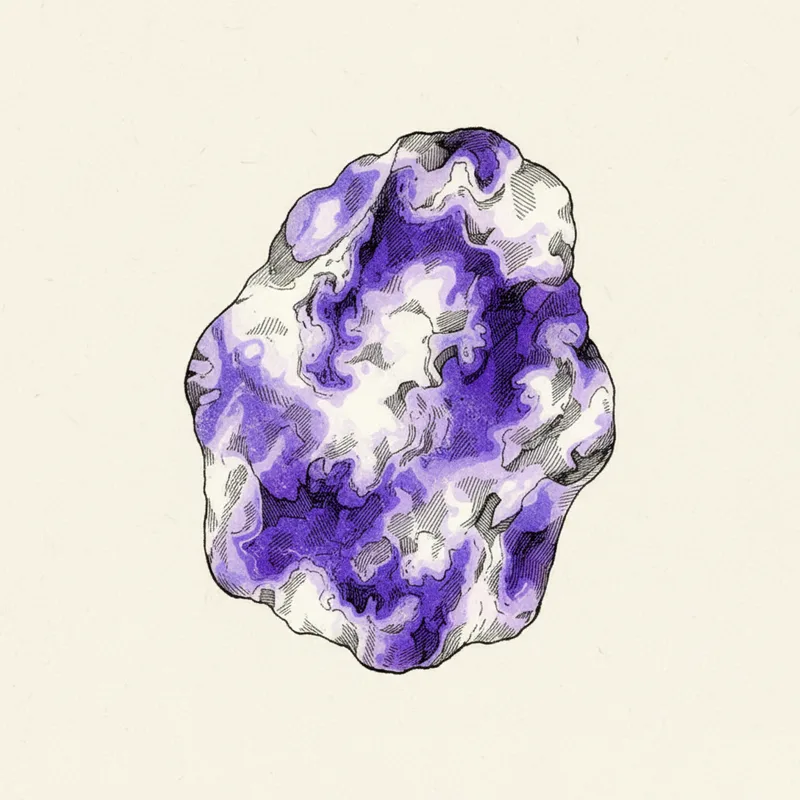
Tiffany stone is a rare, multi-mineral rock composed primarily of opalized fluorite with bertrandite, chalcedony, quartz, and sometimes dolomite and manganese oxides. It's found at a single location - the Brush Wellman beryllium mine at Spor Mountain, Utah.
The material formed through a complex sequence of volcanic and hydrothermal events that deposited fluorite, opal, and other minerals in swirled, flowing patterns within volcanic tuff. The purple color comes from fluorite and manganese, while the white and cream areas are opal and chalcedony.
Tiffany stone's rarity is extreme - it comes from one mine that primarily produces beryllium ore, not gemstones. The Tiffany stone is essentially a beautiful byproduct. Most material was historically discarded or crushed for beryllium processing. Only material rescued from the waste stream reaches the collector market, making supply limited and unpredictable. The mine's eventual closure will make Tiffany stone a finite, non-renewable resource.
Identification Guide
Tiffany stone is identified by its distinctive swirled purple-and-white pattern, waxy to vitreous luster, and mixed-mineral composition. The purple is typically softer and more lavender than amethyst. Under UV light, the fluorite component may fluoresce.
Distinguish from charoite (fibrous swirl pattern, different mineral composition), lepidolite (flaky mica texture), and dyed agate (too uniform, dye in cracks). Tiffany stone's swirled, flowing multi-mineral pattern has a distinctive organic quality.
Spotting Fakes
Tiffany stone's rarity and distinctive appearance make faking uncommon. Some purple-dyed agate or fluorite is marketed as Tiffany stone - genuine material shows a natural, organic swirl of multiple distinct minerals (not uniform dyed color). The mixed-mineral composition means different areas of a specimen may have different hardness and luster, which dyed single-mineral material doesn't show. Provenance from Spor Mountain, Utah, is the ultimate verification.
Cultural & Metaphysical Traditions
Presented as cultural traditions, not scientific evidence
Tiffany stone has no ancient traditions due to its single-source rarity and recent discovery. Modern practitioners associate it with psychic development, spiritual communication, and creative expression. The blend of multiple minerals is interpreted as representing the integration of different spiritual energies. Its extreme rarity gives it a 'chosen' quality among practitioners - the idea that finding or owning Tiffany stone is itself meaningful.
Where It's Found
The only known source
Price Guide
Good to Know
Scratch test: At hardness 5.5, Tiffany Stone resists scratching from a knife but can be scratched by quartz. Best for pendants and earrings rather than rings.
Sources: Found at only one location on Earth - United States. Supply is inherently limited.
Heft test: Tiffany Stone has average mineral density (2.50-3.00). It feels about as heavy as you'd expect from a stone its size.
Related Minerals
Primary purple component of Tiffany stone
White-cream component, opalized silica
Similar swirled purple, different mineral entirely
Beryllium mineral component, the ore being mined
Explore More
Stay in the loop
From the Almanac
Updates from Crystal Almanac, when there’s something worth sharing.