Quick Facts
Formation & Origin
Charoite is found in only one location on Earth - along the Chara River in the remote Sakha Republic of Siberia, Russia. It formed through an extraordinary geological process called contact metasomatism, where a syenite intrusion (an alkaline igneous rock) interacted with limestone under specific conditions of temperature, pressure, and chemistry.
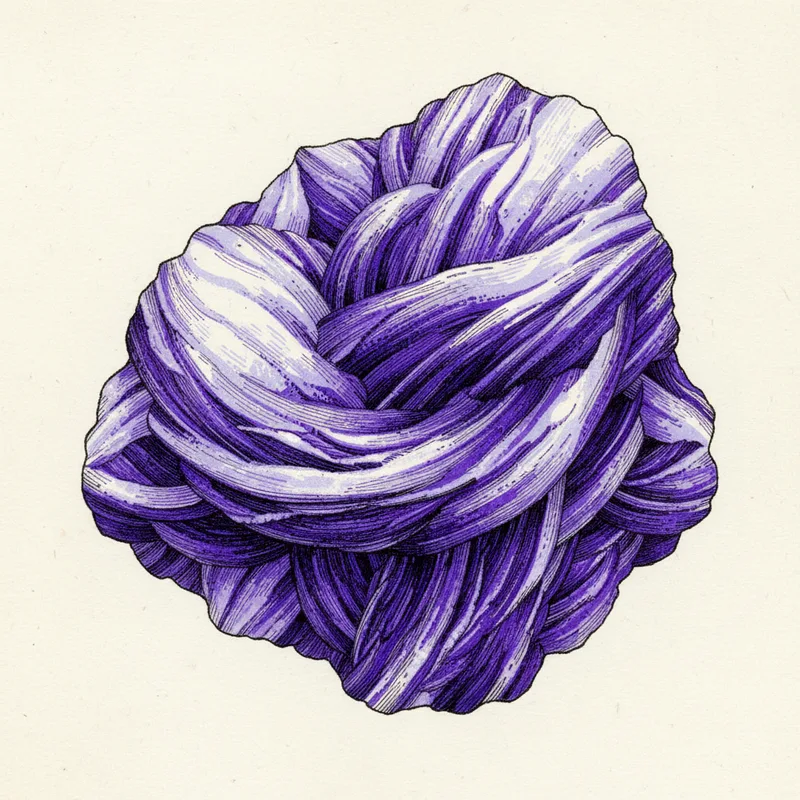
The resulting mineral assemblage is unique - charoite forms swirling, fibrous masses of interlocking crystals that create the distinctive marbled purple pattern. The swirled texture comes from the fibrous crystal habit combined with deformation during formation. Black spots within charoite are augite (a pyroxene mineral), and orange-brown patches are tinaksite (another rare mineral found almost exclusively with charoite).
Charoite wasn't described until 1978, and the remote Siberian location means supply is limited and transport is difficult. The Russian government has periodically restricted export, adding to its mystique and price.
Identification Guide
Charoite is unmistakable - the swirled purple pattern with its characteristic fibrous, silky texture is unique among minerals. No other natural stone shows this exact combination of color and pattern. At hardness 5, it can be scratched by a knife.
Distinguish from sugilite (uniform purple, no swirling), purple fluorite (cubic crystals, much softer), and lepidolite (flaky mica texture, not fibrous). When polished, charoite shows a chatoyant-like silky sheen caused by the aligned fibrous crystal structure.
Spotting Fakes
Charoite's unique pattern makes it difficult to fake convincingly. Occasionally, purple-dyed magnesite or polymer clay are marketed as charoite, but the swirling fibrous pattern with black augite spots and the silky luster are hard to replicate. If the pattern looks painted or printed rather than three-dimensional and naturally flowing, it's likely fake. Genuine charoite has depth - the pattern extends into the stone, not just on the surface.
Cultural & Metaphysical Traditions
Presented as cultural traditions, not scientific evidence
Charoite has no ancient history - it was unknown to science until the 1940s and not officially described until 1978. Some sources claim the name comes from the Russian 'chary' meaning magic or charms, though others attribute it simply to the Chara River locality. In modern crystal practice, charoite is associated with deep transformation, overcoming fear, and spiritual insight. Its Siberian origin and rarity add to its perceived mystical power.
Where It's Found
The only known source in the world
Price Guide
Good to Know
Scratch test: At hardness 5, Charoite resists scratching from a knife but can be scratched by quartz. Best for pendants and earrings rather than rings.
Sources: Found at only one location on Earth - Russia. Supply is inherently limited.
Heft test: Charoite has average mineral density (2.54). It feels about as heavy as you'd expect from a stone its size.
Related Minerals
Another rare purple mineral, different pattern
Purple mica, flaky vs fibrous texture
More common purple mineral, transparent
Rare mineral found almost exclusively with charoite
Explore More
Stay in the loop
From the Almanac
Updates from Crystal Almanac, when there’s something worth sharing.