Quick Facts
Formation & Origin
Benitoite is one of the rarest gemstones on Earth - found in gem quality at only one location: the Benitoite Gem Mine (now closed) in San Benito County, California. It's the state gem of California and one of the few minerals named after its discovery locality.
Benitoite formed under unique geological conditions - a convergent plate boundary where serpentinite, blueschist, and hydrothermal fluids created the specific chemical environment (barium, titanium, and silica together) needed for its crystallization. The crystals grew in veins within blueschist-grade metamorphic rock, alongside natrolite and joaquinite.
The blue color comes from iron and titanium charge transfer - the same mechanism that colors blue sapphire, but in a completely different mineral structure. Under UV light, benitoite fluoresces an intense blue-white - one of the strongest fluorescence responses of any mineral. This fluorescence was historically used to locate benitoite crystals in the mine by working at night with UV lamps.
The original mine closed and is now the official California State Gem Mine, open to the public for collecting. Gem-quality crystals rarely exceed 2 carats.
Identification Guide
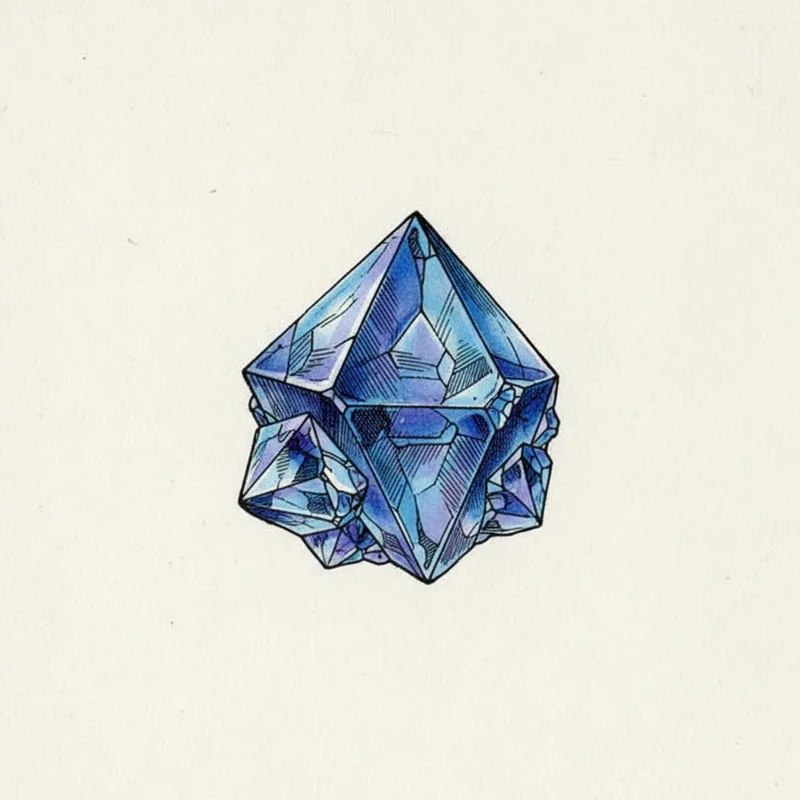
Benitoite is identified by its sapphire-blue color, triangular crystal habit (distinctive flat triangular crystals), strong blue-white UV fluorescence, and extreme rarity. The triangular crystal form is unique among blue gemstones.
Distinguish from sapphire (much harder at 9, hexagonal prisms not triangles), tanzanite (different crystal system, different pleochroism), and blue spinel (cubic, no fluorescence). Benitoite's strong blue-white UV fluorescence is diagnostic - few other minerals fluoresce this intensely.
Spotting Fakes
Benitoite is so rare and so distinctive that conventional faking isn't practical. Synthetic benitoite has been produced experimentally but isn't commercially available. The main verification tools are the UV fluorescence test (intense blue-white glow) and the triangular crystal habit. Any benitoite offered for sale should include provenance documentation. Given that gems rarely exceed 2 carats, any large 'benitoite' should be viewed with extreme skepticism.
Cultural & Metaphysical Traditions
Presented as cultural traditions, not scientific evidence
Benitoite is too rare for extensive metaphysical traditions. Crystal practitioners who work with it associate it with psychic development, astral travel, and communication with higher dimensions. Its extreme rarity and single-source origin give it a 'once in a lifetime' quality. The UV fluorescence - invisible energy becoming visible light - is interpreted as representing hidden truths becoming apparent.
Where It's Found
The only gem-quality source on Earth
Price Guide
Good to Know
Scratch test: At hardness 6.5, Benitoite resists scratching from a knife but can be scratched by quartz. Best for pendants and earrings rather than rings.
Sources: Found at only one location on Earth - United States. Supply is inherently limited.
Heft test: Benitoite has a specific gravity of 3.68 - noticeably heavier than quartz. You'll feel the density when you pick it up.
Related Minerals
Similar blue, different mineral, much harder
Another rare single-source blue gem
Another rare mineral from the same deposit
Black mineral commonly associated with benitoite
Explore More
Stay in the loop
From the Almanac
Updates from Crystal Almanac, when there’s something worth sharing.