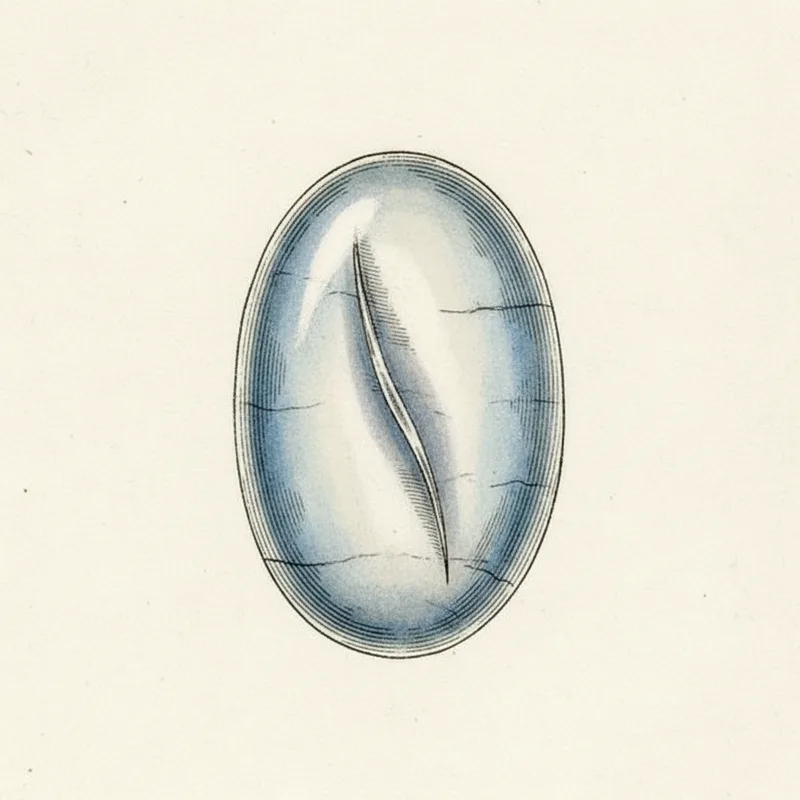
Quick Facts
Formation & Origin
Cat's Eye Moonstone forms in pegmatite pockets where orthoclase and albite feldspars develop fine parallel lamellar intergrowths as the crystal cools. The lamellar spacing produces adularescence, the billowy blue-white glow familiar from standard moonstone. For the rare cat's eye variety, an additional requirement must be met during growth: the crystal must simultaneously incorporate microscopic parallel fiber or tube inclusions oriented perpendicular to the adularescence direction. These inclusions are usually hollow channels or fine mineral needles aligned along a single crystallographic axis.
Sri Lankan cat's eye moonstone from the Meetiyagoda and Imbulpe mining districts produces the finest specimens known. In these deposits, pegmatite melts cooled under conditions that allowed both the feldspar lamellar separation and the oriented tube inclusions to develop simultaneously, yielding stones that show adularescence and chatoyancy on the same dome. The combination is unusual because each phenomenon requires specific growth conditions that rarely overlap.
The stone must be cut as a cabochon, with the dome oriented so that the fiber or tube inclusions run parallel to the base. When cut correctly, the cat's eye band tracks with the light source as the stone is rotated, while the blue adularescence flash shifts independently across the dome. The dual optical effect separates this variety from both ordinary moonstone and from cat's eye chrysoberyl, making fine Sri Lankan pieces among the most prized feldspar gems in the market.
Identification Guide
Cat's Eye Moonstone is identified by the simultaneous presence of two optical phenomena on a single cabochon: a single narrow reflected band (chatoyancy) that tracks with the light source, and a diffuse blue or silver glow (adularescence) that floats across the dome. Rotate the stone under a single point light and observe both effects independently. The cat's eye band should be sharp and continuous, not broken or doubled. The adularescence should appear as a soft billowy sheen, not a rainbow flash.
At hardness 6, the stone can be scratched by quartz and has two directions of cleavage that make it somewhat fragile for daily wear in rings. Specific gravity of 2.57 is typical for feldspar, lighter than cat's eye chrysoberyl (3.7) and much lighter than cat's eye tourmaline (3.1). Under magnification at 20x or higher, parallel tube or fiber inclusions should be visible in the interior, oriented perpendicular to the adularescence direction. The stone feels warm to the touch compared to glass imitations, reflecting the lower thermal conductivity of feldspar.
Spotting Fakes
Fiber-optic glass cabochons are the dominant fake in the market. These show a perfect, uniform cat's eye band but have no adularescence at all. They also feel cold to the touch because glass has higher thermal conductivity than feldspar. Genuine Cat's Eye Moonstone feels warm and shows both chatoyancy and blue sheen simultaneously. Cat's eye chrysoberyl is sometimes sold to unsuspecting buyers as cat's eye moonstone. Chrysoberyl has hardness 8.5 (versus 6 for moonstone) and specific gravity 3.7 (versus 2.57), so a simple weight check of a known-volume stone separates them. Chrysoberyl also never shows the blue adularescence characteristic of moonstone. Chrysoberyl is a legitimate and more expensive gem in its own right, but it is not moonstone. Treated or coated white feldspars with painted surface lines appear periodically in budget markets. The painted "eye" will wear through at the edges of the cabochon over time, revealing a duller stone underneath. Inspection at 10x loupe along the cabochon rim typically shows paint irregularities. Synthetic moonstone exists but rarely shows a convincing cat's eye effect and is uncommon in the jewelry trade. Genuine Cat's Eye Moonstone must show both chatoyancy and adularescence on the same cabochon dome, with the effects behaving independently as the stone rotates.
Cultural & Metaphysical Traditions
Presented as cultural traditions, not scientific evidence
Moonstone has held sacred status in Hindu tradition for centuries, with cat's eye varieties considered especially powerful because they combine the lunar qualities of regular moonstone with the protective focus associated with chatoyant gems across Asian traditions. Sri Lankan cat's eye moonstone has been used in Sinhalese royal jewelry and is still a ceremonial gift for important life passages. Modern metaphysical writers describe the stone as integrating intuition (the moonstone's blue sheen) with clear perception (the focused eye band), framing it as a stone for decision-making during emotional transitions. Ancient Romans considered ordinary moonstone to be solidified moonlight sacred to Diana; cat's eye varieties were not systematically distinguished in Roman sources, though they would have been prized as unusually vivid examples.
Where It's Found
Finest cat's eye moonstone with strong blue adularescence
Silver and gray cat's eye varieties
Rare chatoyant moonstone from classic moonstone locality
Champagne-toned cat's eye specimens, modern source
Price Guide
Good to Know
Scratch test: At hardness 6, Cat's Eye Moonstone resists scratching from a knife but can be scratched by quartz. Best for pendants and earrings rather than rings.
Sources: Found in 4 notable locations worldwide, from Sri Lanka to Tanzania.
Heft test: Cat's Eye Moonstone has average mineral density (2.57). It feels about as heavy as you'd expect from a stone its size.
Explore More
Stay in the loop
From the Almanac
Updates from Crystal Almanac, when there’s something worth sharing.