Quick Facts
Formation & Origin
Labradorite forms deep within the Earth's crust as magma slowly cools into igneous rock, primarily gabbro, basalt, and anorthosite. As the molten rock solidifies over thousands of years, alternating layers of different feldspar compositions crystallize in microscopically thin sheets, stacked like pages of a book.
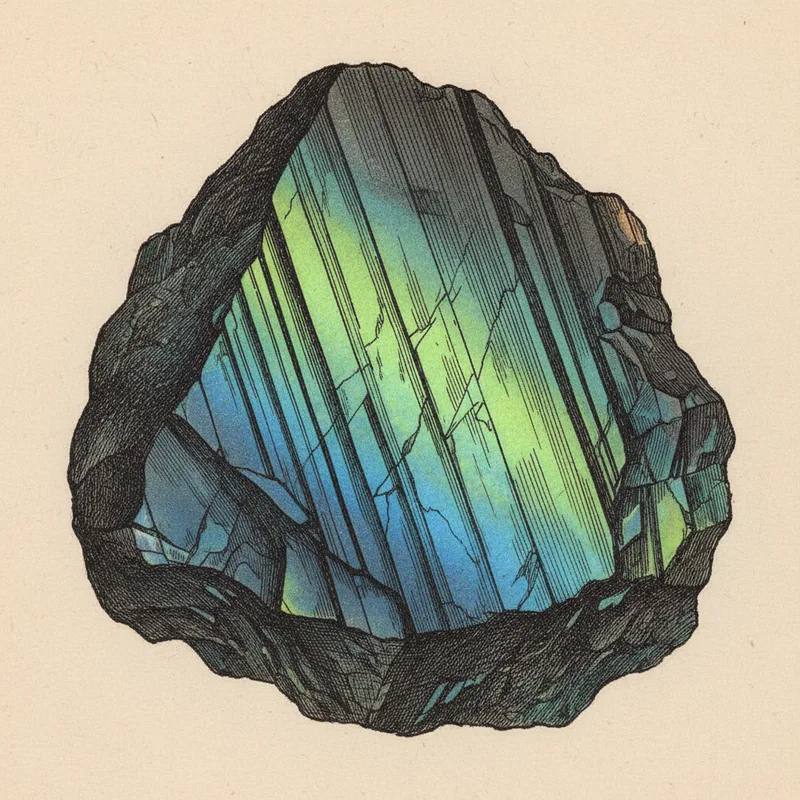
This layered internal structure is what creates labradorescence, the spectacular flash of color that appears when light enters the stone and bounces between these internal planes. The thickness and spacing of the layers determine which wavelengths of light are reflected back, producing blues, golds, greens, and occasionally the full visible spectrum. It's essentially the same physics that make a soap bubble iridescent, but frozen in stone for hundreds of millions of years.
The finest specimens, known as spectrolite, come from Finland, where tectonic forces and specific cooling conditions created unusually regular internal layering that produces intense, full-spectrum color play.
Identification Guide
Labradorite is most easily identified by its signature labradorescence, an iridescent play of color visible when the stone is rotated under light. The base color is typically dark gray to black, which distinguishes it from moonstone (which has a lighter base and a softer, more diffuse glow called adularescence).
At 6-6.5 on the Mohs scale, labradorite can be scratched by quartz but not by a steel knife. It has two directions of good cleavage at nearly right angles, and broken surfaces often show a pearly luster. The flash is directional. You may need to tilt the specimen to find the angle where color appears.
Spotting Fakes
Genuine labradorite is rarely faked because it's relatively affordable, but coated stones do exist. Watch for unusually uniform flash across the entire surface. Natural labradorite typically shows flash in specific zones, not everywhere. Some sellers coat low-quality feldspar with thin metallic films to simulate labradorescence. These coatings can be scratched off with a fingernail. 'Rainbow moonstone' is actually white labradorite, not true moonstone. Not a fake per se, but a misleading trade name.
Cultural & Metaphysical Traditions
Presented as cultural traditions, not scientific evidence
The Inuit people of Labrador believed labradorite fell from the frozen fire of the Aurora Borealis. In Finnish tradition, spectrolite is connected to the Northern Lights and considered a stone of magic and protection. Modern crystal practitioners use it for intuition, transformation, and shielding against negative energy.
Where It's Found
Original discovery site, strong blue flash
Full-spectrum flash, top gem grade material
Spectrolite variety with vivid full-spectrum color
Dark base with intense blue and gold flash
Price Guide
Good to Know
Scratch test: At hardness 6.5, Labradorite resists scratching from a knife but can be scratched by quartz. Best for pendants and earrings rather than rings.
Sources: Found in 4 notable locations worldwide, from Canada to Mexico.
Heft test: Labradorite has average mineral density (2.70). It feels about as heavy as you'd expect from a stone its size.
Related Minerals
Same feldspar family, different optical effect
Feldspar with aventurescence instead of labradorescence
Closely related plagioclase feldspar
Feldspar family, colored by lead and water
Explore More
Feldspar Group
The Protection Collection
Inuit legend says the Northern Lights were trapped in coastal rocks until a warrior freed them with his spear - the remaining light became labradorite.
The Creative Collection
The flash of color from within represents the spark of inspiration emerging from the subconscious.
The Meditation Collection
The shifting iridescent play of color provides an ever-changing visual meditation focus. No two viewing angles are identical.
The Manifestation Collection
The labradorescent flash represents potential hidden beneath the surface. Associated with bringing unseen possibilities into visible reality.
The Confidence Collection
The flash from within. Labradorite's iridescence is hidden until you tilt it at the right angle - a metaphor for the confidence that emerges when you show your full self.
The Travel Collection
The stone of transformation and new places. Its hidden iridescence emerges fully only when the angle changes - a metaphor for the revealing quality of travel and encountering the unknown.
The Workplace Collection
The creativity stone. Its hidden iridescence represents insights that emerge from sustained focus. Associated with the lateral thinking that turns routine work into inspired work.
Best Crystals for Confidence and Self-Esteem
Best Crystals for Manifestation: A Practical Guide
Moonstone vs Opal: The Ethereal Stone Showdown
Mohs Hardness Scale
See where Labradorite sits on the scale
Crystal Care Guide
Water safety, sunlight, and handling tips
Stay in the loop
From the Almanac
Updates from Crystal Almanac, when there’s something worth sharing.