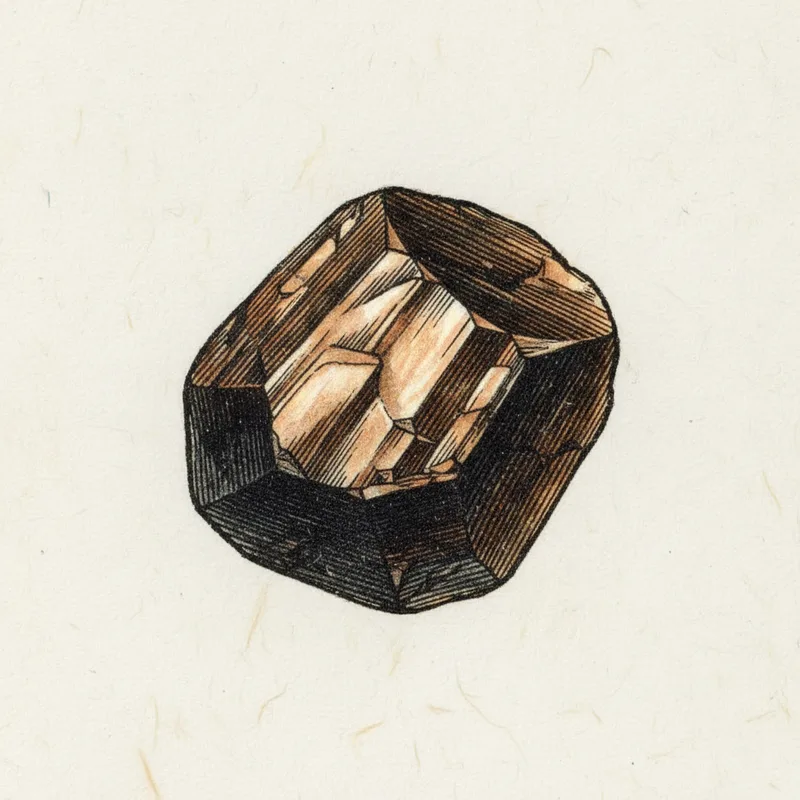
Quick Facts
Formation & Origin
Hypersthene is an orthopyroxene in the enstatite-ferrosilite series, where magnesium and iron substitute freely for one another. Traditionally the name referred to compositions with roughly 30 to 50 percent of the ferrosilite end member. In 1988 the International Mineralogical Association discredited hypersthene as a valid species name and folded it into enstatite, so the correct modern name for most of this material is ferroan enstatite. The old trade name survives because cutters, dealers, and older references all still use it.
Hypersthene crystallizes at high temperature in mafic and ultramafic igneous rocks, including gabbro, norite, and pyroxenite, and in high-grade metamorphic rocks of the granulite facies. The large schiller-rich masses sold as specimens come from anorthosite complexes, where orthopyroxene occurs as coarse cumulate grains alongside plagioclase feldspar. Labrador, Ontario, Norway, and parts of the Indian shield all host such bodies.
The characteristic bronze-to-black iridescent flash, called schiller, comes from exsolution lamellae of ilmenite or magnetite. As the pyroxene slowly cooled, minor titanium and iron oxides unmixed along preferred crystallographic planes, forming thin ordered layers inside each crystal. Light reflects off those layers to produce the coppery metallic sheen that moves across the surface when the stone is rotated.
Identification Guide
Hypersthene is dark brown, greenish black, or nearly black, with a vitreous to submetallic luster and a specific gravity between 3.4 and 3.9 that feels noticeably heavy in hand. Hardness is 5 to 6, so it will scratch glass but is scratched by quartz. The streak is grayish white to pale brown.
The single most useful diagnostic feature is the schiller. When a polished surface is tilted under a direct light, a bright bronze, copper, or sometimes dark red flash sweeps across the stone in a narrow band. The reflection stays sharp and metallic, not rainbow colored, and it comes from inside the crystal rather than the surface.
Two cleavage directions meeting at nearly 90 degrees mark it as a pyroxene and distinguish it from amphiboles, which cleave at about 120 and 60 degrees. Crystal faces, when present, are prismatic and orthorhombic in habit.
Spotting Fakes
Bronzite, a magnesium-rich orthopyroxene from the same series, is frequently sold as hypersthene because the two grade into each other. Bronzite tends to show a softer golden sheen rather than the dark bronze-to-black flash of iron-richer material. Unless the seller specifies composition, assume any lower-priced schiller pyroxene is closer to bronzite. Labradorite is the most common point of confusion for the flashy look. Labradorite is a feldspar, softer at 6 to 6.5, lower in specific gravity at around 2.7, and shows broad rainbow labradorescence rather than a narrow metallic bronze band. Hypersthene feels noticeably denser in hand and flashes in a more restricted color range. Black tourmaline is sometimes passed off as hypersthene for cheaper tumbled lots. Tourmaline has striated prism faces, a triangular cross section, and no schiller at all. If a so-called hypersthene tumble shows no internal flash when rotated under direct light, treat it as a mislabeled black stone. Glass and resin imitations occasionally appear in jewelry with painted or foil-backed flash. These look the same from every angle because the flash is on the back, not inside the stone, and they have low specific gravity. Genuine hypersthene always shows a moving reflection that tracks with the viewing angle.
Cultural & Metaphysical Traditions
Presented as cultural traditions, not scientific evidence
Hypersthene has no significant ancient tradition because it was only described scientifically in 1804. Its current metaphysical reputation is entirely modern, built around its dark grounded color and flashing schiller. Crystal practitioners associate it with focus, decision making, and quieting mental chatter, often pairing it with labradorite as a high-energy and low-energy flash combination.
Where It's Found
Classic source for schiller-rich specimens in anorthosite
Large masses with bronze-to-copper flash, commercially cut
Most tumbled and cabbed hypersthene on the market comes from here
Orthopyroxene in gabbroic host rocks, locally with schiller
Well-studied layered intrusion with ferroan enstatite zones
Price Guide
Good to Know
Scratch test: At hardness 5.5, Hypersthene resists scratching from a knife but can be scratched by quartz. Best for pendants and earrings rather than rings.
Sources: Found in 5 notable locations worldwide, from Canada to Greenland.
Heft test: Hypersthene has average mineral density (3.4–3.9). It feels about as heavy as you'd expect from a stone its size.
Related Minerals
Magnesium end member of the same orthopyroxene series
Magnesium-rich orthopyroxene with golden schiller, often confused
Iron end member of the enstatite-ferrosilite series, very rare pure
Feldspar with rainbow flash, frequently mistaken for hypersthene
Clinopyroxene cousin found in the same igneous rocks
Explore More
Stay in the loop
From the Almanac
Updates from Crystal Almanac, when there’s something worth sharing.