Quick Facts
Formation & Origin
Iolite is the gem variety of cordierite, an aluminum magnesium silicate that forms during metamorphism of aluminum-rich sedimentary rocks. It requires specific pressure and temperature conditions (moderate pressure, moderate-to-high temperature) and is commonly found in gneisses, schists, and hornfels.
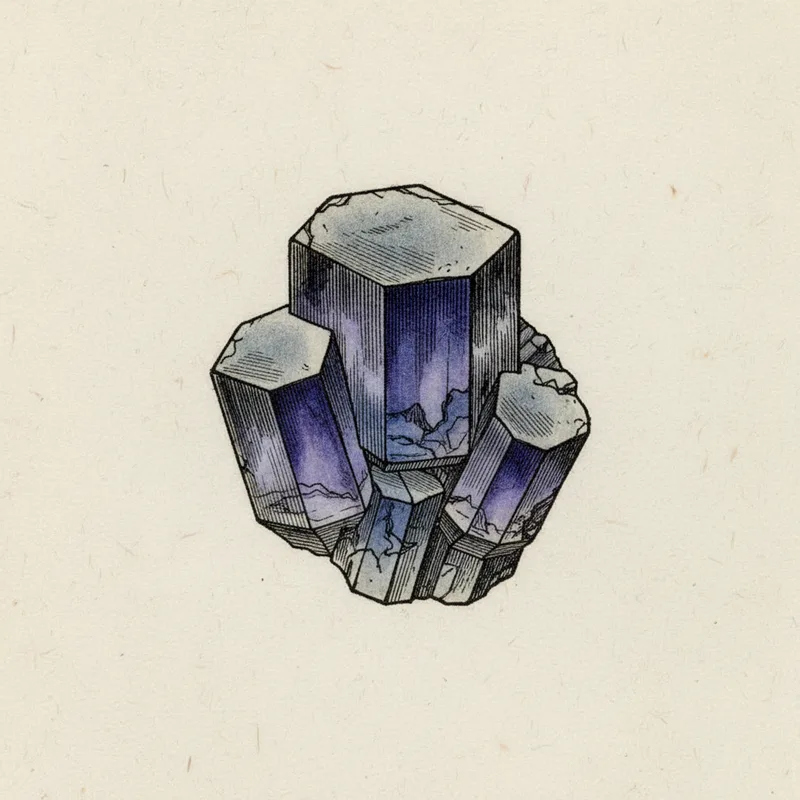
Iolite's most remarkable property is its extreme pleochroism - it shows three distinctly different colors depending on the viewing direction: violet-blue, blue-gray, and pale yellow-clear. This trichroism is stronger than in virtually any other gemstone. It's so pronounced that gem cutters must orient the stone very precisely to show the best blue face-up.
The Viking compass legend suggests that Norse seafarers used iolite as a polarizing filter to locate the sun on overcast days, enabling navigation across the open Atlantic. While the historical evidence is debated (calcite may be the actual 'sunstone' referenced in the sagas), iolite does have polarization properties and the story has become inseparable from the gem's marketing.
Identification Guide
Iolite's dramatic pleochroism is its most diagnostic feature. Rotate the stone and watch it shift from violet-blue to pale yellow to gray-blue. No other common gem-quality blue stone shows this degree of color change with direction.
Distinguish from tanzanite (softer at 6.5, different pleochroism axis), blue sapphire (much harder at 9, different SG), and blue tourmaline (different crystal system, less extreme pleochroism). At hardness 7, iolite is durable but has some cleavage that requires care in setting.
Spotting Fakes
Iolite is affordable enough that synthetic production isn't commercially viable. The main risk is confusion with more expensive stones (iolite sold as sapphire or tanzanite) or cheaper substitutes sold as iolite. The trichroic test is definitive - rotating a genuine iolite reveals three distinct colors. Glass and synthetic sapphire lack this specific three-directional color change.
Cultural & Metaphysical Traditions
Presented as cultural traditions, not scientific evidence
The Viking navigation legend dominates iolite's cultural narrative. Beyond that, iolite has been used since antiquity but was often confused with sapphire - the name 'iolite' (from Greek 'ios' meaning violet) is relatively recent. Leif Erikson supposedly used iolite to navigate to North America. Modern practitioners associate it with inner vision, self-discovery, and finding direction in life - themes that naturally extend from the Viking compass story.
Where It's Found
Primary commercial source
Fine gem quality, alluvial deposits
Good quality material
Significant producer
Price Guide
Good to Know
Scratch test: At hardness 7, Iolite can scratch glass and steel. It's durable enough for any type of jewelry.
Sources: Found in 4 notable locations worldwide, from India to Madagascar.
Heft test: Iolite has average mineral density (2.61). It feels about as heavy as you'd expect from a stone its size.
Related Minerals
Similar blue-violet, different mineral
Historically confused, much harder
The parent mineral species of iolite
Another blue metamorphic mineral
Explore More
Other Silicates & Gems
The Manifestation Collection
The Viking compass stone. Norse navigators used iolite to find the sun through cloud cover. Associated with finding your true direction and navigating toward it.
Crystals by Color: Meaning and Stone Selection Guide
Mohs Hardness Scale
See where Iolite sits on the scale
Crystal Care Guide
Water safety, sunlight, and handling tips
Stay in the loop
From the Almanac
Updates from Crystal Almanac, when there’s something worth sharing.