Quick Facts
Formation & Origin
Jeremejevite forms only where boron-rich hydrothermal fluids interact with aluminum-rich granitic rocks during the final stages of pegmatite crystallization. This narrow geochemical window explains its extreme rarity. Most pegmatites are either boron-poor, aluminum-limited, or lack the late-stage fluid activity needed to concentrate both elements in the same pocket.
The Erongo Mountain deposit in Namibia, which produced the first gem-quality blue jeremejevite in 2001, formed within miarolitic pockets in a peraluminous granite. As the granite body cooled approximately 130 million years ago, residual fluids enriched in boron, fluorine, and volatile components collected in cavities where they slowly crystallized into aquamarine, schorl, and rarely jeremejevite. The Mt. Soktuj locality in Russia, where the mineral was first described in 1883 and named for the Russian mineralogist Pavel Eremeev (transliterated into German as Jeremejev), yielded smaller and generally paler crystals from similar granitic pegmatite settings.
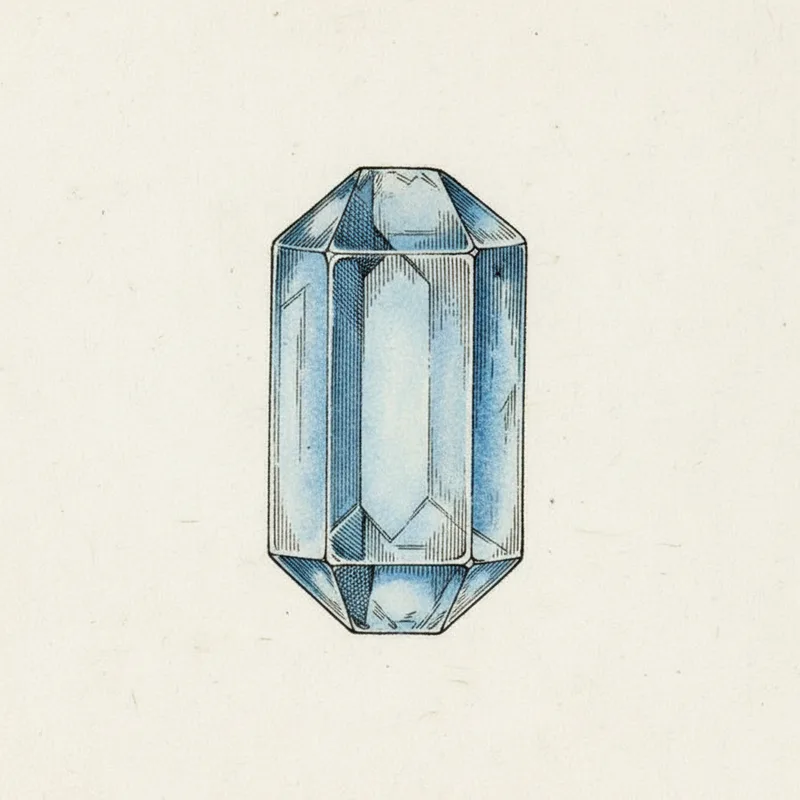
The blue color in Namibian material comes from small amounts of Fe²⁺ substituting for Al³⁺ in the octahedral sites of the crystal structure. This is the same color mechanism that produces aquamarine, which explains why the two minerals look so similar despite having completely different chemistries. Crystals grow as slender hexagonal prisms, typically terminated by a flat basal pinacoid. Faceted gems are usually 1 to 3 carats. Anything over 3 carats is museum-grade, and stones over 5 carats are effectively unique.
Identification Guide
Jeremejevite presents as slender hexagonal prismatic crystals with vitreous luster, typically pale cornflower blue but also colorless or rarely pale yellow. The crystal habit is distinctive: thin prisms that often taper slightly, with flat terminations rather than pyramidal caps. Refractive index of 1.64 to 1.65 and specific gravity of 3.28 are key diagnostic properties.
The most important identification test is weight. Jeremejevite feels markedly heavier than an equivalent piece of aquamarine due to its SG of 3.28 versus aquamarine's 2.69. Birefringence of 0.013 is visible under a loupe as slight doubling of back facets in faceted stones. Hardness at 7 is comparable to quartz. The stone is brittle and has one direction of indistinct cleavage, so cut stones require careful handling.
Distinguish from aquamarine by SG and RI. Distinguish from blue topaz by RI (topaz 1.61 to 1.62) and crystal system (topaz is orthorhombic, not hexagonal). Distinguish from blue sapphire by hardness and dispersion (sapphire is much harder at 9 and shows no doubling).
Spotting Fakes
The main risk is confusion with aquamarine, not deliberate faking. Aquamarine is hexagonal, blue, and iron-colored just like jeremejevite, so visual ID alone is unreliable. Test refractive index: aquamarine reads 1.57 to 1.58 while jeremejevite reads 1.64 to 1.65. Test specific gravity with a hydrostatic scale or heft comparison. Jeremejevite at 3.28 feels noticeably heavier than aquamarine at 2.69, often obvious just by holding the stones side by side. Blue topaz is another possible confusion (RI 1.61 to 1.62, SG 3.53). Synthetic jeremejevite does not exist commercially. The mineral is too obscure to justify laboratory production. Glass imitations are easy to spot: look for gas bubbles, rounded facet edges, and isotropic response under crossed polarizers (real jeremejevite is doubly refractive). The most common fraud is actually reverse. Genuine jeremejevite is sometimes sold as "rare blue aquamarine" or "Namibian blue beryl" without disclosure, which cheats the buyer out of significant value since jeremejevite is worth several times more per carat than aquamarine. If you buy Namibian Erongo blue material, request a lab report identifying the species, especially for stones over 1 carat.
Cultural & Metaphysical Traditions
Presented as cultural traditions, not scientific evidence
Jeremejevite has no ancient cultural traditions given its recent discovery and extreme rarity. The mineral was identified in Russia in 1883, and gem-quality material only became available after the 2001 Erongo find in Namibia. Contemporary crystal practitioners associate it with clarity of thought, higher communication, and spiritual insight, often grouping it with other rare blue gems like aquamarine, benitoite, and hauyne. Because of its scarcity and price, it rarely appears in traditional crystal healing practice and is primarily a connoisseur's collector gem rather than a working stone.
Where It's Found
Premier gem-quality source, cornflower blue crystals from miarolitic granite pockets, discovered 2001
Type locality (1883), smaller and paler crystals than Namibian material
Rare colorless to pale blue crystals from alpine pegmatites
Minor occurrence of small colorless crystals
Price Guide
Good to Know
Scratch test: At hardness 7, Jeremejevite can scratch glass and steel. It's durable enough for any type of jewelry.
Sources: Found in 4 notable locations worldwide, from Namibia to Madagascar.
Heft test: Jeremejevite has average mineral density (3.28). It feels about as heavy as you'd expect from a stone its size.
Related Minerals
Similar blue color from Fe²⁺, same hexagonal system, commonly confused
Another rare blue collector gem, also iron-colored
Related rare borate mineral, also forms in pegmatites
Explore More
Stay in the loop
From the Almanac
Updates from Crystal Almanac, when there’s something worth sharing.