Quick Facts
Formation & Origin
Aquamarine is the blue variety of beryl - the same mineral species that includes emerald (green), morganite (pink), and heliodor (yellow). It forms in granitic pegmatites, the coarse-grained igneous rocks that crystallize from the last volatile-rich dregs of cooling magma.
The blue color comes from trace amounts of iron (Fe²⁺) substituting for aluminum in the crystal structure. Unlike emerald, which is colored by chromium and typically riddled with inclusions, aquamarine tends to form in cleaner geological environments, resulting in crystals of exceptional clarity. Some aquamarine crystals from Brazil have grown to extraordinary sizes - the Dom Pedro, the world's largest cut aquamarine, weighs 10,363 carats (over 2 kg) and stands in the Smithsonian.
Most aquamarine on the market has been heat-treated to remove greenish tints, shifting the color toward a purer blue. This treatment involves heating the stone to about 400-450 degrees Celsius, which changes the oxidation state of the iron. The treatment is permanent, stable, and universally accepted in the gem trade.
Identification Guide
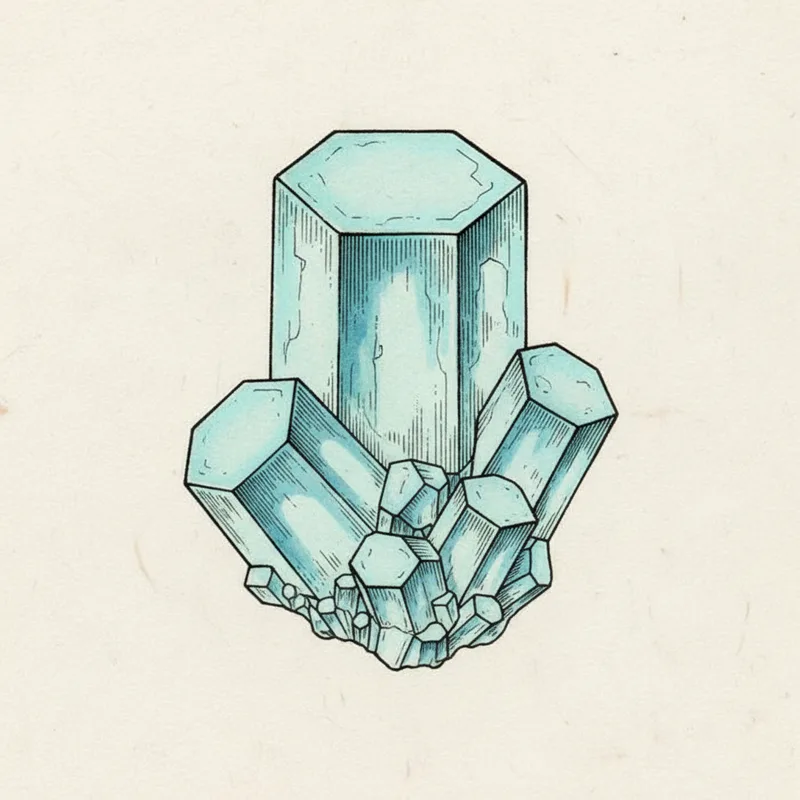
Aquamarine's combination of blue color, excellent transparency, and hexagonal crystal habit is distinctive. At 7.5 Mohs, it's hard and durable. It lacks cleavage (unlike topaz, which it sometimes resembles) and has a vitreous luster.
Distinguish from blue topaz (slightly higher specific gravity, perfect cleavage), blue tourmaline/indicolite (triangular cross-section), and blue glass (warm to touch, may contain bubbles). Aquamarine often contains characteristic 'rain' inclusions - tiny parallel tubes that are diagnostic of beryl. Viewed down the crystal axis, beryl shows a distinctive hexagonal shape.
Spotting Fakes
Synthetic aquamarine exists but is rare in the market. The primary concern is blue topaz being sold as aquamarine - blue topaz is irradiated and heated to achieve a similar color but is less valuable. Blue glass is also used as an imitation. Key tells: genuine aquamarine is typically a softer, more pastel blue than treated topaz, which tends toward a more intense 'Swiss' blue. Lab reports are recommended for stones over 5 carats or sold at premium prices.
Cultural & Metaphysical Traditions
Presented as cultural traditions, not scientific evidence
Roman fishermen called it 'water of the sea' and carried it for protection on voyages. Medieval Europeans believed aquamarine could reawaken love between married couples. It was traditionally associated with the sea god Neptune. Sailors wore aquamarine amulets engraved with Neptune's likeness for safe passage. Modern practitioners associate it with clear communication, courage, and emotional clarity.
Where It's Found
Largest crystals ever found, including the 110 kg Dom Pedro
Fine gem-grade crystals from high-altitude mines
Deep blue saturated color, highly sought after
Good quality material, growing source
Price Guide
Good to Know
Scratch test: At hardness 7.5, Aquamarine can scratch glass and steel. It's durable enough for any type of jewelry.
Sources: Found in 4 notable locations worldwide, from Brazil to Madagascar.
Heft test: Aquamarine has average mineral density (2.72). It feels about as heavy as you'd expect from a stone its size.
Explore More
Beryl Family
The Communication Collection
The 'sailor's stone.' Associated with courage under pressure and clear communication in difficult situations.
The Travel Collection
The sailor's stone. Roman sailors carried it for safe passage across water. Named for the Latin 'aqua marina' (sea water), its blue-green color connects it to ocean travel across Mediterranean cultures.
Lepidolite for Anxiety: Science vs. Lore
Carnelian: Meaning, Properties, and How to Use It
Crystals by Zodiac Sign: A Complete Guide
Mohs Hardness Scale
See where Aquamarine sits on the scale
Crystal Care Guide
Water safety, sunlight, and handling tips
Stay in the loop
From the Almanac
Updates from Crystal Almanac, when there’s something worth sharing.