Quick Facts
Formation & Origin
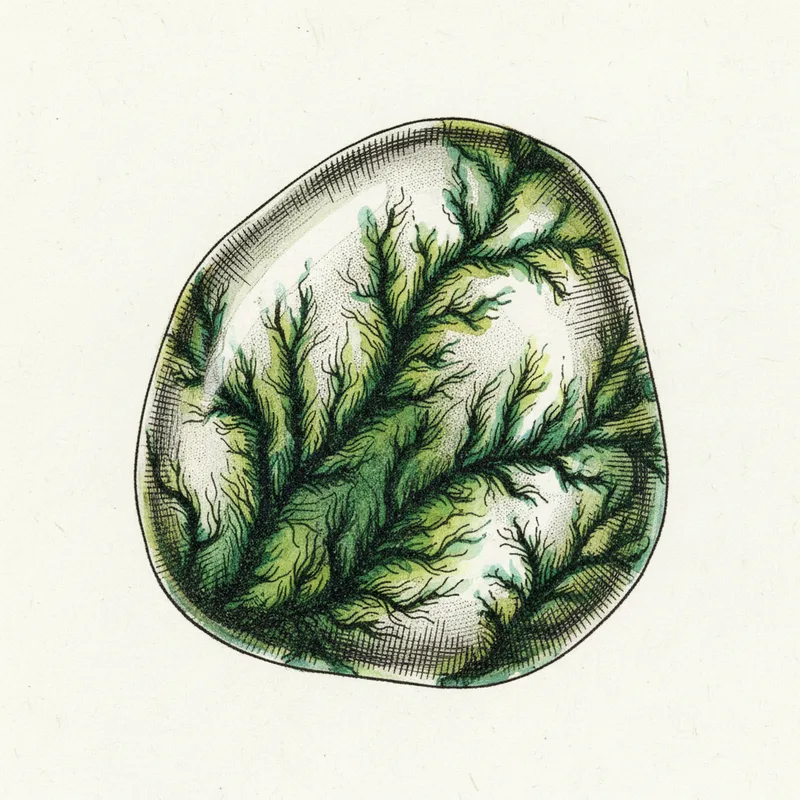
Moss agate isn't technically an agate (it lacks the banding that defines true agate) - it's translucent chalcedony with green filamentous inclusions of chlorite, hornblende, or iron oxide minerals that resemble moss, ferns, or tree branches growing inside the stone.
These inclusions form when mineral-rich fluids infiltrate silica gel during the chalcedony's formation in volcanic rock cavities. The green minerals crystallize within the gel in branching patterns influenced by diffusion physics - the same processes that create dendritic agate's tree patterns, but with three-dimensional green mineral growths rather than flat manganese oxide deposits.
The result is a stone that genuinely looks like it contains tiny fossilized plants - a visual coincidence that has made moss agate one of the most popular semiprecious stones for thousands of years. The best specimens show vivid green inclusions suspended in clear to translucent chalcedony, creating a miniature landscape effect.
Identification Guide
Moss agate is identified by its translucent chalcedony host containing green, filamentous inclusions that resemble moss or lichen. At hardness 7, it's durable and takes a good polish.
Distinguish from dendritic agate (flat black/brown dendrites vs three-dimensional green filaments), tree agate (opaque white with green spots, not translucent), and serpentine (uniform green, no inclusions in clear host). The green inclusions in moss agate have depth and dimension visible when the stone is rotated.
Spotting Fakes
Moss agate is common and inexpensive, making faking rare. Glass imitations with embedded green material exist but lack the natural randomness of genuine inclusions. Dyed green agate may be sold as moss agate but lacks the characteristic filamentous inclusion pattern. Genuine moss agate's green inclusions follow natural crystal growth patterns visible under magnification.
Cultural & Metaphysical Traditions
Presented as cultural traditions, not scientific evidence
European farmers historically placed moss agate in fields and hung it from trees to ensure successful harvests and protect livestock. It was considered the most powerful agricultural talisman. In Indian tradition, moss agate is associated with nature spirits. Modern crystal practitioners call it the gardener's stone, associating it with abundance, new beginnings, and connection to nature. It's popular among people who work with plants or spend time outdoors.
Where It's Found
Major commercial source, wide variety
Fine translucent material
Scenic specimens with vivid inclusions
Good quality agate with moss inclusions
Price Guide
Good to Know
Scratch test: At hardness 7, Moss Agate can scratch glass and steel. It's durable enough for any type of jewelry.
Sources: Found in 4 notable locations worldwide, from India to Uruguay.
Heft test: Moss Agate has average mineral density (2.60). It feels about as heavy as you'd expect from a stone its size.
Explore More
Quartz & Chalcedony
The Abundance Collection
European farmers placed moss agate in fields for abundant harvests. The oldest agricultural prosperity stone tradition in Western culture.
Crystals by Zodiac Sign: A Complete Guide
Best Crystals for Beginners: 12 Stones to Start With
Mohs Hardness Scale
See where Moss Agate sits on the scale
Crystal Care Guide
Water safety, sunlight, and handling tips
Stay in the loop
From the Almanac
Updates from Crystal Almanac, when there’s something worth sharing.