Quick Facts
Formation & Origin
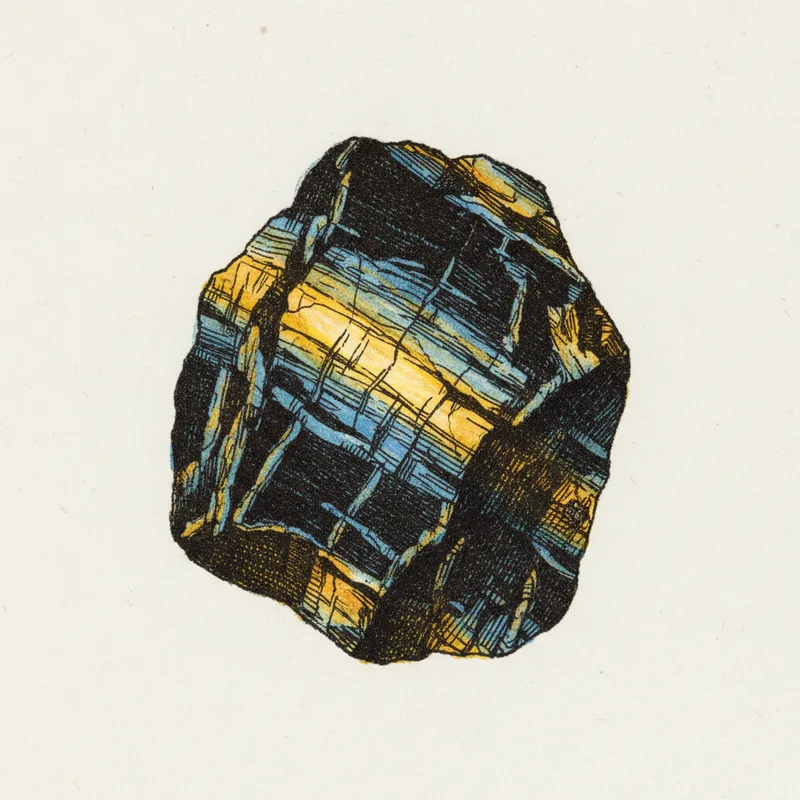
Nuummite is a metamorphic rock composed primarily of two amphibole minerals - gedrite and anthophyllite - that formed approximately 3 billion years ago in what is now Greenland, making it one of the oldest rocks used as a gemstone. The name comes from Nuuk, Greenland's capital.
The characteristic iridescent flashes that make nuummite visually striking are caused by lamellar intergrowths of the two amphibole minerals. As the rock underwent metamorphism, thin layers of gedrite and anthophyllite formed in alternating sheets. Light reflecting between these thin layers produces golden, bronze, blue, green, and occasionally violet flashes through thin-film interference.
Nuummite's remote Arctic source - accessible only during Greenland's brief summer and requiring difficult overland travel to reach the deposit - severely limits supply. This genuine scarcity, combined with its impressive visual properties and ancient age, has made it a premium collector's stone.
Identification Guide
Nuummite is identified by its black base color with distinctive iridescent flashes that appear when the stone is rotated. The flashes are typically golden to bronze but can include blue and green. The effect is similar to labradorite but from a completely different mineral assemblage.
Distinguish from labradorite (feldspar, blue-dominant flash, different rock type), black opal (silica, different iridescence mechanism), and arfvedsonite (similar black with flash but single mineral). Nuummite's golden-bronze flash on a dark amphibole matrix is distinctive.
Spotting Fakes
Genuine nuummite is expensive enough to warrant caution. Some black stones with surface treatments or metallic coatings are sold as nuummite. Genuine nuummite's flashes come from within the stone - not from surface effects. Arfvedsonite and astrophyllite (other black minerals with flashes) are sometimes sold as nuummite but are different rocks. True nuummite comes only from Greenland; any claim of nuummite from other localities should be verified.
Cultural & Metaphysical Traditions
Presented as cultural traditions, not scientific evidence
In Inuit tradition, iridescent stones are associated with the Northern Lights and considered to contain trapped aurora energy. Nuummite's modern metaphysical reputation centers on 'deep magic' and sorcery - it's often called the sorcerer's stone or the magician's stone. Practitioners associate it with accessing ancestral wisdom, shadow work, and personal power. Its extreme age (3 billion years) reinforces associations with ancient Earth energy.
Where It's Found
The only known source of gem-quality material
Price Guide
Good to Know
Scratch test: At hardness 6, Nuummite resists scratching from a knife but can be scratched by quartz. Best for pendants and earrings rather than rings.
Sources: Found at only one location on Earth - Greenland. Supply is inherently limited.
Heft test: Nuummite has average mineral density (3.00-3.40). It feels about as heavy as you'd expect from a stone its size.
Related Minerals
Different mineral, similar iridescent flash
Black mineral with blue flash, sometimes confused
Star-shaped golden inclusions in black matrix
Finnish labradorite with full spectrum flash
Explore More
Stay in the loop
From the Almanac
Updates from Crystal Almanac, when there’s something worth sharing.