Quick Facts
Formation & Origin
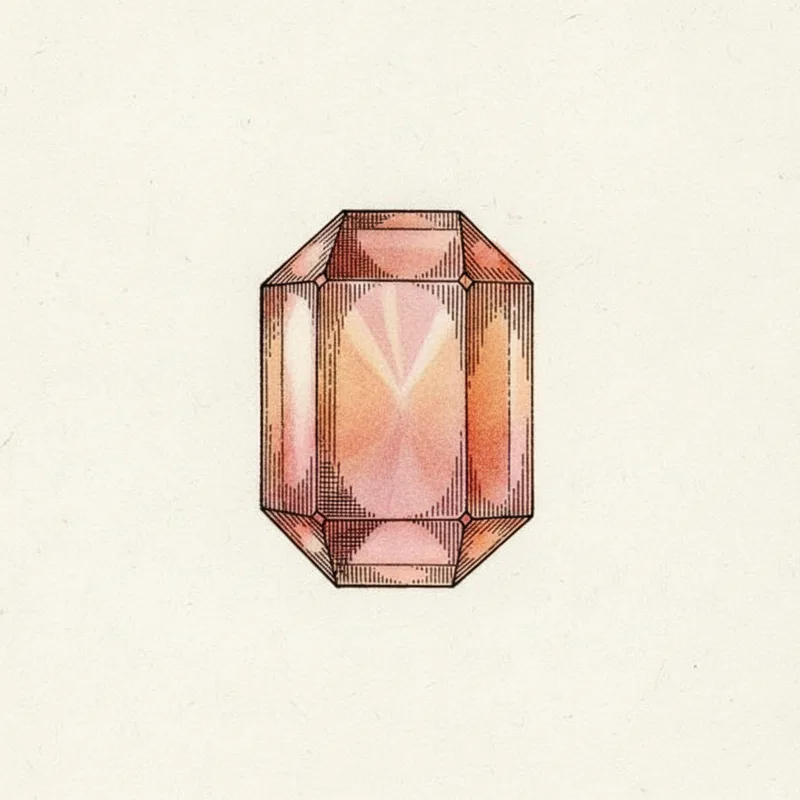
Padparadscha is the rarest color of sapphire: a pastel pinkish-orange to orangey-pink corundum whose name comes from the Sanskrit 'padma raga', meaning lotus color. Sri Lankan stones form in pegmatites and metamorphic rocks of the island's central highlands, then weather into the alluvial gem gravels around Ratnapura where they have been mined for over a thousand years.
The color is produced by an unusual balance of two trace elements in the corundum lattice. Chromium (Cr³⁺) contributes pink tones, the same element that colors ruby, while iron (Fe³⁺) contributes yellow and orange. Neither element alone produces padparadscha. Only the precise mixture, at low concentrations that keep the stone pastel rather than saturated, creates the characteristic lotus color.
The GIA describes the ideal as 'a delicate blend of pink and orange', and gemological labs disagree on the exact boundaries. Some accept only Sri Lankan origin as true padparadscha, while GIA, AGL, and most Western labs accept stones from Madagascar and Tanzania that meet the color criteria. The coloring conditions are so specific that padparadscha is among the rarest gems on earth, with perhaps one stone qualifying for every several thousand fancy sapphires mined.
Identification Guide
Padparadscha is identified first by color: a soft blend of pink and orange, lighter and more delicate than orange sapphire or pink sapphire alone. Laboratory reports generally describe the hue as 'pinkish-orange' or 'orangey-pink' with moderate saturation and medium-light tone. Refractive index (1.762-1.770), specific gravity near 4.00, and hardness of 9 confirm corundum.
Under magnification, natural stones may show silk-like rutile needles, fingerprint inclusions, or zones of color layering. Pleochroism is moderate, with the stone appearing slightly more orange in one direction and more pink in another. Origin determination requires advanced testing of trace-element chemistry and inclusion scenes by a major gemological lab.
Spotting Fakes
The biggest risk is beryllium lattice-diffusion treatment, introduced in the early 2000s, which can turn cheap pale yellow or near-colorless sapphires into convincing padparadscha lookalikes. Detection requires laboratory testing such as LIBS or LA-ICP-MS to measure beryllium content, which is impossible to identify with a loupe alone. Under immersion in methylene iodide with strong lighting, gemologists can sometimes see a shallow color 'rim' on diffusion-treated stones where the surface is saturated but the core remains pale. Heat-only treatment is common and accepted in the trade. Flame-fusion (Verneuil) and flux-grown synthetic sapphires in padparadscha color exist at low price points; these show curved growth striae or platinum platelets under 10x magnification, features never seen in natural stones. Glass imitations show bubble inclusions and lack corundum's high specific gravity. Any serious purchase should come with a GIA, SSEF, or Gübelin report confirming natural origin, disclosing treatments, and stating 'padparadscha' as the color grade. Unheated, untreated Sri Lankan stones with top lab pedigree command the highest prices in the colored-gem market.
Cultural & Metaphysical Traditions
Presented as cultural traditions, not scientific evidence
In Sinhalese Buddhist tradition, the lotus blossom symbolizes awakening and purity rising through muddy water, and padparadscha has long been associated with compassion and creative passion. Crystal practitioners link its warm pastel tones to heart opening balanced with the creative fire of the sacral chakra. It is often described as a stone of tender courage and gentle joy, softer than ruby but warmer than pink sapphire.
Where It's Found
Classic origin, the only source some labs accept as true padparadscha
Major modern source since the late 1990s, accepted by most major labs
Occasional fine material, typically smaller stones under 2 carats
Price Guide
Good to Know
Scratch test: At hardness 9, Padparadscha can scratch glass and steel. It's durable enough for any type of jewelry.
Sources: Found in 3 notable locations worldwide, from Sri Lanka to Tanzania.
Heft test: Padparadscha has a specific gravity of 3.99-4.00 - noticeably heavier than quartz. You'll feel the density when you pick it up.
Explore More
Stay in the loop
From the Almanac
Updates from Crystal Almanac, when there’s something worth sharing.