Quick Facts
Formation & Origin
Rainbow lattice sunstone formed in a single pegmatite pocket inside the Harts Range, part of the Central Australian Precambrian basement. During slow cooling of the pegmatite melt, potassium feldspar crystallized as orthoclase and began to unmix microscopic iron and titanium impurities through a process called exsolution.
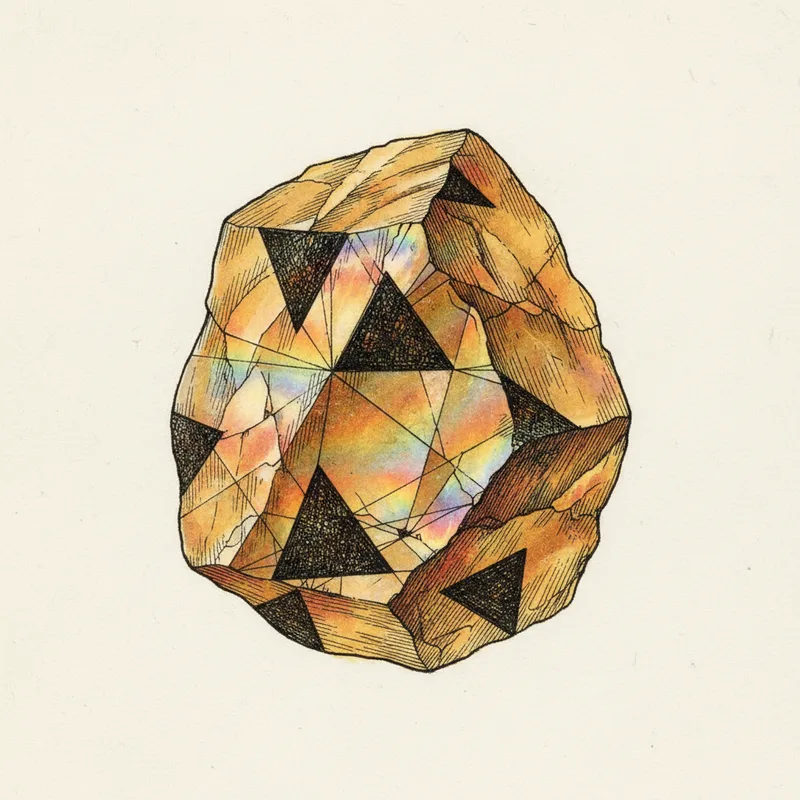
Two separate exsolution events produced the stone's optical signature. First, ilmenite (iron titanium oxide) unmixed as oriented triangular platelets that grew parallel to the 001 crystallographic face of the host orthoclase. These dark triangles sit in precise geometric arrangements, forming the visible lattice pattern that gives the stone its name. Second, hematite unmixed as vanishingly thin platelets aligned with the orthoclase twin planes. The hematite films are thinner than visible light wavelengths, so they produce iridescent color flash through thin-film interference, the same physics that creates rainbows on soap bubbles.
The result is a feldspar that shows two optical effects at once: classic sunstone aventurescence from the hematite platelets, and a geometric lattice that looks engineered rather than grown. This exact combination has never been documented anywhere else on Earth. The pocket was discovered in the 1980s by prospectors, but commercial mining only began around 2000 after the traditional owners and miners formalized an operating agreement. Yields are small. Most finished cabochons fall between 1 and 5 carats, and clean gem-quality stones above 10 carats are exceptional.
Identification Guide
Genuine rainbow lattice sunstone shows three diagnostic features at once. Look for oriented triangular dark inclusions (ilmenite) that sit in a visibly geometric arrangement rather than randomly scattered. Rotate the stone and you should see both metallic glitter flashes (aventurescence from hematite) and rainbow iridescence that shifts through blues, greens, oranges, and reds as the angle changes.
The iridescence has depth. Because the hematite platelets sit at different levels inside the feldspar, the color flash appears to come from inside the stone rather than sitting on its surface. Hardness runs around 6 on the Mohs scale, typical for orthoclase, and the host feldspar shows the two perfect cleavages common to the species. Specific gravity sits in the normal feldspar range of 2.55 to 2.63.
Under magnification, the triangular ilmenite plates align consistently relative to the feldspar's internal structure. Random orientations would point to an imitation.
Spotting Fakes
The most common imitations are synthetic opalite glass (often sold as 'sea opal' with added flakes), manufactured goldstone (copper-flake glass), and dyed or heat-treated orthoclase without any genuine lattice pattern. Goldstone is the closest visual match at a glance but falls apart under a 10x loupe. Its copper flakes sit in a perfectly random, fully saturated pattern with no triangular geometry and no depth. Genuine rainbow lattice shows clearly triangular dark plates in oriented rows. Opalite glass produces a milky all-over iridescence with no discrete lattice inclusions at all. Dyed feldspars can fake the color but cannot reproduce the oriented ilmenite triangles. Three practical checks: use a 10x loupe to confirm triangular (not irregular) dark inclusions, tilt the stone under a single light source and watch for iridescence that appears to come from different depths inside the stone rather than purely off the surface, and be skeptical of any seller who cannot trace the stone to the Utnerrengatye mine. Because only one mine on Earth produces this material, every legitimate dealer should be able to name it.
Cultural & Metaphysical Traditions
Presented as cultural traditions, not scientific evidence
Rainbow lattice sunstone entered the modern crystal trade only in the early 2000s, so it has no deep historical folklore. Contemporary practitioners treat it as a stone of joy, creativity, and personal sovereignty, drawing on general sunstone associations combined with the lattice's geometric symbolism. Traditional owners of the Harts Range region have their own cultural relationships to the land where it is mined, which are not shared publicly and should not be conflated with metaphysical marketing.
Where It's Found
The only locality on Earth producing genuine rainbow lattice sunstone. The name Utnerrengatye is Eastern Arrernte for 'spotty rock,' and the mine is operated on Aboriginal land under an ethical partnership.
Price Guide
Good to Know
Scratch test: At hardness 6, Rainbow Lattice Sunstone resists scratching from a knife but can be scratched by quartz. Best for pendants and earrings rather than rings.
Sources: Found at only one location on Earth - Australia. Supply is inherently limited.
Heft test: Rainbow Lattice Sunstone has average mineral density (2.55–2.63). It feels about as heavy as you'd expect from a stone its size.
Explore More
Stay in the loop
From the Almanac
Updates from Crystal Almanac, when there’s something worth sharing.