Quick Facts
Formation & Origin
Oregon sunstone is a copper-bearing labradorite, a calcium-sodium plagioclase feldspar that crystallized inside basaltic lava flows in south-central and southeastern Oregon roughly one million years ago. As the parent magma rose through the crust, dissolved copper was held in the melt by high temperature and pressure. When the lava erupted and began cooling, plagioclase feldspar crystallized first as large phenocrysts while copper remained dissolved in the surrounding liquid.
As cooling continued and the copper became oversaturated, it precipitated as native copper platelets directly inside the already-formed feldspar crystals. This is the key mechanism that sets Oregon sunstone apart: the copper is not a surface coating or fracture filling but a structurally oriented inclusion locked inside the feldspar lattice along specific crystallographic planes. Later erosion of the weathered basalt released the durable feldspar crystals into surface soils, where they are now mined from both in-place basalt and surface eluvial deposits.
Color in Oregon sunstone is a direct function of copper concentration and platelet size. Champagne and pale yellow stones contain dispersed sub-microscopic copper that tints the feldspar without visible schiller. Increasing copper content shifts color through pink and peach to deep orange and the prized cherry red. The largest copper plates, oriented parallel to a crystallographic face, produce the reflective schiller that flashes metallic gold or red when the stone is tilted. This is the only gem feldspar in North America colored by copper, and one of only a handful worldwide.
Identification Guide
Oregon sunstone is identified by the combination of feldspar optical and physical properties with copper-driven color and schiller. Hardness of 6, specific gravity between 2.62 and 2.65, and the triclinic cleavage of plagioclase place it firmly in the labradorite family. The refractive index runs 1.563 to 1.572, higher than alkali feldspars like orthoclase. Most decisive is the schiller: tilt a faceted stone or cabochon in direct light and watch for directional metallic flashes that come from reflection off oriented copper plates inside the stone.
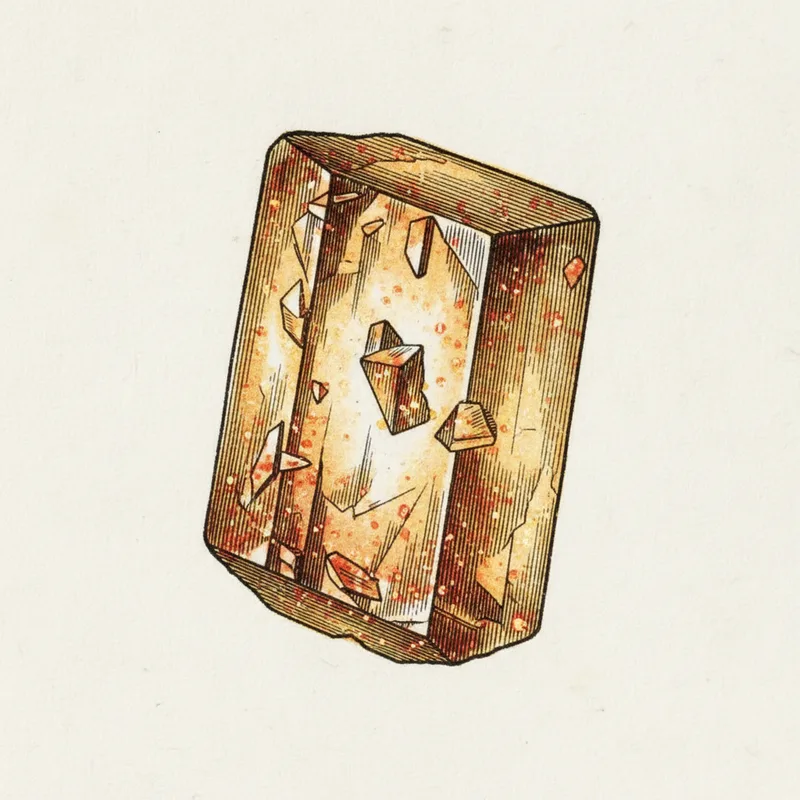
Under magnification, genuine Oregon sunstone shows copper platelets as hexagonal or triangular metallic inclusions scattered irregularly through the stone, often with slight variation in size and orientation. In dichroic red-green material, rotating the stone reveals distinct green and red zones along different crystallographic directions, a pleochroic effect caused by the interaction of light with aligned copper clusters. The bodycolor should gradate naturally through the stone, with richer color typically concentrated in the areas with densest copper inclusion.
Spotting Fakes
Two imitations dominate the market and both are identifiable under a 10x loupe. Manufactured goldstone, a copper-flecked glass invented in 17th-century Venice, is sometimes sold as sunstone to uninformed buyers. Under magnification it is unmistakable: the copper flakes are perfectly ordered in a dense, regular grid, all the same size, all the same hexagonal shape, with no variation or natural clustering. Real Oregon sunstone copper inclusions are irregular in size, scattered in orientation, and embedded within a transparent feldspar matrix rather than a glassy substrate. Goldstone also shows tiny gas bubbles under magnification and has a lower specific gravity around 2.5, with a warmer glass feel in the hand. The more sophisticated fake is Chinese-origin "andesine sunstone," which is pale feldspar diffusion-treated with copper at high temperature to create red color at the surface. This material entered the market around 2008 and has been the subject of multiple gemological investigations. Diagnostics include color concentrated at the rim rather than evenly distributed, absence of oriented copper platelets under magnification since the copper is diffused atomically rather than precipitated, and frequent lack of genuine schiller. Stones sold as "red andesine from Tibet" or at prices well below market for fine Oregon red should be assumed to be diffusion-treated until proven otherwise. Certified material from Ponderosa, Spectrum, or Dust Devil with documented provenance is the safest buy.
Cultural & Metaphysical Traditions
Presented as cultural traditions, not scientific evidence
Oregon sunstone was used by the Northern Paiute people long before its commercial rediscovery, collected from surface weathering of the host basalts and traded across the Great Basin. It was designated Oregon's state gem in 1987. In contemporary crystal traditions the stone is associated with personal power, vitality, and creative warmth, an association drawn directly from its fiery copper-driven color. The red variety in particular is sometimes called heart-fire stone in modern lapidary writing.
Where It's Found
Premier producer of red and deep orange sunstone with strong schiller, working the same basalt flow since the 1970s
Known for rare bi-color and green-red dichroic crystals, operating in the Rabbit Hills district
BLM-managed site where the public can collect loose crystals from weathered basalt on the surface
Produces champagne, peach, and occasional red gem rough from the same Pleistocene basalt sequence
Price Guide
Good to Know
Scratch test: At hardness 6, Oregon Sunstone resists scratching from a knife but can be scratched by quartz. Best for pendants and earrings rather than rings.
Sources: Found in 4 notable locations worldwide, from Ponderosa Mine to Dust Devil Mine.
Heft test: Oregon Sunstone has average mineral density (2.62-2.65). It feels about as heavy as you'd expect from a stone its size.
Related Minerals
Parent plagioclase species of Oregon sunstone, same chemistry without copper
Feldspar sunstone colored by hematite platelets instead of copper
Plagioclase of similar composition, commonly diffusion-treated and sold as sunstone
Explore More
Stay in the loop
From the Almanac
Updates from Crystal Almanac, when there’s something worth sharing.