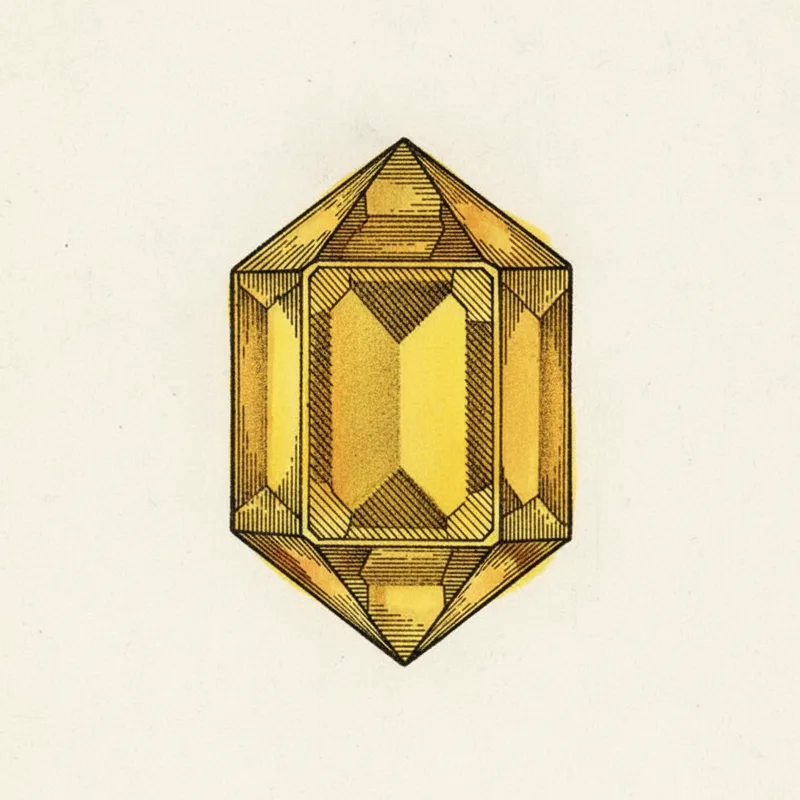
Quick Facts
Formation & Origin
Yellow sapphire is the yellow variety of corundum, the same mineral species that produces ruby and blue sapphire. The yellow color comes from trace iron (Fe³⁺) substituting for aluminum in the crystal lattice. In some stones, trace magnesium pairs with iron to produce a more intense canary yellow through a color center mechanism. Unlike pink and red corundum, yellow sapphire contains no chromium.
Corundum forms in aluminum-rich, silica-poor environments. Gem-quality yellow sapphire typically crystallizes in two settings. The first is alluvial gravels derived from weathered pegmatites and metamorphic rocks, which is how Sri Lankan and Madagascan stones reach the surface. The second is basalt-hosted deposits, where corundum xenocrysts are carried up from deeper crustal sources, the pattern seen in Australia and parts of East Africa.
Sri Lankan yellows from the Ratnapura gravels are the classic Ceylon reference, known for a soft golden tone and high clarity. Madagascar, producing commercial volume since the late 1990s, yields more saturated golden stones. Montana yellows are geologically distinct, forming in metamorphosed volcanic host rocks, and tend to be paler with cooler undertones.
Identification Guide
Yellow sapphire is identified by its combination of high hardness (9), high specific gravity (3.99 to 4.00), and strong double refraction. Refractive index sits at 1.762 to 1.770, higher than most yellow gem look-alikes. Under magnification, natural stones often show silk (fine rutile needles) or angular color banding that follows the hexagonal growth structure.
Distinguish from citrine (hardness 7, lower SG at 2.65, singly refractive character in quartz terms), yellow topaz (hardness 8, lower SG, distinct cleavage), yellow beryl or heliodor (hardness 7.5 to 8, lower SG), and yellow tourmaline (hardness 7, strong pleochroism). Yellow sapphire typically shows weak to moderate pleochroism, golden yellow to pale yellow, visible with a dichroscope. Iron-colored stones show weak fluorescence, whereas magnesium-color-center stones may fluoresce apricot under long-wave UV.
Spotting Fakes
The most common substitution is yellow citrine sold as yellow sapphire. Citrine is roughly a tenth of the price and has hardness 7 versus sapphire 9. A scratch test against a glass plate is decisive: sapphire scratches glass easily and is itself unscratched by a steel file, citrine will not scratch sapphire. Specific gravity testing separates them immediately, 2.65 for citrine against near 4.00 for sapphire. Yellow YAG, synthetic cubic zirconia, and glass imitations are singly refractive. Use a polariscope or check for doubling of back facets under 10x loupe, sapphire shows clear doubling, the imitations do not. Glass also traps gas bubbles and shows swirl marks, never present in natural corundum. The most serious trap is beryllium-diffused sapphire. Pale pink or near-colorless corundum is heated with beryllium oxide to produce vivid yellow-orange color that penetrates only the outer layer. Dealers must disclose this treatment, but it often goes unstated in lower tiers of the trade. Warning signs include color concentration at facet junctions visible in immersion (methylene iodide or diiodomethane with a darkfield loupe), and an unnaturally uniform saturated yellow-orange. Definitive identification requires LIBS or LA-ICP-MS lab testing. For any yellow sapphire over 1 carat, insist on a report from GIA, SSEF, Gubelin, or GRS. Standard heat treatment without beryllium is accepted in the trade and should be disclosed, but does not carry the same value discount as diffusion.
Cultural & Metaphysical Traditions
Presented as cultural traditions, not scientific evidence
In Vedic astrology yellow sapphire is called Pukhraj and is the primary gemstone of Brihaspati, the planet Jupiter. Jyotish tradition prescribes it to strengthen Jupiter's influence on wisdom, teaching, prosperity, and marriage, particularly for those born under Sagittarius and Pisces ascendants. The stone is traditionally set in gold and worn on the right index finger, first activated on a Thursday at sunrise. In medieval European lapidaries yellow sapphire was a symbol of divine favor and royal authority, and the Catholic Church used yellow and blue sapphires interchangeably in ecclesiastical rings. In modern Western crystal traditions it is associated with personal will, abundance mindset, and mental clarity.
Where It's Found
Classic Ceylon yellows. Soft golden tone, the historical reference for the variety
More saturated yellows, dominant modern commercial source
Warm golden to honey tones, often heat-treated
Paler yellows, unheated natural stones rare and collectible
Price Guide
Good to Know
Scratch test: At hardness 9, Yellow Sapphire can scratch glass and steel. It's durable enough for any type of jewelry.
Sources: Found in 4 notable locations worldwide, from Sri Lanka to United States.
Heft test: Yellow Sapphire has a specific gravity of 3.99-4.00 - noticeably heavier than quartz. You'll feel the density when you pick it up.
Related Minerals
Same mineral, iron and titanium color
Same mineral, chromium color
Common yellow imitation, lower hardness
Explore More
Stay in the loop
From the Almanac
Updates from Crystal Almanac, when there’s something worth sharing.