Quick Facts
Formation & Origin
Zircon is the oldest mineral on Earth. The Jack Hills zircons from Western Australia have been dated at 4.4 billion years old - formed just 150 million years after Earth itself. These tiny crystals survived the Hadean eon, the period of intense meteorite bombardment and magma oceans, and preserve evidence of conditions on the earliest Earth, including signatures suggesting liquid water existed far earlier than previously thought.
Zircon crystallizes from magma as an accessory mineral in igneous rocks, particularly granites and pegmatites. It's extremely resistant to weathering and alteration, which is why it survives billions of years of geological recycling. Zircon is also the primary mineral used for uranium-lead radiometric dating - the technique that determined Earth's age.
Gem-quality zircon comes primarily from Cambodia, Sri Lanka, and Myanmar. Natural colors include yellow, orange, red, brown, and green. Blue zircon - the most popular gem variety - is produced by heating brown or reddish zircon from Cambodia.
Identification Guide
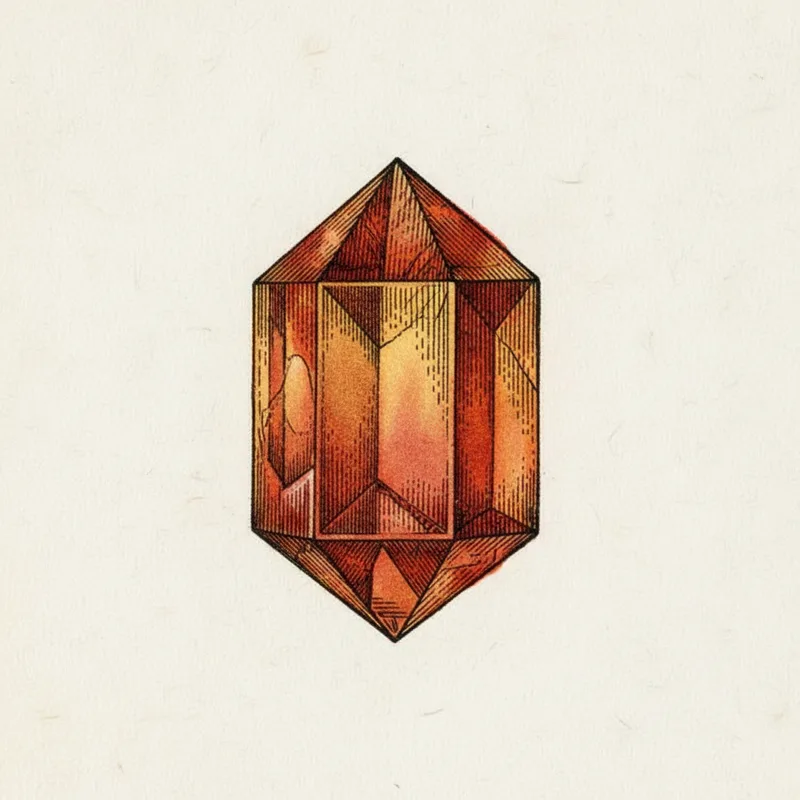
Zircon is identified by its high luster (adamantine - diamond-like), strong double refraction (visible doubling of back facet edges when viewed through the stone), and high specific gravity (4.70 - it feels noticeably heavy). The tetragonal crystal habit produces square prism shapes.
Distinguish from cubic zirconia (synthetic, singly refractive, different density), diamond (singly refractive, harder), and aquamarine (lower SG, lower luster). Zircon's doubled back facets visible through the crown are the quickest gemological test.
Spotting Fakes
Zircon's biggest problem is its name. Most consumers confuse 'zircon' with 'cubic zirconia' (CZ) - these are completely different materials. Zircon is a natural mineral; CZ is a synthetic lab product. This confusion has unfairly damaged zircon's market reputation. Beyond naming: synthetic zircon doesn't exist commercially, so any genuine zircon is natural. Heat treatment of zircon to produce blue color is universal and accepted.
Cultural & Metaphysical Traditions
Presented as cultural traditions, not scientific evidence
In Hindu tradition, zircon (called 'hyacinth' historically) is associated with the celestial serpent Rahu. Medieval travelers believed it protected against disease and injury. Victorian-era jewelry featured brown and red zircon extensively. Its status as Earth's oldest mineral has given it modern associations with wisdom, memory, and deep time. Blue zircon is a December birthstone.
Where It's Found
Major source of blue-treated material
Full color range, historic source
Fine natural colors
Contains Earth's oldest minerals (4.4 billion years)
Price Guide
Good to Know
Scratch test: At hardness 7.5, Zircon can scratch glass and steel. It's durable enough for any type of jewelry.
Sources: Found in 4 notable locations worldwide, from Cambodia to Australia.
Heft test: Zircon has a specific gravity of 4.70 - noticeably heavier than quartz. You'll feel the density when you pick it up.
Related Minerals
NOT related - synthetic, different chemistry entirely
Hafnium analogue of zircon, extremely rare
Similar blue when treated, different properties
Similar blue, different mineral and luster
Explore More
Stay in the loop
From the Almanac
Updates from Crystal Almanac, when there’s something worth sharing.