Phantom Quartz: The Complete Guide to Ghost Crystals
Key Takeaway: Phantom quartz forms when a quartz crystal stops growing, mineral dust settles on its surface, and then growth resumes, trapping a ghostly outline of the earlier crystal inside. These "phantoms" are geological time capsules. The color of the phantom tells you what mineral interrupted growth: green from chlorite, red from hematite, gray from carbon or volcanic ash, purple from iron-irradiated quartz. Phantoms are always inside the crystal, never on the surface, and real ones show distinct geometric outlines that follow the hexagonal habit of quartz.
Pick up a piece of phantom quartz and hold it to the light. Inside the crystal, floating like a ghost, you'll see the outline of a smaller crystal. It looks like someone painted a translucent pyramid inside solid quartz. That's not a painting, and it's not a trick of the light. It's a geological record of interrupted growth, sometimes spanning millions of years, frozen inside a single crystal.
Phantom quartz goes by several names. Ghost quartz, ghost crystal, shadow quartz, specter quartz. They all describe the same phenomenon: a visible record of a crystal's growth history preserved inside the stone itself. If you've ever wondered what makes these crystals so captivating to both geologists and collectors, the answer is the same. You're looking at time.
What Phantom Quartz Actually Is
A phantom is not a separate crystal trapped inside another crystal. It's the same crystal at two different stages of its life.
Here's what happens. A quartz crystal grows slowly in a hydrothermal vein or a cavity inside rock, molecule by molecule, layer by layer. Quartz is silicon dioxide (SiO₂), and each new layer of SiO₂ deposits on the existing crystal faces in perfect atomic alignment. The crystal gets bigger while maintaining its hexagonal shape.
Then something disrupts the growth. The mineral-rich fluids feeding the crystal slow down or stop entirely. Maybe the hydrothermal system cools. Maybe tectonic activity shifts the fluid pathways. Maybe volcanic activity dumps ash into the environment. Whatever the cause, the crystal sits dormant. During this pause, fine mineral dust, clay particles, or other dissolved minerals settle on the crystal's surface like dust on furniture.
Then conditions change again. Fresh silica-rich fluids return. The quartz crystal resumes growing, depositing new layers of SiO₂ right on top of that dusty surface. The mineral coating gets sealed inside. Growth continues outward, and the crystal gets bigger. But now, trapped within the crystal, there's a thin layer of foreign material that traces the exact shape the crystal had when growth stopped. That layer is the phantom.
The result is a crystal within a crystal. The phantom marks the boundary between old growth and new growth, like a tree ring marks the boundary between one year and the next. Some phantom quartz crystals contain multiple phantoms, meaning growth was interrupted and resumed several times over their history. A single crystal might record three, five, or even a dozen separate growth events spanning millions of years.
How Phantoms Form: Step by Step
The formation process deserves a closer look because it explains why phantoms look the way they do and why some are sharp while others are fuzzy.
Step 1: Initial Growth
Quartz nucleates on a surface inside a rock cavity or hydrothermal vein. Silica-saturated water, heated by deep geological processes, deposits SiO₂ molecules onto the growing crystal. At temperatures between 100°C and 450°C, quartz grows steadily. The crystal develops its classic hexagonal prism shape with a pointed termination on top. This initial crystal might grow for thousands or millions of years.
Step 2: Growth Interruption
Something disrupts the supply of silica-rich fluid. Common causes include:
- Tectonic shifts that redirect hydrothermal flow away from the cavity
- Volcanic eruptions that alter pressure and temperature conditions
- Cooling of the hydrothermal system as magmatic heat dissipates
- Chemical changes in the fluid that make it undersaturated in silica
The crystal stops growing. It just sits there in its cavity, geologically idle.
Step 3: Mineral Deposition
During the dormant period, other minerals settle on the crystal surface. This is the crucial step that creates the phantom. The type of mineral that settles determines the phantom's color:
- Chlorite (a sheet silicate mineral) produces green phantoms
- Hematite (Fe₂O₃) produces red, orange, or rusty brown phantoms
- Carbon, volcanic ash, or clay produces gray or black phantoms
- Iron-bearing compounds in trace amounts produce yellow phantoms
- The crystal's own surface weathering can produce white or milky phantoms
The coating doesn't need to be thick. Even a layer just a few micrometers deep is enough to create a visible phantom. In fact, the thinnest coatings often produce the sharpest, most dramatic phantoms because they create a crisp boundary between old and new growth.
Step 4: Resumed Growth
Conditions change again. Fresh silica-rich fluids return to the cavity. The quartz crystal resumes growth, depositing new SiO₂ layers over the mineral-coated surface. Because quartz grows in crystallographic continuity (new layers follow the same atomic arrangement as old layers), the new growth wraps perfectly around the old crystal, preserving the phantom's shape.
If conditions are stable, the crystal grows a thick outer layer of clear quartz around the phantom, making the ghostly shape visible from outside. If growth is interrupted again, another phantom forms. Repeat this cycle enough times and you get a crystal with nested phantoms like geological nesting dolls.
Types of Phantom Quartz
Not all phantoms look the same. The mineral that creates the phantom determines its color, and each type has its own character.
Green Phantoms (Chlorite Phantoms)
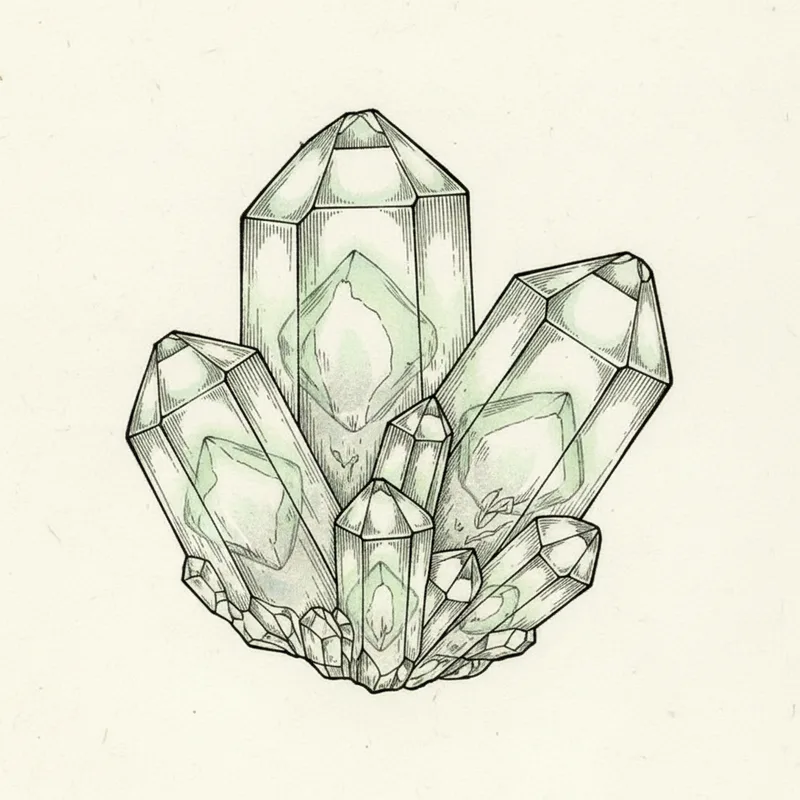
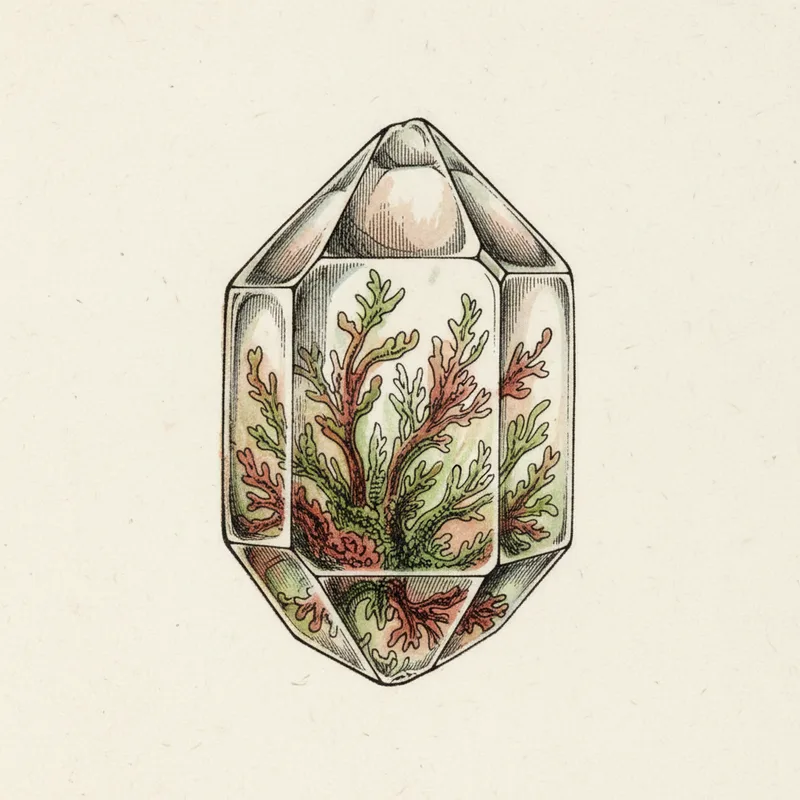
The most sought-after variety. Green phantoms form when chlorite, a common green sheet silicate mineral, coats the crystal during a growth pause. The chlorite creates a vivid green outline inside otherwise clear quartz. Some green phantom specimens also contain wispy chlorite inclusions throughout the crystal, earning them the additional name "garden quartz" or lodolite. The best green phantom specimens come from Minas Gerais, Brazil, where hydrothermal veins in pegmatites produce exceptional clarity with intense green phantoms.
Red and Orange Phantoms (Hematite Phantoms)
Hematite (Fe₂O₃) creates red, rusty orange, and brownish-red phantoms. These form in iron-rich environments where hematite dust or dissolved iron settles on the crystal surface during growth pauses. Some of the most striking red phantom specimens come from Orange River deposits in Namibia and South Africa, where the iron-rich geology produces deep, vivid red outlines. Red phantoms can also form when iron-bearing fluids interact with the crystal surface, leaving a thin oxide layer.
Smoky and Gray Phantoms
Gray and smoky phantoms form when volcanic ash, carbon particles, or fine clay minerals settle on the crystal. These are common in regions with volcanic activity. The gray phantom inside a clear crystal can look remarkably like a puff of smoke trapped in glass. These gray phantoms are distinct from smoky quartz, which gets its overall brownish color from aluminum impurities irradiated by natural gamma radiation. A smoky phantom is specifically a gray outline inside an otherwise different-colored crystal.
Amethyst Phantoms (Purple Phantoms)
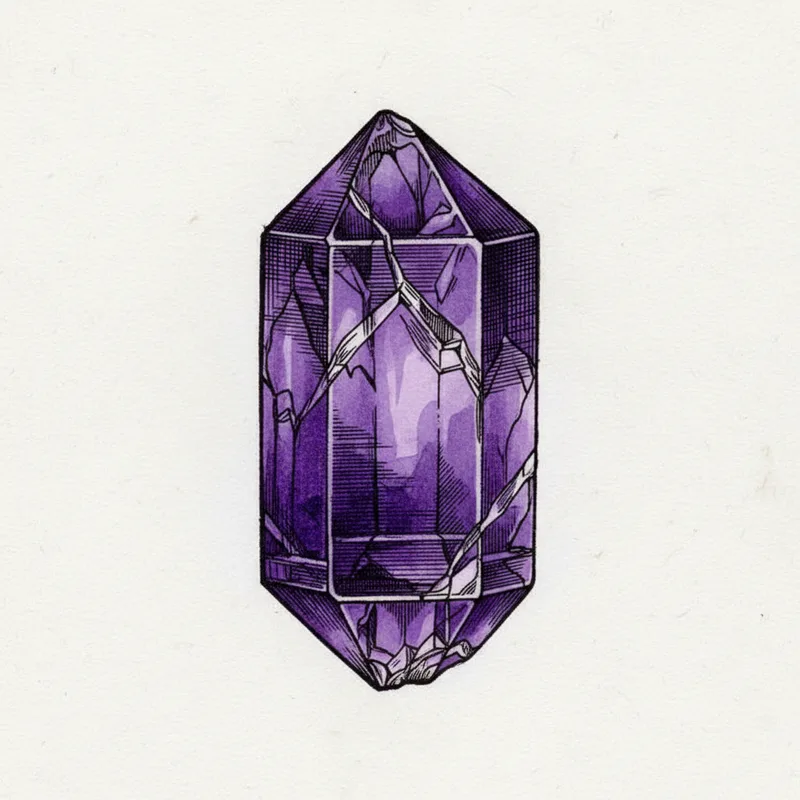
Purple phantoms occur when the crystal itself transitions between amethyst-forming conditions and non-amethyst conditions. During one growth phase, trace iron (Fe³⁺) and natural gamma radiation produce amethyst-colored quartz. Then conditions change. Growth resumes without the iron or radiation, producing clear quartz over the purple core. The result is a purple phantom inside a clear crystal, or sometimes a clear phantom inside an amethyst crystal. These form primarily in volcanic geodes in southern Brazil and Uruguay.
White and Milky Phantoms
The subtlest variety. White phantoms form when the crystal surface develops a thin layer of microcrystalline quartz or when tiny fluid inclusions are trapped at the growth boundary. These can be hard to see without good lighting but are common in clear quartz from Arkansas and the Alps. Milky phantoms are created by microscopic fluid-filled cavities along the growth boundary that scatter light, producing a cloudy outline.
Where Phantom Quartz Is Found
Phantoms form wherever quartz crystals experience interrupted growth, which is actually quite common. But certain localities are famous for producing exceptional specimens.
Brazil
Minas Gerais is the world capital of phantom quartz. The state's complex geological history, with multiple episodes of hydrothermal activity, pegmatite formation, and tectonic movement, created ideal conditions for repeated growth interruptions. Brazilian phantoms tend to be large, clear, and well-defined. Green chlorite phantoms from the Diamantina and Corinto regions are particularly prized. The area also produces spectacular multi-phantom specimens showing five or more growth layers in a single crystal.
Madagascar
Madagascar produces some of the finest phantom quartz on the market today. The island's unique geology, shaped by its separation from the African continent around 160 million years ago, created hydrothermal systems that produced exceptional quartz with sharp, well-defined phantoms. Malagasy phantoms tend to have excellent clarity and often feature multiple phantom layers. Green and smoky phantoms are the most common varieties from this locality.
Arkansas, USA
The Ouachita Mountains of Arkansas have been producing quartz crystals for over a century, and phantoms are a regular feature of the deposits. Arkansas phantoms are typically white or smoky, formed during the region's complex Paleozoic hydrothermal history. Mount Ida and Jessieville are the most productive localities. While Arkansas phantoms are generally less colorful than Brazilian or Malagasy specimens, they can be extremely sharp and well-defined, with excellent transparency.
Other Notable Localities
The Swiss and Austrian Alps produce classic phantom quartz from alpine-type fissures, where repeated glacial and tectonic activity created multiple growth interruptions. Namibia and South Africa are known for red hematite phantoms. Pakistan and Afghanistan produce phantoms in association with tourmaline-bearing pegmatites. China, particularly the Sichuan and Yunnan provinces, has become an increasingly important source for green phantom quartz in recent years.
How to Identify Real Phantom Quartz
Genuine phantoms have distinctive characteristics that separate them from imitations. Here's what to look for.
Geometric Outline
A real phantom follows the crystal geometry of quartz. That means the phantom outline should show the hexagonal prism shape and pointed termination of a quartz crystal. The phantom won't be a random blob or an irregular shape. It will look like a smaller version of the crystal it's inside, because that's exactly what it is. The angles of the phantom's termination should match the angles of the outer crystal's termination (roughly 38.2° for the dominant rhombohedral faces).
Position Within the Crystal
Phantoms are always inside the crystal, never on the surface. They sit somewhere between the center and the outer surface, with clear (or at least translucent) quartz visible between the phantom and the crystal's exterior. If the "phantom" extends to the crystal's surface, it's just a surface coating, not a phantom.
Concentric Alignment
The phantom should be roughly concentric with the outer crystal. Its center should approximately align with the outer crystal's center, and its faces should be roughly parallel to the outer crystal's faces. This happens naturally because the resumed growth follows the same crystallographic directions as the original growth. A phantom that's tilted at a random angle relative to the outer crystal is suspicious.
Thin, Consistent Layer
The mineral layer creating the phantom should be thin and fairly consistent in intensity. Real phantoms are surface coatings on an earlier crystal face. They don't fill the interior of the phantom shape. The space inside the phantom outline is quartz, the same quartz that grew before the interruption. Only the boundary itself shows color.
Spotting Fakes and Artificially Enhanced Phantoms
The popularity and price premium of phantom quartz has predictably attracted fakes. Here's how to protect yourself. For more general guidance, check our fake crystal identification guide.
Painted or Injected Phantoms
The most basic fakes involve painting a phantom-like shape on a quartz crystal, then coating it with epoxy or glass. These are usually easy to spot. The "phantom" will look like paint (because it is). It won't have the soft, mineral-dust texture of a real inclusion. Under magnification, you'll see brush strokes or pooling of pigment. Real phantom layers have an irregular, granular texture at high magnification because they're composed of tiny mineral particles, not liquid paint.
Dyed Quartz Sold as Phantom
Some sellers dye fractured quartz in colored solutions to create phantom-like effects. The dye seeps into fractures and creates colored zones that can vaguely resemble phantoms. The giveaway: the color follows fracture planes, not crystal faces. Real phantoms follow crystal geometry. Dye follows cracks. This distinction is usually obvious under a 10x loupe.
Synthetic Quartz with Inclusions
Lab-grown quartz can be produced with deliberate inclusions, but creating a convincing phantom would require growing a crystal, stopping, adding mineral dust, and resuming growth, a process that's actually harder and more expensive than just mining natural phantoms. This makes synthetic phantom quartz rare in the market. Most fakes are enhanced or misrepresented natural stones, not synthetics.
Misidentified Garden Quartz
Lodolite (garden quartz) contains scattered inclusions of chlorite, feldspar, and other minerals throughout the crystal. These inclusions create beautiful scenic effects but are not phantoms. A phantom is a discrete layer that traces the shape of an earlier crystal. Lodolite inclusions are randomly distributed and don't follow crystal geometry. Some sellers label any quartz with green inclusions as "phantom quartz," which is inaccurate. True phantom quartz has a visible geometric outline.
Price Red Flags
Small, clear phantom quartz points with well-defined single phantoms run $10 to $40. Medium specimens (3 to 5 inches) with sharp green or red phantoms fetch $50 to $200. Museum-quality pieces with multiple distinct phantoms, exceptional clarity, and vivid color can reach $500 to $2,000 or more. If someone offers you a large, perfect, vividly colored phantom for $15, be skeptical.
Why "Ghost Quartz" and "Ghost Crystal" Are the Same Thing
If you're searching online and seeing different terms, here's the simple answer: ghost quartz, ghost crystal, phantom quartz, and specter quartz all refer to the same phenomenon. The term "phantom" literally means ghost, and the different names arose because collectors and dealers in different regions adopted different labels. German-speaking collectors sometimes call them Phantomquarz. French speakers use quartz fantome. The English-speaking market settled on "phantom quartz" as the standard trade name, but "ghost quartz" and "ghost crystal" remain common, especially in casual online discussions and social media.
There's no mineralogical distinction between them. A "ghost crystal" listed on Etsy and a "phantom quartz" in a museum case are the same type of specimen.
Caring for Phantom Quartz
Phantom quartz is regular quartz with inclusions, so it follows the same care guidelines as any other quartz variety. Quartz sits at 7 on the Mohs hardness scale, making it durable enough for everyday handling. It's safe in water, safe in sunlight (assuming the phantom isn't amethyst-colored, in which case the purple may fade over time), and resistant to most household chemicals.
Clean phantom quartz with warm water and mild soap. A soft brush can remove dust from surface crevices. Avoid ultrasonic cleaners if the crystal has any visible fractures, as the vibrations can widen existing cracks.
The main care concern specific to phantoms is display lighting. Backlit display is ideal for viewing phantoms because it makes the internal structure visible. But if your phantom contains an amethyst layer, avoid prolonged direct sunlight to prevent the purple from fading. LED backlighting is a safe alternative.
Why Collectors Love Phantom Quartz
Phantom quartz occupies an unusual position in the mineral world. It's not the rarest crystal. It's not the most expensive. But it might be the most conceptually fascinating.
Every phantom is a geological autobiography. A single crystal with three green phantoms tells you that this crystal grew in silica-rich hydrothermal fluid, stopped three separate times while chlorite dust accumulated on its surface, and resumed growth three times as fresh fluids returned. Each phantom is a chapter. The whole crystal is the book.
For geologists, phantoms are data. The mineral coating tells you what was in the environment during each growth pause. The spacing between phantoms tells you about the duration and frequency of growth interruptions. The clarity of each growth zone reveals how conditions changed over time. A single phantom quartz crystal can encode more geological history than pages of field notes.
For collectors, phantoms are simply beautiful. There's something genuinely mesmerizing about holding a clear crystal up to light and seeing a ghostly green pyramid floating inside it, perfectly geometric, perfectly preserved, a crystal fossil of itself from an earlier age.
Whether you're drawn to phantom quartz for the science or the aesthetics, you're looking at the same thing: millions of years of Earth's history, compressed into something you can hold in your hand.