Turquoise vs Chrysocolla: The Copper Mineral Mix-Up
Key Takeaway: These beautiful blue-green copper minerals are easy to confuse, but their hardness, chemical structures, and durability tell a different story. Turquoise is harder and more suitable for jewelry.
Both turquoise and chrysocolla get their stunning blue-green colors from copper, and both are found in arid regions. However, turquoise contains phosphorus and forms a harder, more stable material suitable for jewelry. Chrysocolla is a copper silicate that is naturally very soft and crumbly, requiring a coating or natural blending with quartz to be worn safely.
At a Glance
| Feature | Turquoise | Chrysocolla |
|---|---|---|
| Hardness | 5 to 6 | 2 to 4 |
| Chemical Formula | CuAl₆(PO₄)₄(OH)₈·4H₂O | (Cu,Al)₂H₂Si₂O₅(OH)₄·nH₂O |
| Crystal System | Triclinic (massive) | Orthorhombic (often amorphous) |
| Color Range | Sky blue, teal, apple green | Cyan, vivid blue, deep green |
| Price Range | $2 to $200+ per carat | $1 to $200+ per carat (Gem Silica) |
| Best For | Southwestern jewelry, cabochons, inlay work | Collector specimens, stabilized cabochons |
How They Form
Both of these minerals are secondary copper minerals. They form in the oxidation zones of copper ore deposits, usually in dry, desert climates like the American Southwest, Chile, and Iran.
Turquoise forms when water percolates through host rocks containing copper, aluminum, and phosphorus. This acidic, mineral-rich water seeps into cracks and voids in the rock. Over time, as the water evaporates and the climate changes, the minerals precipitate out and slowly build up veins or nodules of solid turquoise. The host rock often remains embedded in the turquoise, creating the characteristic dark, web-like patterns known as "matrix."
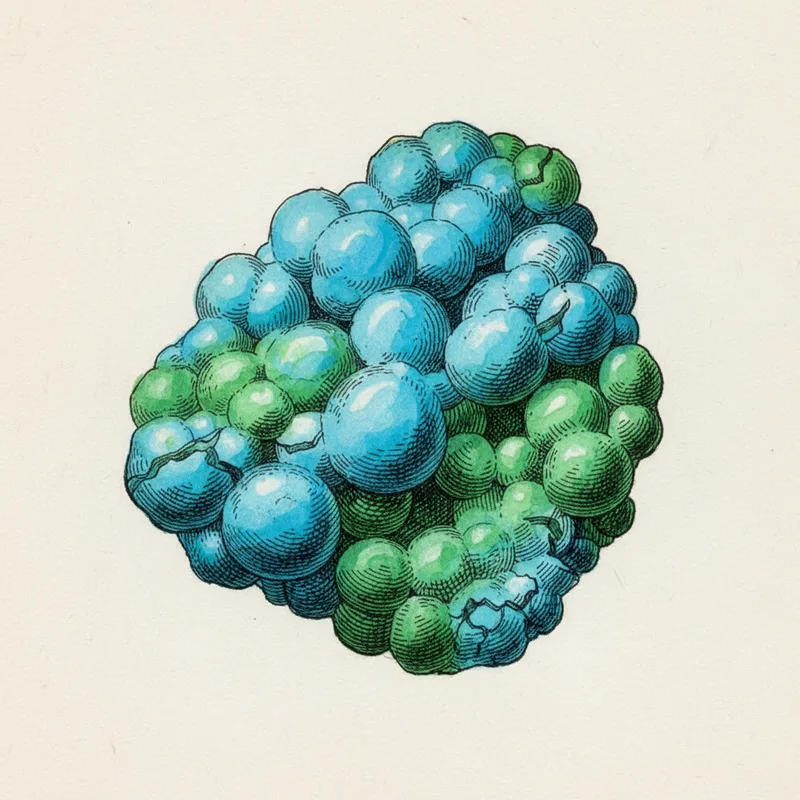
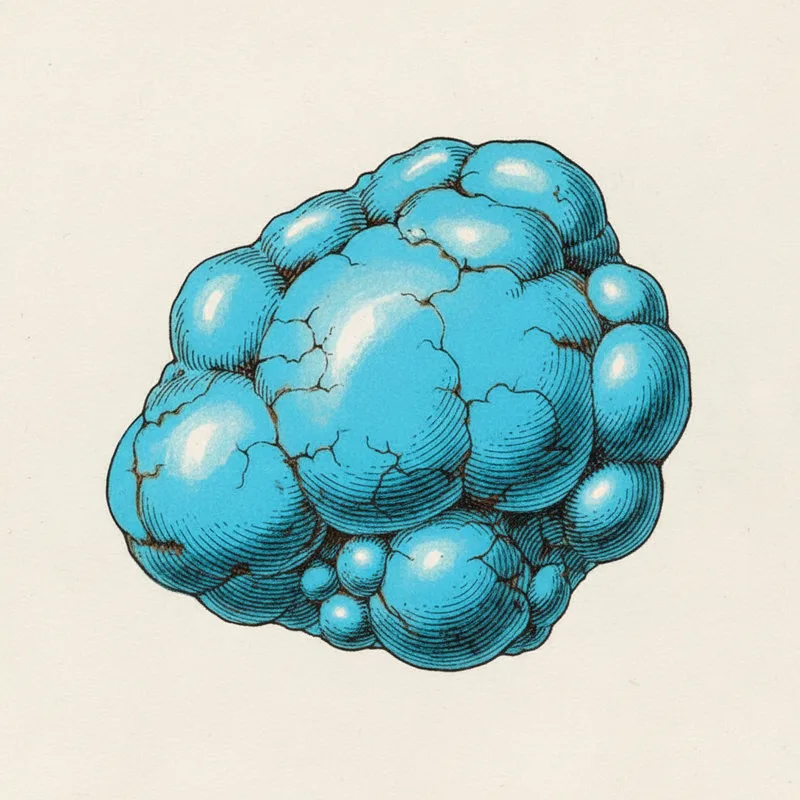
Chrysocolla forms in a similar environment but involves a reaction between copper and silica-rich waters. It usually forms as a crust, botryoidal (grape-like) masses, or vein fillings. Pure chrysocolla is mostly water and silica gel combined with copper. Because it lacks a tight crystal structure, it is highly unstable and soft in its pure form. It often forms alongside other secondary copper minerals like malachite and azurite.
How to Tell Them Apart
Pure chrysocolla has a very bright, almost electric cyan or turquoise-blue color that is often more vivid than actual turquoise. However, pure chrysocolla will stick to your tongue if you lick it because it is highly porous. It is also soft enough to be easily scratched by a steel nail.
Turquoise is generally harder and takes a better polish. It often has a waxy or sub-vitreous luster, whereas raw chrysocolla looks earthy or dull. Be aware that the jewelry market is flooded with fakes. A lot of cheap "turquoise" is actually dyed howlite or magnesite. You can spot these fakes by looking into the cracks of the matrix. If the blue color is darker in the cracks, it is dye pooling.
Price & Value
Turquoise has a massive collector base. Natural, untreated turquoise from famous closed mines, like the Sleeping Beauty mine or the Lander Blue mine, commands very high prices. Most commercial turquoise is "stabilized," meaning it has been infused with clear epoxy resin to improve its hardness and color. Stabilized turquoise is affordable and durable.
Chrysocolla is generally inexpensive. Its value increases significantly when it naturally occurs mixed with clear quartz or chalcedony, a material often called "Gem Silica." Gem silica is incredibly rare, very hard, takes a brilliant polish, and can be exceedingly expensive, but standard opaque chrysocolla remains a budget-friendly collector's stone.
Which Should You Choose?
Turquoise is the clear choice for rings, bracelets, and belts. Even stabilized turquoise is tough enough to withstand reasonable daily wear. Chrysocolla should be reserved for earrings or pendants where it will not be bumped or scratched. If you buy chrysocolla jewelry, ensure it has been stabilized with resin or is naturally agatized, otherwise it will degrade over time.
Crystals in This Article
Keep Reading
Stay in the loop
From the Almanac
Updates from Crystal Almanac, when there’s something worth sharing.