Quick Facts
Formation & Origin
Howlite forms in evaporite deposits - environments where mineral-rich water evaporates, concentrating dissolved minerals until they crystallize. It specifically occurs in borate-rich evaporite sequences, where boron from volcanic activity accumulates in enclosed basins.
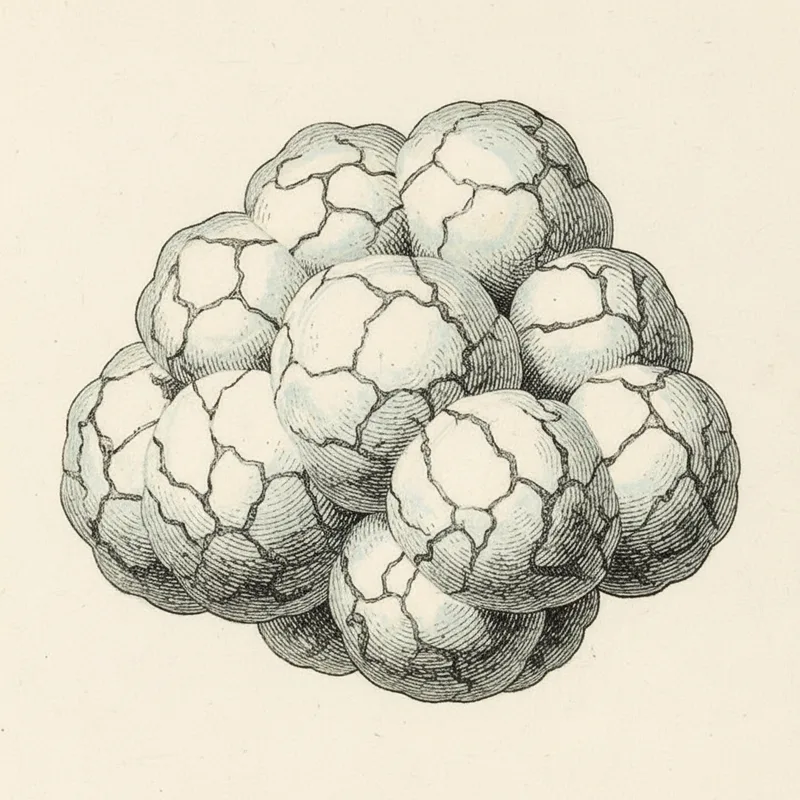
The mineral typically forms as irregular nodules or masses with a distinctive white color and gray to black veining pattern (which is actually the matrix material the howlite grew within). Individual crystals are extremely rare - howlite almost always occurs as massive, cauliflower-like nodules.
Howlite's fame in the crystal world is paradoxically tied to its role as an impostor. Because it's porous, soft, and white, it absorbs dye readily and can be colored to imitate turquoise, lapis lazuli, red coral, and other more expensive stones. More howlite is probably sold dyed than in its natural white form.
Identification Guide
Natural howlite is white with distinctive gray-black veining in an irregular web pattern. At hardness 3.5, it's soft enough to scratch with a copper coin. The porcelain-like luster and light weight help distinguish it from other white minerals.
The key identification scenario is recognizing DYED howlite masquerading as other stones. Blue-dyed howlite sold as 'turquoise' shows dye concentrated in the veining (the veins absorb more dye than the surrounding material) and the color rubs off on a wet cloth. Under the dye, scratching reveals white base material.
Spotting Fakes
Howlite is more commonly the fake than the faked. Natural white howlite is honest and legitimate. The problem is howlite dyed to imitate turquoise (blue), lapis lazuli (dark blue), red coral (red), or other stones. Detection: scratch an inconspicuous area - if white shows under color, it's dyed. Wipe with acetone (nail polish remover) - dye will transfer. Genuine turquoise, lapis, and coral don't lose color this way.
Cultural & Metaphysical Traditions
Presented as cultural traditions, not scientific evidence
Howlite is a relatively modern addition to crystal healing traditions, having been first described scientifically in 1868. It lacks the ancient history of stones like turquoise or jade. Modern practitioners associate it with calming anxiety, promoting sleep, and patience. Its white color connects it to purity and clarity in various traditions. Ironically, howlite's most important cultural role is as the stone most commonly used to deceive crystal buyers through dyeing.
Where It's Found
Original discovery location, commercial source
Classic locality, named after Canadian geologist Henry How
Commercial source for dyed material
Price Guide
Good to Know
Scratch test: At hardness 3.5, Howlite can be scratched with a copper coin. Handle gently and keep away from harder stones in your collection.
Sources: Found in 3 notable locations worldwide, from United States to Turkey.
Heft test: Howlite has average mineral density (2.53). It feels about as heavy as you'd expect from a stone its size.
Explore More
Borates, Tungstates & Rare Groups
The Calming Collection
Associated with slowing an overactive mind. Its white color with gray veining suggests marble calm.
The Sleep Collection
Specifically associated with sleep and overactive minds. Its white color with gray veining is visually quiet. Practitioners place it under pillows to calm the mental chatter that prevents sleep.
How to Tell Real Tourmaline from Glass and Plastic: 9 Tests
Lapis Lazuli vs Sodalite: The Blue Rock Conundrum
Turquoise vs Chrysocolla: The Copper Mineral Mix-Up
Mohs Hardness Scale
See where Howlite sits on the scale
Crystal Care Guide
Water safety, sunlight, and handling tips
Stay in the loop
From the Almanac
Updates from Crystal Almanac, when there’s something worth sharing.